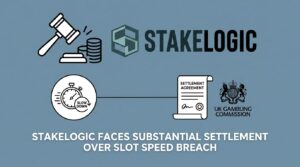
Stakelogic, the Netherlands-headquartered online slot developer, has reached a regulatory settlement with the UK Gambling Commission (GC) after its games were found to breach mandatory spin speed requirements. The enforcement action centres on slots operating below the minimum cycle time designed to protect players from rapid-loss gambling sessions. While the exact financial figure has not been publicly itemised in full, the settlement has been characterised as hefty, underscoring the Commission’s willingness to pursue technical compliance failures with the same vigour it applies to anti-money laundering and social responsibility breaches.
What the Spin Speed Breach Means for Operators and Suppliers
Before unpacking the broader implications, it helps to isolate the core takeaways from this enforcement action. The settlement is not merely a penalty against one supplier; it sends a calibrated signal across the B2B gaming supply chain about where regulatory tolerance ends.
- Technical compliance is now a front-line enforcement priority. The GC has historically focused on operator-side failures, but this case confirms that game suppliers face direct accountability for product-level breaches.
- Spin speed rules exist to limit stake velocity. The minimum 2.5-second cycle time per spin, introduced as part of the GC’s 2021 slot reforms, is a player protection measure. Breaching it is not a grey area.
- Suppliers distributing games across multiple licensed operators risk multiplying their regulatory exposure if a single game mechanic falls outside permitted parameters
- Settlement signals cooperation. Stakelogic’s willingness to settle suggests the company opted to resolve the matter without contesting the findings, a route that typically results in a reduced but still significant financial outcome.
How Spin Speed Rules Became a Regulatory Flashpoint
The 2.5-second minimum spin speed was introduced by the Gambling Commission in October 2021 as part of a package of online slot reforms. That package also banned features such as auto-play and sounds or imagery that gave the impression of a win when the return was equal to or below the stake (a distinction regulators have been slow to enforce uniformly across all licensees). The spin speed rule, though, was always the most technically measurable of the reforms.
And that measurability is precisely what makes it enforceable. Unlike subjective assessments of whether a game’s design is misleading, spin cycle timing can be tested mechanically. If a game completes a round in under 2.5 seconds, the breach is binary. There is no interpretive wiggle room.
Stakelogic, which supplies slots to a range of UK-licensed operators through its online casino game portfolio, would have been expected to ensure all titles distributed into the British market met this threshold. The fact that one or more games fell short raises a practical question that the settlement itself does not fully answer: how long were non-compliant games live before the issue was identified?
Regulatory Pressure on B2B Suppliers Is Accelerating
For years, the Gambling Commission’s enforcement actions targeted operators. Suppliers occupied a quieter corner of the regulatory landscape, largely shielded by the argument that operators bore ultimate responsibility for the games they offered. That argument has eroded steadily.
The GC’s current strategic direction treats the supply chain as a shared compliance ecosystem. Suppliers holding a licence are expected to build compliance into the product itself, not rely on downstream operators to catch defects. This case reinforces that expectation with financial consequences.
Still, the settlement raises a harder question: should operators who hosted the non-compliant games also face scrutiny? At least on paper, operators are required to verify that third-party content meets regulatory standards before going live. Whether any operator-side investigations follow remains to be seen.
Comparative Context: Recent GC Enforcement Actions
| Licensee | Year | Issue | Outcome |
|---|---|---|---|
| In Touch Games | 2022 | Social responsibility and AML failures | Licence revoked |
| Entain | 2023 | AML and safer gambling failures | £17 million settlement |
| Stakelogic | 2025 | Slot spin speed non-compliance | Regulatory settlement (amount characterised as hefty) |
| Sky Betting & Gaming | 2022 | Failure to prevent problem gambling | £1.17 million penalty |
What stands out in this table is the category of breach. Stakelogic’s case is arguably the most technically specific enforcement action the GC has publicised against a supplier in recent years.
Why Game Integrity Testing Needs a Harder Look
Every game entering the UK market passes through approved test houses. These labs verify RTP calculations, random number generation, and compliance with specific market rules, including spin speed. So how did a non-compliant game reach live environments?
One possibility: the breach emerged from a post-certification update or configuration change that altered cycle timing without triggering a re-test. Another: the testing regime itself may not catch every edge case in real-world deployment conditions. Neither explanation is comfortable for the industry.
Game suppliers typically push updates frequently. Each update represents a potential compliance risk if the change pipeline does not include automated checks against market-specific rules. For a supplier operating across multiple jurisdictions, each with its own technical standards, the complexity compounds fast. But complexity is not a defence the GC tends to accept.
Framing the Business Impact: What Suppliers Should Reassess
This settlement is not just a cost for Stakelogic. It functions as a recalibration point for every B2B supplier holding a GC licence. Several operational areas deserve immediate review:
- Automated compliance testing: Every game build deployed to the UK market should be validated against current technical standards before release, not just at initial certification.
- Post-deployment monitoring: Real-time telemetry on spin cycle times can flag deviations before regulators do.
- Contractual clarity with operators about who bears responsibility when a supplier-side defect triggers enforcement
- Jurisdiction-specific QA pipelines: A single global build cannot safely serve all markets. UK-specific rules demand UK-specific validation layers.
Frequently Asked Questions
What is the minimum spin speed for online slots in the UK?
The Gambling Commission mandates a minimum cycle time of 2.5 seconds per spin for online slots. This rule took effect in October 2021 as part of a broader package of slot design reforms aimed at reducing the intensity of play.
Can game suppliers be directly penalised by the Gambling Commission?
Yes. Any entity holding a GC licence, whether operator or supplier, is subject to enforcement action. The Stakelogic settlement confirms that suppliers face direct financial consequences for product-level compliance failures, not just operators who host the games.
Does this affect Stakelogic’s ability to operate in the UK?
The settlement does not appear to involve licence revocation. Stakelogic has resolved the matter through a financial agreement with the GC, which typically allows continued operation under enhanced compliance commitments. Whether additional conditions were attached has not been fully disclosed.



