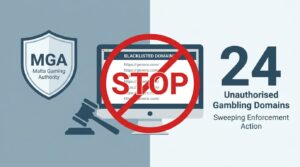
The Malta Gaming Authority (MGA) has moved decisively against a sprawling network of 24 unlicensed gambling websites, publishing a formal enforcement notice that strips any veneer of legitimacy from the flagged portals. None of the domains hold valid licensing credentials under the Maltese regulatory framework, and the MGA has directed consumers, payment processors, and digital marketing affiliates to sever all ties with these operators immediately. The action targets offshore sportsbooks, lottery platforms, and digital casino applications operating without statutory permits or consumer protections.
What the MGA’s Blacklist Signals for the Industry
This enforcement wave is broader than a routine compliance update. It reflects a sharpening posture from one of Europe’s most influential gambling regulators, and the implications ripple well beyond Malta’s borders.
- Scale of the crackdown: Twenty-four domains in a single enforcement notice is unusually large, suggesting coordinated intelligence gathering rather than ad hoc complaints.
- Payment intermediaries and banking partners now face direct regulatory pressure to block transactions tied to these entities, raising the compliance burden across the financial services chain.
- Affiliate networks are on notice: The MGA explicitly called out digital marketing affiliates, signalling that traffic referral to unlicensed operators could itself attract regulatory scrutiny.
- Consumer protection framing: The authority positioned the action as a safeguard for international consumers, reinforcing Malta’s claim to extraterritorial regulatory relevance in the online gambling space.
- Operators seeking MGA licensing will likely face heightened due diligence requirements in the wake of this enforcement cycle.
A Regulator Flexing Extraterritorial Muscle
Malta’s gambling regulator has long occupied a peculiar position in the global iGaming ecosystem. The island nation licenses a disproportionate share of the world’s online gambling operators (a distinction that has drawn both admiration and criticism from peer regulators). Yet the MGA’s authority, at least on paper, extends only to entities operating under its own framework. What makes this blacklist notable is the explicit targeting of offshore operators who never sought Maltese authorisation in the first place.
That shift matters because it repositions the MGA not merely as a licensor but as a consumer-facing watchdog with ambitions beyond its jurisdictional footprint. By naming 24 domains publicly, the regulator creates reputational consequences that transcend legal enforcement. Payment providers, app stores, and search engines now have a documented basis for restricting access to these platforms.
Still, whether downstream intermediaries actually act on these notices remains an open question. The MGA lacks direct enforcement power over payment processors headquartered outside the EU, and the effectiveness of blacklists depends heavily on voluntary compliance from third parties.
How Payment Processors and Affiliates Are Affected
The enforcement notice carries specific operational consequences for two groups that often operate in the background of the gambling value chain.
| Stakeholder | Immediate Impact | Longer-Term Risk |
|---|---|---|
| Payment processors | Must screen and block transactions linked to blacklisted domains | Potential liability exposure if continued processing is documented after the notice |
| Affiliate marketers | Required to cease traffic referral to all 24 domains | Risk of being flagged in future MGA enforcement actions, with possible impact on relationships with licensed operators |
| Consumers | No regulatory recourse for disputes with blacklisted operators | Funds deposited with unlicensed platforms carry no protection under Maltese law |
For affiliates in particular, this is not a theoretical risk. The Malta Gaming Authority’s official regulatory portal has increasingly emphasised that marketing partnerships with unlicensed operators can jeopardise an affiliate’s standing with legitimate licensees. And in a market where affiliate revenue depends on maintaining relationships with multiple licensed brands, even the perception of non-compliance can be commercially devastating.
Why Offshore Operators Keep Testing Boundaries
The persistence of unlicensed gambling operations, despite repeated enforcement actions by regulators worldwide, points to a structural incentive problem. Operating without a licence eliminates compliance costs that can run into six or seven figures annually for legitimate operators. No responsible gambling obligations. No anti-money-laundering audits. No consumer dispute mechanisms. The margins are, arguably, irresistible for operators willing to accept the legal exposure.
But the calculus is shifting. Coordinated blacklists, tighter payment processing controls, and growing cooperation between European regulators are gradually narrowing the operational space for unlicensed platforms. The MGA’s latest action fits within a broader pattern that includes similar enforcement campaigns by the UK Gambling Commission and the Netherlands’ Kansspelautoriteit over the past eighteen months.
Building Awareness: What Consumers Should Recognise
One dimension of this enforcement action that deserves closer attention is the cognitive framework consumers use when evaluating gambling platforms. Behavioural research consistently shows that players tend to anchor their trust on surface-level cues: professional website design, the presence of recognisable payment logos, and promotional offers that mimic those of licensed operators. These heuristics, while efficient, are precisely what unlicensed operators exploit.
Effective consumer protection requires more than regulatory blacklists. It demands a shift in how players process risk signals. Regulators like the MGA have begun investing in public awareness campaigns that encourage consumers to verify licensing status before depositing funds. The principle is straightforward: if a platform cannot produce a verifiable licence number linked to a recognised authority, the absence of that credential is itself the most important piece of information available. Reframing the decision from “does this site look trustworthy?” to “can I independently verify this site’s legal status?” changes the evaluation entirely.
This kind of reframing draws on well-established principles of cognitive restructuring. When consumers learn to question their automatic assumptions about legitimacy, they become significantly harder targets for unlicensed operators. The MGA’s public enforcement notices serve a dual function here: they provide concrete data points for verification, and they disrupt the default trust heuristic by making the existence of unlicensed operators more salient in consumer awareness.
Frequently Asked Questions
What does it mean when the MGA blacklists a gambling domain?
It means the domain has been formally identified as operating without valid authorisation under Maltese law. Consumers using these platforms have no regulatory protections, and payment processors are expected to block associated transactions.
Can the MGA shut down these websites directly?
Not necessarily. The MGA’s enforcement power is strongest within its own jurisdiction. For offshore operators, the blacklist functions primarily as a reputational and financial deterrent, pressuring intermediaries to cut ties rather than compelling the operator directly.
How can players verify whether a gambling site is licensed?
Players should check the operator’s website for a licence number and cross-reference it against the MGA’s public registry. If no verifiable licence exists, the platform should be treated as unauthorised regardless of how professional it appears.
Are affiliate marketers legally liable for promoting blacklisted sites?
The legal exposure varies by jurisdiction, but the MGA has made clear that affiliates directing traffic to unlicensed operators risk regulatory consequences. In practice, this often manifests as loss of partnerships with licensed brands rather than direct legal action.