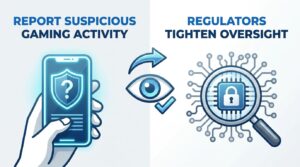
Regulators have issued a fresh call for members of the public to actively report suspicious gaming-related activity, signalling a broader push to tighten oversight across the sector. The appeal reflects growing concern that unlicensed operations and irregular betting patterns continue to slip through existing enforcement frameworks. While the specific jurisdiction behind the latest campaign has not been named in full detail, the directive aligns with a global trend of gambling authorities leaning harder on community vigilance as a frontline compliance tool.
Why Regulators Are Turning to the Public for Help
For years, the burden of identifying suspicious gaming activity sat almost entirely with operators and their compliance teams. That model, at least on paper, made sense: licensed operators hold the data, run the platforms, and employ the analysts. But enforcement bodies have increasingly acknowledged a gap between what operators flag and what actually occurs on the ground. Unlicensed gambling operations, informal betting rings, and match-fixing schemes often thrive in spaces where regulated operators have no visibility at all.
This latest public appeal represents a shift in strategy.
Rather than relying solely on industry self-reporting, regulators are now positioning everyday citizens as an additional layer of detection. The logic is straightforward: people embedded in local communities can spot irregularities that remote monitoring systems cannot. A neighbourhood gambling den operating without a licence, unusual cash movements tied to sports events, or aggressive marketing by unregistered platforms are all patterns that neighbours, local business owners, and sports club members might notice before any algorithm does. Whether this approach yields measurable results remains an open question (and one that regulators have been notably quiet about answering with hard data).
Strategic Implications for the Gaming Industry
The call for public reporting carries consequences that extend well beyond enforcement optics. Here’s what industry stakeholders should be watching:
- Licensed operators face reputational spillover. Even legitimate businesses could find themselves subject to public scrutiny or false reports, creating compliance and PR headaches that demand proactive community engagement strategies.
- Unlicensed operators, particularly those running informal or online-only platforms, now face a wider net of potential exposure from sources they cannot predict or control.
- Regulatory budgets are strained. Crowdsourcing intelligence from the public is arguably an admission that enforcement agencies lack the resources to monitor the market comprehensively on their own.
- The move could accelerate legislative proposals requiring operators to fund public awareness campaigns about responsible gambling and reporting mechanisms.
- Data quality risks. A surge in public reports, many of which may be inaccurate or motivated by personal disputes, could overwhelm already stretched regulatory teams.
How Public Reporting Mechanisms Typically Work
Most gambling regulators that accept public reports operate through dedicated hotlines, online portals, or email channels. The UK Gambling Commission’s reporting framework is one of the more established models, allowing individuals to submit concerns about unlicensed gambling, underage access, or operator misconduct. Reports are typically triaged by severity, with the most credible allegations escalated to investigation teams.
Still, the effectiveness of these systems varies enormously by jurisdiction. Some regulators publish annual statistics on reports received and actions taken. Others offer little transparency about outcomes, which can erode public trust in the process itself. And without feedback loops that inform reporters about what happened with their submission, participation tends to decline over time.
| Reporting Channel | Typical Use Case | Strengths | Limitations |
|---|---|---|---|
| Online portal | Unlicensed operator complaints | Accessible 24/7, documented trail | May lack urgency in processing |
| Telephone hotline | Immediate suspicious activity | Real-time human interaction | Limited operating hours in some jurisdictions; staffing constraints |
| Email submission | Detailed evidence sharing | Allows attachments, screenshots | Slower response times, risk of being deprioritised |
| In-person reporting | Local enforcement coordination | Direct engagement with investigators | Geographically limited, not scalable |
The Psychology Behind Public Participation in Enforcement
Understanding why people do or don’t report suspicious activity draws on principles well studied in behavioural science and neuro-linguistic programming. At its core, the decision to report hinges on three psychological factors: perceived risk, perceived reward, and identity alignment.
Perceived risk is the most immediate barrier. Individuals weigh whether reporting could expose them to retaliation, social stigma, or bureaucratic hassle. Regulators who want higher participation rates need to actively reduce these friction points through anonymity guarantees and simplified submission processes. The framing matters enormously. Campaigns that position reporting as “protecting your community” rather than “informing on your neighbours” tap into fundamentally different identity structures.
Perceived reward doesn’t necessarily mean financial incentives, though some jurisdictions have experimented with those. More often, it’s about psychological closure: the sense that one’s action led to a tangible outcome. This is where feedback loops become critical. When regulators acknowledge reports and, where possible, share outcomes, they reinforce the neural association between action and impact. Without that reinforcement, motivation erodes quickly.
Identity alignment is perhaps the subtlest lever. People are far more likely to act when they see reporting as consistent with their self-image. A sports fan who views match-fixing as a personal affront to the integrity of their game is a natural ally for regulators. A casual observer with no emotional stake in gambling outcomes is not. Effective campaigns segment their audiences and craft messaging that resonates with specific identity anchors rather than broadcasting generic appeals.
Even the language used in regulatory communications shapes behaviour. Phrases like “help us protect fair play” activate different cognitive frames than “report illegal gambling.” The former invites collaboration; the latter implies obligation. Regulators who grasp this distinction tend to generate higher-quality, more actionable intelligence from the public.
Frequently Asked Questions
What counts as suspicious gaming activity?
This can range from unlicensed gambling operations and underage participation to unusual betting patterns that suggest match-fixing or money laundering. If something looks irregular in a gaming context, regulators generally prefer to receive the report and assess it themselves rather than have the public self-filter.
Can reports be made anonymously?
In most jurisdictions with established reporting frameworks, yes. Anonymity protections vary, so checking with your local regulator is advisable before submitting.
Do public reports actually lead to enforcement action?
They can, and in several documented cases they have. But the path from report to action is rarely quick. Investigations require corroboration, and not every report meets the evidentiary threshold for formal proceedings. The honest answer is that most individual reports contribute to a broader intelligence picture rather than triggering standalone enforcement.
What should I include in a report?
As much specific detail as possible: dates, locations, names of platforms or individuals, screenshots, and any financial details you’ve observed. Vague reports are harder to act on.