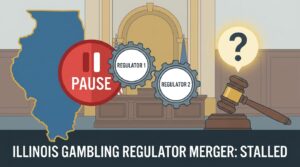
Illinois legislators recently declined to advance a proposal that would have consolidated the state’s gambling regulatory bodies into a single oversight authority. The move, which had gained traction among efficiency advocates in Springfield, was shelved not because consolidation lacked a logical foundation, but because the political and operational complexities proved too tangled to resolve within the current legislative session. The decision leaves Illinois with its existing fragmented regulatory structure, at least for now, and raises pointed questions about how the state intends to manage one of the fastest-growing gambling markets in the United States.
What the Regulatory Merger Would Have Changed
Before dissecting why the proposal stalled, it helps to understand what was actually on the table. Illinois currently splits gambling oversight across multiple bodies, including the Illinois Gaming Board, which handles casino and video gaming terminal regulation, and a separate framework governing the state lottery and sports wagering compliance. The merger proposal aimed to fold these functions into a unified agency, reducing administrative redundancy and creating a single point of regulatory contact for operators.
Proponents argued the consolidation would cut costs, streamline licensing, and eliminate jurisdictional grey areas that have occasionally slowed enforcement actions. On paper, the logic was sound. In practice, the proposal ran headlong into institutional resistance and competing legislative priorities.
Strategic Implications of the Stalled Consolidation
The failure to move forward carries consequences that extend well beyond Springfield’s statehouse corridors. Here’s what industry stakeholders should be watching:
- Regulatory fragmentation persists: Operators in Illinois will continue navigating multiple oversight bodies, each with distinct compliance expectations and reporting timelines — a burden that disproportionately affects smaller licensees.
- Enforcement gaps remain unaddressed: Without a unified authority, coordination on cross-platform issues (a sports bettor also playing VGTs, for instance) stays cumbersome.
- The political appetite for structural reform in gambling governance appears weaker than public statements suggest.
- Neighbouring states gain a comparative edge: States that have already consolidated their gaming oversight, or never fragmented it in the first place, offer operators a simpler compliance environment.
- Future merger attempts will carry this precedent: Lawmakers who blocked the proposal have now established a political template that opponents of consolidation can reference in subsequent sessions.
The Politics Behind the Block
It would be easy to frame this as a straightforward policy disagreement. It wasn’t.
Several factors converged to sink the proposal. Key legislators expressed concern that a merged regulator could concentrate too much authority in a single appointed body, reducing legislative leverage over gambling policy. Others worried about job losses within existing agencies — a concern that, while rarely stated publicly, carries real weight in a state capital where government employment anchors the local economy. And some lawmakers simply didn’t want to spend political capital on regulatory restructuring when higher-profile issues like the state budget and pension reform dominated the session calendar.
What remains less clear is whether the governor’s office genuinely backed the merger or merely allowed it to float as a trial balloon. No strong executive push materialized, and without that, legislative champions found themselves without air cover.
How Fragmented Oversight Shapes Operator Behaviour
For gambling companies operating in Illinois, the status quo isn’t neutral. It actively shapes strategy. Multi-jurisdictional compliance within a single state forces operators to maintain separate reporting pipelines, dedicate legal teams to tracking divergent rule changes, and occasionally delay product launches while awaiting clearance from more than one body.
Consider the practical friction: a casino operator expanding into sports wagering must satisfy one set of regulators for its floor operations and another for its digital sportsbook. The licensing timelines don’t always align. Neither do the audit cycles. That kind of structural drag doesn’t show up in headline tax rates, but it absolutely affects speed to market (a distinction regulators have been slow to acknowledge).
What Other States Have Done Differently
| State | Regulatory Structure | Scope |
|---|---|---|
| New Jersey | Division of Gaming Enforcement (unified) | Casinos, online gaming, sports betting |
| Pennsylvania | PA Gaming Control Board (unified) | Casinos, VGTs, sports wagering, iGaming |
| Illinois | Multiple bodies | Split across casino, VGT, lottery, and sports betting oversight |
| Michigan | Michigan Gaming Control Board | Commercial casinos, online gaming, sports betting under one roof |
The contrast is stark. States with consolidated regulators have generally moved faster on licensing, launched new verticals more efficiently, and attracted operator investment with fewer compliance hurdles.
Reframing the Debate: Efficiency Versus Accountability
Advocates for consolidation tend to anchor their arguments in efficiency metrics — fewer agencies, lower overhead, faster decisions. But opponents raise a point worth sitting with: distributed oversight can function as a check against regulatory capture. When a single body controls all licensing, enforcement, and policy interpretation, the risk of undue industry influence arguably rises. Illinois lawmakers who blocked the merger may not have articulated this concern elegantly, but the underlying logic isn’t baseless.
Still, there’s a difference between principled caution and institutional inertia. Whether Illinois’s decision reflects the former or the latter will only become apparent if legislators propose alternative reforms to address the coordination problems everyone acknowledges exist.
Frequently Asked Questions
Why was the Illinois gambling regulator merger proposed?
The proposal aimed to unify the state’s fragmented gambling oversight into a single regulatory body, reducing duplication and improving enforcement coordination across casinos, video gaming terminals, and sports wagering.
Did lawmakers reject the merger because consolidation was a bad idea?
Not exactly. The proposal stalled due to political dynamics, concerns about concentrated authority, and competing legislative priorities rather than a fundamental rejection of the consolidation concept itself.
How does this affect gambling operators in Illinois?
Operators will continue managing compliance across multiple regulatory bodies, which increases administrative costs and can slow licensing and product launches. Smaller operators feel this burden most acutely, though larger companies aren’t immune to the friction.
Could the merger proposal return in a future legislative session?
It could, though the precedent set by this session’s failure gives opponents a playbook. Any future attempt would likely require stronger executive backing and a clearer political coalition than the current effort managed to assemble.



