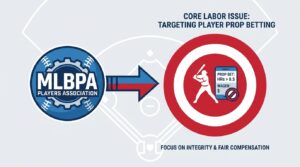
The Major League Baseball Players Association has formally elevated player prop betting into a collective bargaining matter, framing it not as a gambling policy question but as a workplace rights issue. The union’s push comes amid growing tension between professional athletes and the sportsbook industry over how individual performance data gets monetized. By folding prop betting into labor negotiations, the MLBPA is staking out territory that could reshape how leagues, operators, and players interact for years to come.
Why the Union’s Framing Shifts the Entire Debate
Before unpacking the details, it helps to understand what this move actually changes. The MLBPA isn’t asking for a ban on prop bets. It’s asserting that players have a material stake in how their names, likenesses, and statistical outputs get used by sportsbooks. That distinction matters enormously. Here are the strategic takeaways:
- Labor leverage over gambling policy: By classifying prop betting as a labor issue, the union gains negotiating power that a simple regulatory complaint would never provide.
- Revenue-sharing implications: If player performance data drives sportsbook revenue, the MLBPA’s position implies players deserve compensation, not just protection.
- The move pressures MLB’s league office to take a clearer stance on integrity fees and data licensing agreements with betting operators.
- Cross-league precedent: Other unions in the NFL, NBA, and NHL are watching closely. A successful framework here could cascade across professional sports.
- Sportsbooks that rely heavily on player-level markets may face new licensing costs or restrictions tied to collective bargaining outcomes.
What Player Prop Betting Actually Looks Like in 2025
Player prop bets allow gamblers to wager on individual statistical outcomes: whether a pitcher will record more than six strikeouts, or whether a batter will hit a home run in a given game. These markets have exploded in popularity since the U.S. Supreme Court struck down the Professional and Amateur Sports Protection Act in 2018. According to the American Gaming Association, legal sports betting handle in the United States exceeded $119 billion in 2023, with prop bets representing a rapidly growing share of that volume.
The growth hasn’t been painless. Players across multiple sports have reported increased harassment from bettors, particularly on social media, when individual performances don’t align with betting lines. And the integrity risks cut both ways. A pitcher who underperforms relative to his prop line might face unfounded suspicion, while a batter on a hot streak could attract unwanted scrutiny from league compliance officers.
Still, the financial engine is hard to ignore. Sportsbooks market player props aggressively because they generate higher margins than traditional moneyline or spread bets (a distinction regulators have been slow to enforce). That margin differential is precisely what makes the MLBPA’s intervention so pointed.
The Labor Mechanics Behind the Move
Collective bargaining in professional sports typically covers compensation, working conditions, health benefits, and revenue sharing. Adding gambling-related provisions isn’t entirely new. The current MLB CBA already includes language around integrity protocols and cooperation with league investigations. But treating prop betting as a condition of employment rather than a compliance matter represents a qualitative shift.
The MLBPA’s collective bargaining framework has historically evolved to absorb new commercial realities. When broadcast revenue surged in the 1990s, the union negotiated for a larger share. When digital media rights became valuable, those too entered the bargaining conversation. Prop betting follows the same logic: if someone profits from a player’s individual output, the player’s union wants a seat at the table.
What remains less clear is whether MLB’s league office views this as a legitimate bargaining subject or an overreach. Management could argue that gambling regulation falls under league governance, not employment terms. That tension will likely define the next round of negotiations.
How This Reshapes the Relationship Between Leagues and Sportsbooks
Major sportsbook operators including DraftKings, FanDuel, and BetMGM hold official partnership agreements with MLB. These deals typically include data licensing, branding rights, and co-marketing arrangements. If the MLBPA successfully negotiates restrictions or revenue-sharing provisions around player props, those partnership structures could require renegotiation.
| Stakeholder | Current Position | Potential Impact |
|---|---|---|
| MLB League Office | Supports regulated betting partnerships | May face pressure to renegotiate data licensing terms with operators |
| MLBPA | Classifies prop betting as a labor issue | Gains bargaining leverage; could secure compensation or restrictions |
| Sportsbook Operators | Rely on player props for margin growth | Face potential new costs, licensing requirements, or market limitations |
| State Regulators | Vary widely in prop bet oversight | Could see federal or league-level standards that preempt state frameworks |
The ripple effects extend beyond baseball. If one major union succeeds in treating athlete-level betting markets as a bargainable subject, every professional sports league in North America will confront the same question.
The Broader Stakes for Athletes and the Betting Industry
At its core, the MLBPA’s position rests on a simple premise: players are not abstract data points. They are workers whose identities and performances generate commercial value. When a sportsbook posts a line on whether a specific reliever will record a save, it is, in effect, building a financial product around that individual’s labor. And the individual has had no say in that arrangement.
This framing resonates beyond sports. Across industries, workers are increasingly questioning how their data, output, and identities get commercialized by third parties. The gig economy, content creation, and now professional athletics all share a common thread: the gap between who generates value and who captures it.
Arguably, the MLBPA is ahead of other labor organizations in recognizing this dynamic. Whether that translates into concrete contract language depends on bargaining power, public sentiment, and how aggressively sportsbook operators push back.
Frequently Asked Questions
Are player prop bets currently legal in the United States?
Yes, in most states where sports betting is legal, player prop bets are permitted. However, some states like New York have considered or implemented restrictions on certain types of player-level wagers, particularly for college athletes.
Has the MLBPA proposed banning prop bets entirely?
No. The union’s approach centers on treating prop betting as a labor issue subject to collective bargaining, not on prohibiting the markets outright. The goal appears to be securing player protections and potentially a share of related revenue.
Could this affect other sports leagues?
Almost certainly. The NFL Players Association and NBA Players Association have both expressed concerns about player prop markets. A successful precedent in MLB would give those unions a template to follow, and the political cover to pursue it aggressively.
What would change for bettors?
In the short term, likely nothing. But if bargaining leads to restrictions on certain prop bet types or increased costs for operators, sportsbooks might adjust their offerings or pricing. The bettor experience could narrow in ways that aren’t yet predictable.