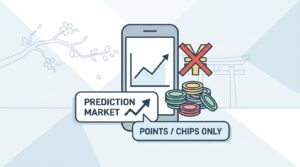
A quiet but deliberate shift is underway in Japan’s prediction market landscape. While platforms like Polymarket and Kalshi have built their models around real-money betting on event outcomes, Japanese prediction market apps are carving out growth by avoiding that exact mechanism. The approach reflects both regulatory pragmatism and a cultural calculation about how far speculative platforms can push before triggering enforcement action in one of Asia’s most tightly regulated gambling environments.
Why Japan’s Approach to Prediction Markets Deserves Attention
The divergence between Japanese prediction apps and their Western counterparts isn’t merely cosmetic. It signals a fundamentally different theory about what prediction markets are for, and who they serve. Here are the strategic takeaways worth tracking:
- Regulatory survival over disruption: Japanese platforms are deliberately structured to fall outside the country’s strict gambling laws, which prohibit most forms of real-money wagering outside of licensed exceptions like horse racing and certain lotteries.
- Engagement without financial risk: By using virtual currencies, point-based systems, or reputation scores instead of cash stakes, these apps attract users who want the forecasting experience without legal or financial exposure.
- The model may prove more scalable in jurisdictions across Asia where gambling regulations remain restrictive but appetite for prediction-style engagement is high.
- Advertiser and enterprise appeal: Stripping out real-money wagering makes these platforms more palatable to corporate partners, opening revenue streams that Polymarket and Kalshi cannot easily access.
- Data as the product: Without the noise of speculative money flows, Japanese platforms can position aggregated forecast data as a cleaner signal for institutional or research use.
What Separates Japan’s Model from Polymarket and Kalshi
Polymarket, which operates on blockchain-based infrastructure, and Kalshi, a CFTC-regulated exchange in the United States, both treat prediction markets as financial instruments. Users deposit real money. They trade contracts on outcomes ranging from elections to economic indicators. The value proposition is straightforward: put capital at risk, and if your forecast is correct, you profit.
Japan’s emerging prediction apps reject that premise entirely.
Instead of functioning as quasi-exchanges, these platforms lean into gamification. Users earn points, climb leaderboards, and build forecasting track records. Some apps reward accuracy with non-monetary prizes or enhanced platform status. The result: a market caught between two frameworks, one rooted in finance, the other in social engagement. And while Western platforms chase regulatory clarity to expand their real-money offerings, Japanese developers are betting (figuratively, at least) that the non-monetary path offers fewer legal obstacles and broader demographic reach.
This is not a trivial distinction. Japan’s gambling laws, anchored by the Penal Code’s prohibition on gambling (Articles 185 and 186), leave very little room for platforms that facilitate real-money wagering without explicit government authorization. Even Japan’s long-debated integrated resort legislation took years to pass, and the first casino has yet to open. Against that backdrop, any prediction market app that touches real money would almost certainly face regulatory scrutiny, if not outright enforcement.
The Behavioral Design Behind Non-Monetary Prediction Platforms
What makes these Japanese apps compelling from a user psychology standpoint goes beyond regulatory compliance. The design philosophy borrows heavily from behavioral engagement principles that align with how people naturally process uncertainty and reward.
When users forecast outcomes without financial stakes, the cognitive framing shifts. Rather than loss aversion dominating decision-making (a well-documented pattern in real-money markets), participants engage with a sense of curiosity and competence-building. The feedback loop becomes about accuracy and status rather than profit and loss. This reframing taps into intrinsic motivation, the kind of internal drive that sustains engagement over longer periods than extrinsic financial incentives typically do.
Platforms leveraging this model often incorporate progressive mastery mechanics. Users see their forecasting ability improve over time, tracked through visible metrics and comparative rankings. That sense of growth activates what behavioral researchers call a “competence need” — one of the core psychological drivers identified in self-determination theory. It keeps users returning not because they might win money, but because they want to prove (mostly to themselves) that they understand how the world works.
There’s also a social anchoring effect at play. Leaderboards and community forecasts create reference points that shape individual predictions. Users don’t just forecast in isolation; they calibrate against the crowd, which paradoxically can improve aggregate accuracy while keeping individual engagement high. Japanese app developers appear to understand this dynamic intuitively, building interfaces that foreground community consensus alongside personal performance.
Still, whether this engagement model can generate the revenue density of real-money platforms remains an open question (and not one the current user growth numbers alone can answer).
How Does This Reshape the Competitive Landscape?
The implications extend beyond Japan. Across Southeast Asia, South Korea, and parts of the Middle East, gambling restrictions make Polymarket-style platforms either unlicensed or outright prohibited. Japan’s non-monetary model offers a template that could be adapted for these markets without requiring the kind of regulatory breakthroughs that real-money prediction exchanges demand.
For Polymarket’s blockchain-based prediction exchange, the Japanese approach arguably represents less of a competitive threat and more of a parallel evolution. The two models serve different user motivations. But if Japanese-style apps demonstrate that prediction accuracy can be maintained without financial stakes, it undermines one of the core arguments real-money platforms use to justify their existence: that skin in the game produces better forecasts.
| Feature | Polymarket / Kalshi | Japanese Prediction Apps |
|---|---|---|
| Wagering model | Real money / crypto | Points, virtual currency, reputation |
| Regulatory posture | Seeks licensing or operates in grey zones | Designed to avoid gambling classification entirely |
| Primary user motivation | Financial return | Status, accuracy, community engagement |
| Revenue model | Trading fees, spreads | Advertising, enterprise data licensing, premium features |
| Geographic scalability | Limited by gambling law in most Asian markets | Potentially high across restrictive jurisdictions |
Frequently Asked Questions
Are prediction markets legal in Japan?
Real-money prediction markets would likely conflict with Japan’s Penal Code provisions on gambling. The apps gaining traction in Japan avoid this by not involving real-money stakes, operating instead on points or virtual reward systems.
Can Japanese prediction apps match the forecast accuracy of real-money platforms?
That remains unproven at scale. Proponents of real-money markets argue that financial stakes force participants to be more honest in their predictions. But early data from gamified platforms suggests that reputation-based incentives can produce surprisingly calibrated forecasts, at least in certain event categories.
Will this model expand beyond Japan?
Conditions favor it. Markets across Asia with strict gambling laws but high smartphone penetration and digital engagement represent natural expansion targets. Whether any single Japanese app becomes the vehicle for that expansion, or whether the model simply gets replicated locally, is a different matter entirely.