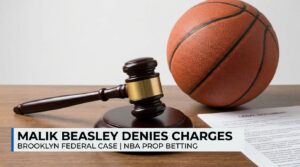
Former NBA guard Malik Beasley has entered a not-guilty plea to federal charges filed in Brooklyn, New York, in a case prosecutors say is connected to a broader scheme involving NBA player prop betting. The charges mark another chapter in a widening federal investigation into suspicious wagering activity tied to professional basketball. Beasley, who most recently played for the Detroit Pistons during the 2023–24 season, now faces allegations that could carry significant legal and professional consequences. The case underscores growing scrutiny from both federal authorities and league officials over the integrity risks posed by the expanding legal sports betting market.
What the Federal Case Against Beasley Actually Involves
Details surrounding the indictment remain partially sealed, but court filings in the Eastern District of New York indicate that Beasley is accused of participating in a conspiracy linked to manipulating NBA player prop bets. Player props, for those outside the betting world, are wagers placed on individual statistical performances rather than game outcomes. Think over/under on points scored, assists, or rebounds by a specific athlete in a given contest.
Beasley’s arraignment took place in a Brooklyn federal courtroom, where he formally denied all charges. His legal team has signalled an intent to mount a vigorous defence, though specifics of their strategy have not been disclosed publicly. Federal prosecutors, meanwhile, have suggested that the investigation extends beyond Beasley himself, potentially implicating additional players or associates.
That last point matters. If the case widens, it could become one of the most consequential integrity investigations the NBA has faced since the Tim Donaghy referee scandal nearly two decades ago.
Why Prop Betting Has Become a Regulatory Flashpoint
The rapid expansion of legal sports betting across the United States since the Supreme Court’s 2018 decision in Murphy v. NCAA has created a market now worth tens of billions in annual handle. Prop bets have emerged as one of the fastest-growing segments, particularly among younger bettors drawn to the granularity and perceived edge of wagering on individual player statistics.
But that granularity is precisely what makes props vulnerable to manipulation. Unlike game outcomes, which require coordination among multiple players and coaching decisions, a single player can theoretically influence their own statistical line. A guard who deliberately misses a few shots or racks up turnovers can swing an under bet without dramatically altering the final score. Sportsbooks have flagged this asymmetry for years (a distinction regulators have been slow to enforce), and several operators have quietly reduced prop bet limits or pulled certain markets when alert systems trigger.
The NBA’s official integrity monitoring programs have invested heavily in surveillance technology and partnerships with betting data firms. Still, the Beasley case suggests gaps remain.
Broader Implications for the League and Legal Betting Operators
For the NBA, the timing is uncomfortable. The league has been among the most aggressive of the major North American sports leagues in embracing legal sports betting, signing sponsorship deals with operators and integrating betting content into broadcasts. Commissioner Adam Silver has long positioned the NBA as a forward-thinking partner to the regulated gambling industry.
Yet every integrity breach chips away at the foundation that partnership rests on. If federal prosecutors can demonstrate that active players conspired to influence prop bet outcomes, the pressure on both the league and state regulators to restrict or restructure certain bet types will intensify. Some state gaming commissions have already begun reviewing whether to limit player prop markets for sports where manipulation risk is deemed elevated.
- The American Gaming Association has previously called for standardised integrity monitoring across all states with legal sports betting
- Several sportsbooks voluntarily suspended certain NBA prop markets during the 2023–24 season following suspicious activity alerts
- The NBA’s collective bargaining agreement includes provisions allowing the league to discipline players involved in gambling-related misconduct, including lifetime bans
- Federal wire fraud and conspiracy charges, if proven, carry potential prison sentences of up to 20 years
What This Means for Players, Operators, and the Betting Public
An introduction to the key strategic takeaways from this case requires acknowledging a tension at the heart of modern sports betting: leagues profit from the betting ecosystem while simultaneously bearing responsibility for policing it. That duality shapes every dimension of the Beasley case.
- Player accountability frameworks face a stress test. The NBA’s existing rules prohibit players from betting on league games, but enforcement mechanisms for prop manipulation are less clearly defined.
- Sportsbook operators may face regulatory pressure to curtail prop offerings. States like New Jersey and New York, where betting volumes are highest, could move to restrict or cap player prop markets.
- Federal involvement signals escalation. The fact that this case sits in a federal courtroom rather than a state one suggests prosecutors view the alleged conduct as part of an interstate scheme, likely involving wire communications or financial transactions across state lines.
- Sponsorship and broadcast deals could face renegotiation triggers. Integrity scandals historically prompt advertisers and media partners to reassess exposure.
- The case may accelerate adoption of real-time betting surveillance tools across the industry
The Psychology Behind Prop Bet Manipulation
Understanding why individuals with multimillion-dollar careers would risk everything for betting-related schemes requires looking beyond simple greed. Behavioural research in decision-making suggests that proximity to gambling environments fundamentally reshapes risk perception. When athletes are constantly exposed to betting lines bearing their own names, the psychological boundary between competition and commerce erodes. Cognitive biases like the illusion of control become amplified; a player who believes they can manage the outcome without detection is engaging in what psychologists call optimism bias at its most dangerous.
There is also the social dimension. Prop betting schemes rarely originate with the player alone. Associates, intermediaries, and sometimes family members introduce the opportunity, framing it as low-risk and victimless. The language used in these conversations matters enormously. Phrases like “easy money” or “no one gets hurt” function as linguistic anchors that suppress the brain’s threat-assessment systems. In neuro-linguistic terms, the framing effect overrides rational calculation. The individual doesn’t weigh a 20-year federal sentence against a five-figure payout because the framing never allows that comparison to surface.
What compounds this is the normalisation of betting culture within professional sports itself. Players see their teams’ jerseys next to sportsbook logos. They hear odds discussed during broadcasts of their own games. This environmental saturation creates what behavioural economists call an availability cascade, where the sheer visibility of gambling makes participation feel ordinary rather than transgressive. Breaking that cycle requires more than rules and monitoring. It demands a fundamental rethinking of how leagues, operators, and regulators communicate risk to the very athletes whose performances fuel the market.
Frequently Asked Questions
What are player prop bets?
Player prop bets are wagers placed on individual player statistics in a game, such as points scored, rebounds, or assists, rather than on the overall outcome of the contest. They have become one of the most popular bet types since the expansion of legal sports betting in the U.S.
Could Malik Beasley face an NBA ban?
Under the league’s collective bargaining agreement, players found to have engaged in gambling-related misconduct can face penalties ranging from suspension to a lifetime ban. Whether such discipline applies here depends on the outcome of the federal case and any parallel league investigation.
Why is this case being handled at the federal level?
Federal jurisdiction typically applies when alleged criminal activity crosses state lines or involves interstate communications and financial transactions. The Brooklyn filing suggests prosecutors believe the scheme operated across multiple jurisdictions, which elevates it beyond a state-level matter.
Has the NBA taken any public position on this case?
The league has not issued a detailed public statement specific to the Beasley charges. The NBA has, however, reiterated its commitment to integrity monitoring and cooperation with law enforcement on gambling-related investigations.