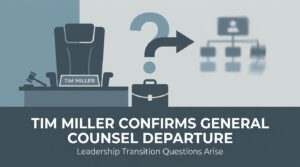
Tim Miller has confirmed the departure of the company’s General Counsel, a move that has prompted immediate speculation about the strategic direction of the firm’s legal and compliance operations. The exit, which appears to have been in the works for some time, leaves a notable gap at a moment when regulatory scrutiny across the sector continues to intensify. Details surrounding the circumstances of the departure remain sparse, and Miller has offered little beyond acknowledgment. What he hasn’t said may matter more than what he has.
What the GC Departure Signals for the Business
Senior legal leadership changes rarely happen in a vacuum. Before unpacking the broader implications, here are the core strategic takeaways from this development:
- Timing is conspicuous: The departure comes during a period of heightened regulatory activity across the industry, making the vacancy more than a routine personnel matter.
- A General Counsel exit can disrupt ongoing compliance initiatives, contract negotiations, and risk management frameworks already in motion.
- Succession planning is unclear: Miller has not publicly identified an interim replacement or outlined a timeline for filling the role, which introduces operational uncertainty.
- Stakeholder confidence could waver if the transition is not handled transparently, particularly among partners and institutional counterparts who rely on legal continuity.
- The departure may reflect deeper internal dynamics that have not yet surfaced publicly.
Why General Counsel Exits Carry Outsized Weight
In most organizations, the General Counsel occupies a uniquely dual role: part strategic advisor, part institutional safeguard. They sit at the intersection of business ambition and legal constraint (a distinction that makes their departure harder to absorb than, say, a marketing lead’s). When that seat goes empty, it doesn’t just create a hiring problem. It creates a governance gap.
The GC typically oversees regulatory filings, manages litigation exposure, and advises the board on risk appetite. Losing that continuity mid-cycle forces remaining leadership to either distribute those responsibilities across less specialized executives or bring in outside counsel at premium rates. Neither option is ideal.
And while Miller’s public comments have been measured, the absence of a clear succession plan suggests this departure may not have been fully anticipated, at least on the timeline it occurred.
Regulatory Context Adds Pressure
The broader industry landscape makes this transition particularly consequential. Regulators across multiple jurisdictions have been tightening enforcement actions, updating licensing frameworks, and demanding more granular compliance reporting from firms. A company navigating these waters without its chief legal officer is, arguably, operating with one hand tied.
That pressure is not abstract. Firms that have experienced similar leadership gaps in recent years have faced delays in regulatory submissions, increased legal costs, and in some cases, enforcement actions tied to compliance lapses during transition periods. The risk is real and measurable.
Still, it’s worth noting that a well-structured legal team can absorb a leadership change if the underlying systems are robust. Whether that applies here remains an open question.
Reading Between Miller’s Statement
Miller’s confirmation was notably brief. No praise for the departing GC’s tenure. No forward-looking language about the firm’s legal strategy. Just confirmation.
That kind of restraint can mean several things. It might reflect an amicable but unremarkable parting. It might signal tension that both parties prefer to keep private. Or it might simply be the communication style of a leader who doesn’t believe in public commentary on personnel matters. The point is that the market will interpret silence, and silence without context tends to breed the least favorable assumptions. Organizations operating in regulated environments, including those with a presence on platforms like Tim Miller’s corporate operations hub, understand that perception management during leadership transitions is not optional.
How Leadership Transitions Reshape Organizational Behavior
From a neuro-linguistic programming perspective, leadership departures trigger predictable cognitive and behavioral patterns within organizations. When a senior figure exits, particularly one whose role involves institutional protection, the remaining team often shifts into a heightened state of vigilance. This is not merely emotional; it manifests in decision-making patterns, communication styles, and risk tolerance thresholds across departments.
Teams anchored to a departing leader’s communication framework may struggle to recalibrate. The General Counsel, by nature of the role, sets the linguistic tone for how risk is discussed internally. They define what gets flagged, what gets escalated, and what gets absorbed quietly. Remove that anchor, and the internal language around risk often becomes either overly cautious or dangerously vague. Both extremes carry operational consequences.
Effective transition management requires what NLP practitioners call “reframing”: consciously reshaping the narrative from loss to opportunity. But reframing only works when it is backed by tangible action. Announcing a clear succession timeline, reinforcing existing compliance structures publicly, and maintaining transparent communication with external stakeholders all serve as behavioral anchors that prevent organizational drift. Without these anchors, teams default to pattern-matching against past negative experiences, which can amplify anxiety and slow decision-making at precisely the moment speed matters most.
Leaders who understand these dynamics invest heavily in the first 72 hours after a departure announcement. The initial framing sets the trajectory. Miller’s sparse commentary, viewed through this lens, represents a missed opportunity to shape the internal and external narrative before others fill the vacuum.
Frequently Asked Questions
Why does a General Counsel departure matter more than other executive exits?
The GC manages regulatory relationships, litigation strategy, and compliance architecture. Their departure can expose the firm to legal and operational risks that other roles simply don’t carry. It’s not just about replacing a person; it’s about maintaining institutional knowledge that often exists nowhere else in documented form.
Has Tim Miller named a successor?
No. As of the confirmation, no interim or permanent replacement has been publicly identified, which adds to the uncertainty surrounding the transition.
Could this departure affect regulatory standing?
Potentially. Regulators pay attention to leadership stability, particularly in legal and compliance functions. A prolonged vacancy could invite additional scrutiny or delay pending regulatory processes.
What should stakeholders watch for next?
The speed and caliber of the replacement hire will be the clearest indicator of how seriously the firm is treating this gap. Any changes to ongoing legal proceedings or compliance filings in the interim period will also be telling.