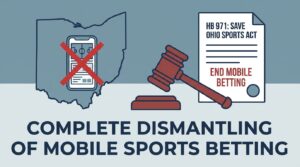
Republican lawmakers in Ohio have moved beyond campaign trail rhetoric and placed a formal legislative challenge to the state’s mobile sports wagering industry. House Bill 971, branded the “Save Ohio Sports Act,” was introduced in the Ohio House of Representatives by Representatives Johnathan Newman and Beth Lear. The bill would repeal all mobile sports betting licences and confine legal wagering to in-person retail counters at physical locations. If enacted, Ohio would become the first state to fully reverse a previously operational mobile betting framework.
What the Save Ohio Sports Act Would Actually Do
Before unpacking the strategic implications, it helps to understand the bill’s core provisions and who stands to be affected most. The legislation doesn’t merely restrict mobile sports betting; it eliminates it entirely from Ohio’s regulatory landscape.
- All existing mobile sports betting licences issued under Ohio’s current framework would be revoked
- Legal wagering would be restricted exclusively to brick-and-mortar retail sportsbook counters
- Operators like DraftKings, FanDuel, and BetMGM would lose their digital foothold in a state with roughly 11.8 million residents
- The bill follows an April 2026 policy announcement, suggesting coordinated legislative momentum rather than a one-off proposal
- Revenue generated through mobile channels, which typically accounts for 80–90% of total handle in mature U.S. markets, would vanish from state coffers
A Revenue Question Regulators Cannot Ignore
Ohio’s mobile sports betting market launched in January 2023 and generated significant tax revenue in its first full years of operation. Stripping away the mobile component doesn’t just affect operators. It reshapes the fiscal math for a state that allocated betting tax proceeds to education and youth sports programs.
Consider the scale. In states where mobile and retail coexist, digital platforms routinely capture the overwhelming majority of total wagers. New York, for instance, saw mobile handle dwarf retail by a factor exceeding 20-to-1 in some months. Ohio’s pattern has tracked similarly. Removing mobile access wouldn’t simply reduce handle; it would collapse it to a fraction of current levels.
That creates a tension the bill’s sponsors have yet to fully address: how to replace the revenue stream without raising taxes elsewhere or cutting funded programs.
Why This Bill Surfaces Now
Timing matters. The Save Ohio Sports Act arrives during a broader national conversation about gambling’s social costs, particularly among younger demographics. Problem gambling advocacy groups have grown louder, and several state legislatures have explored advertising restrictions or stake limits as intermediate measures. Ohio’s approach skips the incremental steps entirely.
Representatives Newman and Lear have framed the bill as a protective measure, citing concerns about addiction, predatory marketing, and the normalization of gambling through smartphone access. These aren’t fringe arguments (though not all market participants agree on the severity of the problem). Still, the leap from regulation to prohibition is substantial, and it raises questions about whether the political appetite exists to push HB 971 through both chambers.
The bill also lands at a moment when DraftKings and other major sportsbook operators are reporting record quarterly revenues nationally, making any state-level rollback a conspicuous counter-trend.
Stakeholder Landscape and Industry Response
The operator community has not been silent. Industry trade groups, including the American Gaming Association, have historically pushed back against prohibition-style legislation by pointing to consumer protection frameworks, responsible gambling tools, and the displacement effect: bettors migrating to unregulated offshore platforms when legal options disappear.
Retail sportsbook operators at Ohio’s casinos and racinos occupy an unusual position. On one hand, they stand to capture whatever residual demand remains if mobile access is cut. On the other, the overall market contraction would likely reduce foot traffic growth that mobile advertising currently drives. The relationship between digital and physical betting isn’t purely competitive; in practice, mobile platforms often funnel customers toward in-person experiences.
Local businesses tied to the sports betting ecosystem, from media companies running advertising to data providers and payment processors, would also feel the impact.
Comparative State Approaches to Betting Regulation
| State | Mobile Betting Status | Regulatory Approach |
|---|---|---|
| Ohio (proposed) | Full repeal under HB 971 | Prohibition of all mobile licences |
| New York | Active, high-tax model | 51% tax rate on operator revenue |
| Florida | Legally contested | Tribal compact framework with ongoing litigation |
| Utah | Never legalised | Constitutional prohibition on all gambling |
The Behavioural Dimension: What Prohibition Signals
Beyond the fiscal and regulatory mechanics, there’s a behavioural layer worth examining. Neuro-linguistic programming principles suggest that the framing of legislation profoundly shapes public perception and, by extension, political viability. The bill’s title itself, “Save Ohio Sports Act,” anchors the debate in protective language. It presupposes that Ohio sports need saving, and that mobile betting is the threat. This kind of linguistic anchoring is deliberate and effective.
When legislators name a bill, they aren’t just labelling policy. They are constructing a narrative frame that influences how voters, media outlets, and even fellow lawmakers process the proposal. The word “save” triggers loss aversion, a well-documented cognitive bias where people weigh potential losses more heavily than equivalent gains. By framing mobile betting as something Ohio needs to be rescued from, sponsors bypass a rational cost-benefit discussion and appeal directly to emotional processing.
That framing will likely shape the lobbying battle ahead. Operators will need to reframe the conversation around consumer choice, regulated safety, and economic contribution. Advocacy groups opposing mobile betting will lean into stories of personal harm and family disruption. Whichever frame dominates public discourse will arguably determine the bill’s trajectory more than any committee hearing.
And yet, framing alone doesn’t pass legislation. The bill still needs votes, committee approvals, and a governor willing to sign. Whether the narrative momentum behind HB 971 can survive the counter-pressure of a well-funded industry remains the central, unresolved question.
Frequently Asked Questions
What is the Save Ohio Sports Act?
House Bill 971, introduced by Representatives Newman and Lear, would repeal all mobile sports betting licences in Ohio and restrict legal wagering to in-person retail locations only.
When was mobile sports betting legalised in Ohio?
Ohio’s mobile sports betting market went live in January 2023 under a regulatory framework that licensed both mobile and retail operators.
Would this bill affect retail sportsbooks?
No. Retail sportsbooks at physical locations like casinos and racinos would continue operating. The bill targets mobile and online platforms exclusively, though the broader market contraction could still reduce overall betting activity statewide.
Has any U.S. state reversed a mobile betting legalisation before?
Not yet. If passed, Ohio would set a precedent as the first state to fully dismantle an operational mobile sports betting market after legalisation.