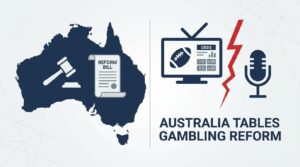
Australia’s Federal Government has introduced the Interactive Gambling Amendment (Gambling Reform) Bill 2026 to Parliament, marking what could become the most significant regulatory intervention in the country’s commercial wagering sector in over a decade. Communications Minister Anika Wells tabled the legislation, which targets the deep entanglement between sports broadcasting and sports betting through statutory advertising caps, uniform branding bans, and expanded enforcement powers. Alongside it, the National Self-Exclusion Register (Cost Recovery Levy) Bill establishes a funding mechanism that shifts compliance costs squarely onto licensed operators.
What the Bill Actually Proposes — and Why It Matters Now
Before unpacking the specifics, it helps to understand the scale of what’s being attempted here. This isn’t a single-issue reform. The bill bundles together advertising restrictions, sponsorship prohibitions, product bans, and a new financial levy into one legislative package. That breadth is deliberate — and politically calculated.
- Television advertising caps: The bill introduces concrete statutory limits on the volume and timing of gambling commercials across both linear and digital broadcast platforms, targeting saturation during live sport
- Uniform branding bans: Sports teams would no longer be permitted to carry betting operator logos on player kits or team merchandise, severing a revenue stream that clubs have relied on for years
- Specific niche lottery formats face outright elimination under the proposed framework
- Enforcement expansion: Regulatory bodies gain broader investigative and penalty powers to pursue non-compliant operators across state and territory lines
- Cost recovery levy: The companion bill creates a financial mechanism requiring operators to fund the National Self-Exclusion Register, removing the burden from public budgets
Advertising Restrictions: Structural, Not Cosmetic
The advertising provisions go well beyond what previous Australian governments have attempted. Rather than voluntary codes or industry-led guidelines (a distinction regulators have been slow to enforce), the bill imposes hard statutory caps. That means enforceable limits, not aspirational targets.
For broadcasters, the implications are immediate. Live sport in Australia has become inseparable from betting promotions. During peak sporting events, gambling advertisements can appear every few minutes. The bill seeks to break that cycle by restricting both the frequency and placement of commercials, with particular attention to time slots when younger audiences are most likely watching.
Digital platforms face parallel constraints. The legislation acknowledges that advertising saturation has migrated from television to social media, streaming services, and in-app environments. By extending statutory caps across these channels, the government is attempting to close a loophole that rendered previous broadcast-only restrictions largely ineffective.
Uniform Branding: A Revenue Question for Clubs
Banning betting logos from team uniforms will hit professional sporting organisations where it counts — their balance sheets. Several major Australian football, rugby league, and cricket franchises derive significant sponsorship income from wagering companies. Losing that revenue without a replacement stream could force clubs into uncomfortable budget recalculations.
Still, the political logic is straightforward. When a child wears a replica jersey bearing a betting company’s name, the branding does work that no advertisement could replicate. The government’s position treats this as a public health issue, not merely a commercial one. Whether sporting bodies accept that framing quietly or mount a lobbying campaign remains an open question.
How Does This Compare Internationally?
Australia is not the first jurisdiction to pursue this path. The United Kingdom implemented restrictions on gambling shirt sponsorship in the Premier League, with a voluntary agreement phasing out front-of-shirt betting logos by the 2025–26 season. Italy banned all gambling advertising in 2019 under its Dignity Decree. Spain imposed strict watershed rules. But Australia’s approach is arguably more comprehensive in scope, bundling advertising, sponsorship, product bans, and operator levies into a single legislative instrument.
The Self-Exclusion Levy and Operator Accountability
The companion Cost Recovery Levy Bill deserves separate attention. Australia’s Australian Communications and Media Authority has overseen various enforcement actions against unlicensed offshore operators, but funding the infrastructure of harm minimisation has remained politically contentious. This levy resolves that tension by requiring licensed operators to bear the cost of maintaining the National Self-Exclusion Register.
In practice, this means operators pay for the system that allows problem gamblers to ban themselves. The levy structure ties operator contributions to market activity, so larger firms shoulder proportionally greater costs. It’s a user-pays model applied to regulatory infrastructure.
Reframing the Narrative: What Behavioural Science Tells Us
Beyond the legislative mechanics, there’s a deeper behavioural dimension worth examining. Neuro-linguistic programming research and behavioural economics both point to the same insight: repeated exposure to gambling messaging doesn’t just inform — it normalises. When betting odds appear on screen as naturally as the match score, the cognitive boundary between entertainment and wagering dissolves.
The bill’s architects appear to understand this. By targeting not just the volume of advertising but its contextual placement — during live sport, on team uniforms, within digital feeds — the legislation addresses what psychologists call “environmental cueing.” These are the subtle triggers that prime decision-making before a person consciously recognises they’re being influenced. Removing betting logos from jerseys, for instance, disrupts a pattern of associative conditioning where team loyalty becomes entangled with brand recognition for wagering platforms.
Framing effects matter too. When a betting company sponsors a beloved team, the implicit message is one of legitimacy and trust. The reform attempts to sever that association at the symbolic level, not just the commercial one. And while advertising bans alone rarely eliminate demand, they do reshape the choice architecture within which consumers operate. The cumulative effect — fewer visual cues, reduced normalisation, weaker associative links — creates friction in the pathway from passive viewer to active bettor. That friction, at least on paper, is the entire point.
Frequently Asked Questions
When would these changes take effect?
The bill must pass both houses of Parliament before receiving Royal Assent. Given the current legislative calendar and the likelihood of Senate committee review, implementation timelines remain uncertain, though the government has signalled urgency.
Are existing sponsorship contracts grandfathered?
The bill’s text will determine whether current agreements receive transitional provisions. Previous Australian regulatory reforms in gambling have typically included phase-out periods, but no official transition timeline has been confirmed for uniform branding.
Does this affect online-only betting platforms?
Yes. The legislation explicitly extends advertising restrictions to digital media, including social platforms and streaming services, closing a gap that limited the reach of earlier broadcast-focused rules.
How is the self-exclusion levy calculated?
Operator contributions are expected to scale with market activity. The precise formula has not been publicly detailed, though the Cost Recovery Levy Bill establishes the framework for proportional assessment.