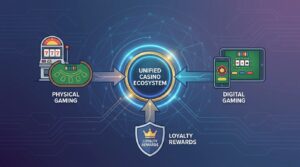
A major casino operator has announced plans to consolidate its brick-and-mortar casinos, digital gaming platforms, and customer loyalty rewards programme into a single unified ecosystem. The move signals a strategic pivot toward omnichannel integration, a direction that several tier-one gaming companies have pursued with varying degrees of success over the past three years. By merging these previously siloed operations, the company aims to create a seamless player experience that bridges the gap between in-person visits and online engagement. What makes this particular effort noteworthy is its scope: rather than layering digital features onto existing infrastructure, the operator appears to be rebuilding the connective tissue between all three verticals from scratch.
Why Consolidation Matters for Gaming Operators Right Now
Before unpacking the strategic details, it helps to frame why this kind of unification has become a competitive imperative across the gaming sector. Here are the core takeaways for industry stakeholders:
- Revenue convergence: Operators that successfully link land-based and digital channels have reported measurable lifts in cross-platform player spend, with some publicly traded companies citing 15–25% increases in average customer value post-integration.
- Loyalty as the binding layer: The rewards programme isn’t an afterthought here. It functions as the primary mechanism connecting physical and digital touchpoints, giving players a single identity across environments.
- Regulatory complexity increases substantially when digital and physical gaming share a unified backend, particularly in jurisdictions where online and land-based licensing frameworks remain separate.
- Competitive positioning: Operators without an omnichannel strategy risk losing younger demographics who expect fluid transitions between mobile, desktop, and in-venue experiences.
- The consolidation also creates richer first-party data pools, arguably the most valuable asset in modern gaming operations.
How the Unified Model Actually Works
At its core, the integration connects three distinct operational layers. The casino floor, with its slot machines, table games, and hospitality services, feeds into the same player profile that tracks online betting activity and digital game engagement. A single loyalty currency sits on top, accruing and redeeming across all channels without friction.
That sounds straightforward on paper. In practice, the technical architecture required to synchronize real-time data from physical gaming machines with cloud-based digital platforms is anything but simple. Legacy property management systems, often decades old, need middleware to communicate with modern iGaming backends. And the loyalty engine itself must handle dynamic tier calculations, promotional targeting, and fraud detection simultaneously across both domains.
Still, the payoff justifies the complexity. Players who engage on multiple channels tend to exhibit significantly higher retention rates. One industry benchmark (a distinction regulators have been slow to formally codify) suggests that omnichannel players carry a lifetime value roughly three times that of single-channel users.
The Loyalty Programme as Strategic Infrastructure
Most gaming loyalty programmes evolved as marketing tools. Points for play, comps for volume, tiered status for frequency. But this operator’s approach treats loyalty less as a promotional lever and more as core infrastructure.
By making the rewards programme the connective layer between physical and digital, the company effectively turns every player interaction into a data event. A slot session in Las Vegas, a sports bet placed from a mobile app in New Jersey, a poker tournament entered through a desktop client: all of these feed a unified profile that informs everything from personalized offers to responsible gaming interventions. The Caesars Rewards programme has pioneered elements of this approach, though the full integration of digital and physical remains a work in progress across the industry.
Whether this particular operator can execute at scale depends on several factors that remain less clear, including the maturity of its data infrastructure and its ability to negotiate consistent regulatory treatment across state lines.
Regulatory and Market Implications
Unifying gaming operations across channels introduces regulatory questions that don’t have uniform answers. In the United States alone, online gaming is legal in fewer than ten states, while land-based casinos operate under a patchwork of tribal, state, and local frameworks. A unified player account that spans both environments must comply with each jurisdiction’s distinct requirements for identity verification, geolocation, responsible gaming protocols, and tax reporting.
European markets present a different but equally complex picture. Operators licensed in multiple EU member states face divergent advertising rules, deposit limits, and self-exclusion registries. A single loyalty ecosystem that crosses these borders needs to be flexible enough to enforce local rules without breaking the seamless experience that justifies the integration in the first place.
Key Regulatory Considerations
| Dimension | Land-Based | Digital | Unified Challenge |
|---|---|---|---|
| Licensing | State or tribal authority | State-specific online permits | Dual compliance per jurisdiction |
| Player Identity | Often anonymous at lower tiers | Full KYC required | Reconciling anonymous and verified profiles |
| Responsible Gaming | On-site intervention protocols | Automated deposit and loss limits | Cross-channel behavioural monitoring at scale |
| Tax Reporting | Varies by state and game type | Federal and state digital thresholds apply | Consolidated reporting across platforms without double-counting |
What Omnichannel Means for Player Behaviour
Beyond the operational mechanics, there’s a behavioural dimension worth examining. Neurolinguistic research into decision-making suggests that consistency of environment plays a significant role in building trust and habitual engagement. When players encounter the same visual identity, reward logic, and interaction patterns whether they’re on a casino floor or a mobile app, the cognitive load of switching contexts drops substantially. This reduction in friction isn’t just a UX improvement. It taps into what behavioural scientists call “anchoring” — the tendency for people to rely heavily on the first piece of information they encounter when making decisions.
For gaming operators, this means that a player who first engages through a loyalty reward notification on their phone is already primed to continue that engagement when they walk into a physical property. The unified ecosystem creates a continuous feedback loop: digital interactions set expectations, physical experiences reinforce them, and the loyalty programme provides the tangible reward structure that closes the loop. Operators who understand this cycle can design touchpoints that feel less like marketing and more like a natural extension of the player’s own decision-making process. And that subtlety, arguably, is where the real competitive advantage lives.
Frequently Asked Questions
What does unifying casinos and digital gaming mean for players?
Players get a single account and loyalty profile that works across physical casino visits and online gaming. Points earned at a slot machine can be redeemed through a mobile app, and vice versa, without managing separate accounts or currencies.
Does this affect how player data is used?
Yes, significantly. A unified ecosystem consolidates behavioural data from all channels into one profile, enabling more targeted offers but also raising the bar for data privacy compliance. Operators must navigate GDPR, state-level privacy laws, and gaming-specific data regulations simultaneously.
Are other gaming companies pursuing similar strategies?
Several are. But execution varies widely. Some operators have linked loyalty programmes across channels while keeping gaming platforms separate; others have built integrated digital-physical platforms from the ground up. The industry has not yet converged on a single model.