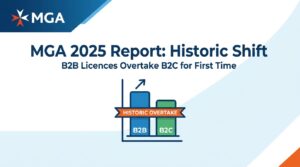
The Malta Gaming Authority (MGA) has published its Annual Report and audited Financial Statements for the year ending 31 December 2025, confirming what many in the sector had anticipated: B2B supply licences have, for the first time in the regulator’s history, surpassed B2C operating licences in active count. The report also details a year of intensified supervisory enforcement, expanded automation in compliance workflows, and a recalibration of how Malta positions itself within the global iGaming supply chain. For an island jurisdiction that has long served as Europe’s primary iGaming licensing hub, the structural implications are significant.
What the B2B Overtake Signals for Malta’s iGaming Ecosystem
Before unpacking the numbers, it helps to understand what this crossover actually represents. The fact that B2B supply licences now outnumber B2C operating licences is not merely a statistical curiosity. It reflects a deeper repositioning of Malta’s role in the global gambling technology landscape, one that favours platform providers, data aggregators, and content studios over front-facing operator brands.
- Active B2B supply licences exceeded B2C operating licences for the first time in the MGA’s regulatory history, marking a definitive structural shift in Malta’s licensing composition.
- The MGA processed 38 new gaming licence applications during the 12-month period, suggesting continued demand for Malta-based authorisation despite growing competition from other European jurisdictions.
- Advanced automation tools were deployed across the authority’s supervisory frameworks, pointing to a modernisation effort aimed at scaling oversight without proportionally increasing headcount.
- Enforcement activity remained robust throughout 2025, with the regulator maintaining pressure on compliance standards across both licence categories.
- The shift toward B2B dominance could reshape how Malta markets itself internationally, potentially attracting more technology-first companies rather than traditional gambling operators.
A Licensing Landscape in Transition
Malta’s iGaming framework has historically been associated with B2C operators, the brands that directly face players. That identity is now evolving. The growth in B2B licences suggests that an increasing number of companies are choosing Malta as the jurisdiction from which to supply games, platforms, risk management tools, and payment solutions to operators licensed elsewhere.
This is not an accident.
Over the past several years, the Malta Gaming Authority’s regulatory framework has been refined to accommodate the technical complexity of modern supply chains. Game aggregation platforms, random number generator certification bodies, and AI-driven compliance vendors all fall under the B2B umbrella. As the technology stack powering online gambling grows more fragmented and specialised, the demand for dedicated supply licences has naturally expanded.
Still, the question of whether Malta can sustain this trajectory depends on factors the MGA only partially controls. Competing jurisdictions (notably the Isle of Man, Gibraltar, and increasingly certain US states) are actively courting the same category of licensees. What Malta offers in regulatory maturity, it sometimes loses in cost structure and bureaucratic pace, though the 2025 automation push appears designed to address the latter.
Automation as a Regulatory Strategy
One of the less headline-grabbing but arguably more consequential elements of the 2025 report is the MGA’s investment in automation. Regulatory technology, or RegTech, has been a buzzword across financial services for years. In gambling regulation, adoption has been slower. Malta’s move to integrate automated tools into its supervisory processes represents a deliberate attempt to close that gap.
The practical benefits are straightforward: faster licence processing, more consistent compliance monitoring, and the ability to flag anomalies in licensee behaviour without relying solely on manual review cycles. But there is a subtler strategic dimension as well. By automating routine oversight tasks, the MGA frees its human resources to focus on higher-risk cases and policy development. That reallocation matters when the number of active licences continues to grow while public-sector hiring remains constrained.
How Does This Compare Globally?
Few gambling regulators have publicly detailed their automation strategies to this degree. The UK Gambling Commission has invested in data analytics capabilities, and several Nordic regulators use algorithmic monitoring for advertising compliance. Malta’s approach, at least on paper, appears to be broader in scope, covering application processing, ongoing supervision, and enforcement triggers within a single modernised framework.
Enforcement Posture: Consistent Pressure
The report confirms that the MGA maintained an active enforcement posture throughout 2025. While specific penalty figures and case details were not fully disclosed in the summary, the authority’s track record in recent years has included licence suspensions, financial penalties, and public warnings directed at both B2B and B2C licensees.
What remains less clear is how enforcement priorities will shift as the licence mix changes. A regulator overseeing more supply companies than consumer-facing operators faces different risk profiles. Supply-side failures (a compromised RNG, a data breach at a platform provider) can cascade across dozens of operators simultaneously. Whether the MGA’s enforcement toolkit is calibrated for that kind of systemic risk is a question the next annual report may need to answer more directly.
Broader Market Implications
| Dimension | B2C-Dominant Era | Emerging B2B-Dominant Era |
|---|---|---|
| Primary licensee profile | Online casinos, sportsbooks | Platform providers, game studios, compliance tech vendors |
| Regulatory focus | Player protection, AML | Supply chain integrity, technical standards, interoperability |
| Revenue model for Malta | Licence fees + gaming tax | Licence fees + ecosystem density (a distinction regulators have been slow to quantify) |
| Competitive threat | UK, Gibraltar | Isle of Man, Estonia, select US states |
| Key risk type | Consumer harm | Systemic cascading failures across multiple operators relying on a single supplier |
Reframing Malta’s Value Proposition
For years, Malta’s pitch to the global iGaming industry centred on being the place where operators set up shop. The 2025 data suggests a pivot, perhaps not intentional in origin, but unmistakable in direction. Malta is becoming the jurisdiction where the infrastructure behind online gambling is built, tested, and certified.
And that shift carries real economic weight. B2B companies tend to employ more specialised technical talent, invest more heavily in R&D, and generate intellectual property that stays within the jurisdiction. They also tend to be stickier; relocating a platform provider is operationally harder than moving a front-end brand to a new licence.
Yet the MGA will need to demonstrate that its regulatory framework evolves in tandem. Supervising a game studio is fundamentally different from supervising a sportsbook. The compliance expectations, the technical audits, the data access requirements all diverge. Whether the authority’s modernisation programme, including its new automation capabilities, is sufficient to handle that divergence at scale is the central question heading into 2026.
Frequently Asked Questions
Why is the B2B licence overtake significant?
It signals that Malta’s iGaming ecosystem is shifting from a consumer-facing operator hub toward a technology and supply-chain centre. This changes the jurisdiction’s risk profile, talent requirements, and competitive positioning relative to other licensing regimes.
What types of companies hold B2B supply licences in Malta?
These include game development studios, platform and aggregation providers, payment processing firms serving gambling operators, and increasingly, companies offering AI-driven compliance and responsible gambling tools.
Does this affect players directly?
Not immediately. Players interact with B2C-licensed operators. But the quality, fairness, and security of their experience depend heavily on the B2B suppliers behind those operators, which is precisely why regulatory oversight of the supply side matters.
How many new licence applications did the MGA process in 2025?
The authority processed 38 applications for new gaming licences during the reporting period, reflecting sustained demand for Malta-based authorisation.