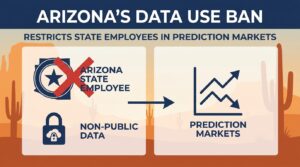
Arizona Governor Katie Hobbs has signed an executive order barring state executive branch employees from leveraging non-public government information to trade on commercial prediction markets. The directive, which took effect immediately upon signing, treats all proprietary data obtained through public service as confidential for wagering purposes. Violations carry steep consequences: termination and referral to state law enforcement. The move positions Arizona as one of the first states to draw a bright regulatory line between government access and the fast-growing prediction market industry.
What Arizona’s Executive Order Signals for Government Ethics and Prediction Markets
This is not a symbolic gesture. The order arrives against a backdrop of federal indictments and mounting concern over how privileged information flows from government corridors into financial and speculative platforms. Before diving into the broader implications, here are the core strategic takeaways:
- Immediate enforcement with real teeth: Non-compliant employees face termination and criminal referral, not just internal review or a slap on the wrist
- Prediction markets are now a policy concern at the state level, not just a federal curiosity or a niche fintech talking point
- The order effectively classifies all non-public government data as confidential when it comes to wagering, closing a loophole that previously existed in most state ethics frameworks
- Other states will be watching. Arizona’s preemptive approach could serve as a template for similar executive actions across the country
- For prediction market operators, this raises the compliance bar significantly when it comes to user vetting and information provenance
Why Prediction Markets Became a Government Ethics Problem
Prediction markets have surged in visibility over the past two years. Platforms like Polymarket and similar event-based trading platforms allow users to place wagers on the outcomes of elections, policy decisions, economic data releases, and regulatory actions. The appeal is straightforward: these markets aggregate information and, in theory, produce more accurate forecasts than polls or punditry alone.
But that information-aggregation function creates a problem when participants hold asymmetric advantages. A state employee who knows the outcome of a pending regulatory decision before it becomes public sits in roughly the same position as a corporate insider trading on earnings data. The difference? Until now, most state-level ethics codes hadn’t caught up to this reality.
Arizona’s order fills that gap. And it does so bluntly.
The Federal Backdrop: Indictments and Intelligence Concerns
Governor Hobbs’s action didn’t emerge in a vacuum. At the federal level, several high-profile cases have drawn attention to the misuse of government-acquired intelligence for personal financial gain. While the specific federal indictments referenced in the order’s framing have not all been publicly detailed, the pattern is clear enough: individuals with access to non-public policy information have allegedly used that access to profit on platforms where such knowledge confers an outsized edge.
What remains less clear is how widespread the practice actually is. Prediction market volumes have grown substantially, but the proportion of trades placed by individuals with genuine inside knowledge (as opposed to informed speculation) is difficult to quantify. Still, the perception of vulnerability was apparently enough for Arizona to act preemptively rather than wait for a local scandal to force its hand.
How the Order Works in Practice
The executive order applies to all employees within Arizona’s executive branch. Its scope is broad by design.
| Provision | Detail |
|---|---|
| Scope | All executive branch employees in Arizona state government |
| Prohibited activity | Using non-public government information to trade or profit on commercial prediction markets |
| Data classification | All proprietary and non-public data acquired through public service is treated as confidential for wagering purposes |
| Penalties | Immediate termination and referral to state law enforcement agencies |
| Effective date | Immediately upon signing by Governor Hobbs |
One notable aspect: the order does not appear to prohibit state employees from participating in prediction markets altogether. The restriction targets the use of non-public information specifically. An employee placing a wager based solely on publicly available data would not, at least on paper, violate the directive. That distinction matters (though enforcement will test its boundaries quickly).
A Shifting Landscape for Prediction Market Operators
For the platforms themselves, Arizona’s order introduces a new dimension of regulatory risk. Prediction market companies have largely operated in a space where user identity verification focuses on age, jurisdiction, and financial suitability. The question of whether a user possesses material non-public information has not been a standard compliance checkpoint.
That may need to change. If other states follow Arizona’s lead, platform operators could face pressure to implement know-your-customer protocols that screen for government employment or affiliation. The operational cost of such screening would be non-trivial, and the legal exposure for failing to detect prohibited activity could grow.
Even so, the burden of compliance under this particular order falls squarely on the employee, not the platform. Whether that balance holds as the regulatory conversation evolves is another question entirely.
What This Means for State-Level Ethics Frameworks
Arizona’s executive order arguably represents a broader reckoning with how government ethics codes handle emerging financial instruments. Traditional insider trading prohibitions were built around securities markets. Prediction markets don’t fit neatly into that framework because they aren’t securities in the conventional sense, a distinction regulators have been slow to address.
By using executive authority rather than waiting for legislative action, Governor Hobbs sidestepped what could have been a lengthy statutory process. The tradeoff is durability: executive orders can be reversed by future administrations. But as a first-mover signal, the approach carries weight.
Other governors now face a quiet question: does inaction look like indifference?
Frequently Asked Questions
Does the order ban Arizona state employees from all prediction market activity?
No. The prohibition specifically targets the use of non-public government information to trade or profit on prediction markets. Employees who participate using only publicly available information are not directly covered by this restriction, though the practical line between the two may prove difficult to police.
What penalties do violators face?
Immediate termination and referral to Arizona state law enforcement.
Are prediction market platforms required to screen for government employees under this order?
The order places the compliance obligation on state employees, not on platform operators. That said, the broader regulatory trajectory could eventually push platforms toward more rigorous user vetting.
Could other states adopt similar measures?
Arizona’s order is likely to be studied as a model. Given the federal attention to insider information misuse on prediction markets, other state executives may face growing pressure to implement comparable safeguards, particularly in states with large government workforces or proximity to federal policy-making.