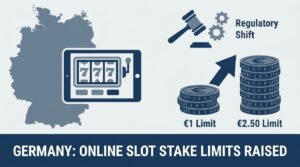
Germany’s gambling regulator has confirmed a notable increase in stake limits for online slot games, a move that reshapes the operating framework for licensed operators across the country. The decision, which adjusts the per-spin cap upward from the existing €1 limit introduced under the 2021 Interstate Treaty on Gambling (GlüNeuRStV), signals a recalibration of Germany’s tightly regulated iGaming market. Operators and industry groups had lobbied for the change for months, arguing the restrictive cap was driving players toward unlicensed offshore platforms.
What the Stake Limit Increase Means for Germany’s iGaming Market
Before unpacking the broader implications, it’s worth grounding the change in context. Germany’s original €1 stake limit was among the most restrictive in any regulated European market, and its enforcement became a flashpoint between regulators, operators, and player advocacy groups. The confirmed increase represents a pragmatic shift rather than a philosophical one: regulators appear to be responding to channelisation data that showed licensed platforms losing ground to unregulated competitors.
- The higher stake limit directly addresses operator complaints that the €1 cap made licensed German slots uncompetitive against unlicensed alternatives offering far higher limits
- Channelisation rates, a key metric for regulatory success, had remained stubbornly below targets set when the GlüNeuRStV took effect
- Player migration to grey-market operators was undermining both tax revenue and consumer protection objectives
- The adjustment could improve the commercial viability of holding a German licence, potentially attracting operators who had previously considered the market unattractive
- Responsible gambling safeguards remain in place alongside the revised limits, though whether they are sufficient is a question the industry hasn’t fully resolved
Why Regulators Moved Now
Timing matters here. Germany’s Gemeinsame Glücksspielbehörde der Länder (GGL), the joint gambling authority of the German states, had been under sustained pressure from multiple directions. Licensed operators pointed to declining revenues. Industry associations published data suggesting that a significant share of German online gambling activity was taking place on unlicensed platforms (a distinction regulators have been slow to enforce with meaningful penalties).
And while the GGL maintained publicly that player protection remained the priority, the economic argument became harder to ignore. Tax receipts from legal online slots were falling short of projections. At the same time, enforcement actions against unlicensed operators, though increasing in frequency, failed to meaningfully shrink the black market.
The result: a regulator caught between two mandates, forced to choose pragmatism over rigidity.
How Germany’s Approach Compares
Germany’s original €1 limit stood out even among Europe’s more cautious regulators. The UK Gambling Commission, for instance, has debated stake reductions for online slots but has not imposed a cap as low as Germany’s original threshold. Sweden and the Netherlands have adopted their own frameworks with varying degrees of restriction, yet neither went as far as Germany did in 2021.
| Market | Online Slot Stake Limit | Regulatory Body |
|---|---|---|
| Germany (previous) | €1 per spin | GGL |
| Germany (revised) | Higher than €1 (exact figure confirmed by GGL) | GGL |
| United Kingdom | Under review | UK Gambling Commission |
| Sweden | SEK 100 weekly deposit cap (temporary COVID measure, since lifted) | Spelinspektionen |
| Netherlands | No fixed per-spin cap; operator-level controls required | Kansspelautoriteit |
That comparison alone suggests Germany’s initial approach was an outlier. Whether the revised limit brings it closer to a European norm depends on the final figure and how operators respond.
The Channelisation Problem Hasn’t Disappeared
Raising stake limits addresses one friction point. But Germany’s channelisation challenge runs deeper than a single number. The licensing process itself has been criticised as slow and opaque, with some operators waiting years for approvals. Advertising restrictions remain tight. The mandatory deposit limit of €1,000 per month across all licensed platforms, enforced through the centralised OASIS system, continues to frustrate operators who argue it pushes high-value players offshore.
Still, the stake limit increase is arguably the most visible concession regulators have made since the treaty took effect. It sends a signal, even if an incomplete one, that the GGL is willing to adapt its framework based on market evidence rather than ideology alone.
Operator Response and Strategic Outlook
Major operators active in Germany, including those holding licences issued by the German gambling authority, have broadly welcomed the announcement. For companies that had scaled back their German-facing offerings due to the restrictive environment, the revised limits may justify renewed investment in product development and marketing for the German market.
Smaller operators face a different calculus. The cost of compliance with German regulations, from technical integration with OASIS to meeting responsible gambling requirements, remains significant. A higher stake limit improves unit economics per player but doesn’t eliminate the overhead that makes Germany one of the more expensive markets to operate in.
Frequently Asked Questions
What was Germany’s previous online slot stake limit?
The per-spin cap was set at €1 under the 2021 Interstate Treaty on Gambling, one of the lowest thresholds among regulated European markets.
Why did Germany decide to raise the limit?
Regulators responded to evidence that the restrictive cap was driving players to unlicensed platforms, undermining both channelisation targets and tax revenue. The commercial case for adjustment had been building for over a year.
Does this change affect responsible gambling protections?
Existing safeguards, including the €1,000 monthly deposit cap and the OASIS exclusion system, remain in effect. The stake limit increase does not, at least on paper, roll back player protection measures.
How does this affect unlicensed operators targeting German players?
If the higher limit improves the competitiveness of licensed platforms, some player migration back to the regulated market is expected. But enforcement against unlicensed operators will likely need to intensify in parallel for the shift to hold.
Whether this adjustment proves sufficient to meaningfully redirect player activity remains the open question hanging over Germany’s entire regulatory experiment.