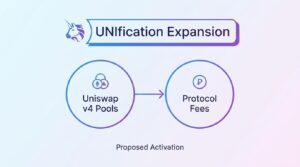
Uniswap Labs put forward a proposal on July 7 to activate protocol fees on a select group of Uniswap v4 pools, marking the next phase of a fee rollout that the DAO had already greenlit as part of the broader UNIfication governance package. The temperature check was submitted to a five-day Snapshot vote, signaling that the decentralized exchange’s newest and most flexible pool architecture could soon begin generating direct protocol revenue. If approved, this move would extend a fee mechanism already operating on earlier versions of the protocol into v4’s hook-enabled environment, where custom pool logic and concentrated liquidity strategies have attracted growing developer interest.
What the v4 Fee Activation Means for UNI Holders and the Protocol
Before diving into the specifics, it helps to frame why this proposal carries weight beyond a routine governance vote. Uniswap v4 introduced a modular pool design that allows developers to attach custom “hooks” to pools, enabling features like dynamic fees, on-chain limit orders, and automated rebalancing. Activating protocol fees on these pools doesn’t just generate revenue. It tests whether the DAO’s fee framework can coexist with v4’s permissionless customization layer without discouraging liquidity provision or developer experimentation.
- Revenue expansion: Protocol fees on v4 pools would create a new income stream for the DAO treasury, supplementing fees already collected from v2 and v3 deployments
- Governance precedent: The proposal extends the UNIfication package’s mandate into a pool architecture that didn’t exist when the original vote passed, raising questions about how broadly that mandate applies
- Liquidity providers face a direct cost consideration, since protocol fees are typically taken as a share of the swap fee that would otherwise flow entirely to LPs
- Developer incentives: Hook creators building on v4 will need clarity on how protocol fees interact with custom fee structures embedded in their hooks
- Signal to the market: A successful vote would demonstrate that UNI token governance can iteratively extend its economic reach across protocol versions without requiring entirely new proposals each time
How Protocol Fees Work on Uniswap v4
Uniswap v4’s architecture differs substantially from its predecessors. Pools on v4 are deployed through a singleton contract, reducing gas costs and enabling composability between pools. Hooks, which are external smart contracts attached at pool creation, can modify behavior at multiple points in a swap’s lifecycle.
Protocol fees in this context would be applied to a subset of pools rather than universally. That distinction matters. Uniswap Labs appears to be taking a measured approach, targeting pools where fee activation is least likely to disrupt existing liquidity dynamics. The proposal does not, at least on paper, mandate fees across every v4 pool.
Still, the mechanics of fee extraction on v4 are more nuanced than on v3. Because hooks can implement their own fee logic, the interaction between a hook’s custom fee and the protocol-level fee creates layered cost structures that LPs and traders will need to evaluate carefully. Whether this complexity discourages participation or simply reshuffles it remains an open question.
The UNIfication Package: A Quick Refresher
The UNIfication governance package, approved by DAO voters earlier this year, consolidated several proposals aimed at aligning UNI token economics with protocol revenue. Its core objective was straightforward: ensure that the protocol’s fee switch, long debated and repeatedly deferred, would finally be turned on in a structured, phased manner.
Extending that mandate to v4 pools is a logical next step. But it also tests the elasticity of voter intent. When the DAO approved UNIfication, v4 was still in its early deployment phase. The current proposal essentially asks whether that approval implicitly covered future protocol versions or whether each new version requires fresh consensus. Uniswap Labs, by routing this through a Snapshot temperature check, is treating it as the former (a distinction governance purists may contest).
Comparative Fee Structures Across Uniswap Versions
| Version | Pool Architecture | Protocol Fee Status | Custom Fee Logic |
|---|---|---|---|
| Uniswap v2 | Constant product AMM | Active on select pairs | Not supported |
| Uniswap v3 | Concentrated liquidity | Active on select pools | Limited (fixed fee tiers) |
| Uniswap v4 | Singleton + hooks | Proposed for subset of pools | Fully customizable via hooks |
Why Timing and Framing Shape Governance Outcomes
Governance proposals in DeFi rarely succeed or fail on technical merit alone. How a proposal is framed, when it surfaces, and who champions it all influence voter behavior. Uniswap Labs choosing a five-day Snapshot window suggests confidence in existing sentiment, but also a desire to move quickly before opposition can consolidate.
From a behavioral standpoint, the framing here leans heavily on continuity. The message is clear: this isn’t a new fee switch debate, it’s an extension of something already decided. That reframing reduces cognitive friction for voters who supported UNIfication and may not want to relitigate the underlying question of whether protocol fees should exist at all.
And yet, the specifics matter enormously. Which pools get fees? At what rate? Who decides if the subset expands? These granular questions often get deferred in temperature checks, only to become contentious during on-chain execution. Experienced DAO participants know that the gap between a Snapshot signal and a binding on-chain vote can be wide enough to change outcomes entirely.
For UNI holders evaluating this proposal, the mental model should be less about whether fees are good or bad and more about whether the governance process adequately captures the complexity of v4’s architecture. A yes vote that glosses over hook-fee interactions could create downstream disputes that are harder to resolve than the original question.
Frequently Asked Questions
What is a Snapshot vote in DeFi governance?
A Snapshot vote is an off-chain signaling mechanism where token holders indicate support or opposition to a proposal without incurring gas fees. It doesn’t execute anything on-chain but serves as a temperature check before formal governance action.
Will all Uniswap v4 pools have protocol fees?
No. The current proposal targets a subset of v4 pools. Universal fee activation has not been proposed, and the selection criteria for included pools have not been fully detailed in public documentation.
How do protocol fees affect liquidity providers?
Protocol fees are typically carved from the swap fee that LPs would otherwise receive in full. The net effect is a reduction in LP earnings per unit of liquidity, which can influence where and how much liquidity gets deployed across Uniswap’s decentralized exchange pools.
Does this proposal require a separate on-chain vote?
Snapshot votes are non-binding. If the temperature check passes, a formal on-chain governance proposal would still need to be submitted and approved by UNI token holders before any fee activation occurs on v4 pools.