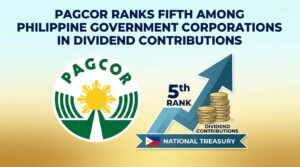
The Philippine Amusement and Gaming Corporation (PAGCOR) secured the fifth spot among 50 government-owned and controlled corporations (GOCCs) for dividend remittances to the national treasury during the latest fiscal period. The ranking underscores the gaming regulator’s persistent financial relevance to Philippine public finances, even as the agency navigates an evolving regulatory landscape and shifting political expectations around the country’s gambling sector. For an entity that simultaneously regulates and operates gaming venues, the result raises questions about how long this dual mandate can sustain its fiscal output.
What PAGCOR’s Dividend Ranking Signals for Philippine Public Finance
Government corporations in the Philippines are required to remit a portion of their earnings as dividends to the Bureau of the Treasury, a mechanism designed to ensure that state-owned enterprises contribute directly to national revenue. PAGCOR’s placement among the top five dividend contributors reflects the scale of the country’s regulated gaming market and the cash-generating capacity of its operations.
Before diving into the strategic implications, here are the core takeaways from this development:
- PAGCOR placed fifth out of 50 GOCCs in dividend payments, reinforcing its role as a significant non-tax revenue source for the Philippine government
- The ranking positions the gaming regulator alongside major state enterprises in sectors like energy and finance, which typically dominate GOCC dividend tables
- Continued high dividend output may intensify debate over PAGCOR’s dual function as both industry regulator and market participant
- Revenue from gaming operations feeds into national programs, giving policymakers a fiscal incentive to maintain or expand the regulated gambling framework
- The result arrives amid broader discussions in Congress about restructuring PAGCOR’s mandate and potentially separating its regulatory and operational arms
A Revenue Engine With a Regulatory Identity Crisis
PAGCOR occupies an unusual position in the Philippine government apparatus. It licenses and oversees gaming operators across the archipelago while simultaneously running its own casinos and electronic gaming parlors. That arrangement has drawn criticism from industry observers and some legislators who argue that a body cannot credibly regulate competitors it also competes against.
Yet the dividend figures tell a different story, at least on paper.
The agency’s ability to generate substantial returns for the treasury has, for years, insulated it from the kind of structural reform that critics advocate. When a government corporation consistently ranks among the top revenue contributors, the political calculus around dismantling or restructuring it shifts considerably. Still, the tension between regulatory credibility and commercial performance is not one that raw dividend numbers can resolve.
How PAGCOR Compares to Other Top-Performing GOCCs
The top positions in the GOCC dividend rankings are typically held by corporations in energy, banking, and infrastructure. PAGCOR’s presence in the fifth slot places it in direct financial comparison with entities whose mandates are far less controversial.
| Rank | Sector | Typical GOCC Profile |
|---|---|---|
| 1–3 | Energy / Banking | Large-scale utilities and state financial institutions with broad national mandates |
| 4 | Varies | Often a major infrastructure or development corporation |
| 5 | Gaming | PAGCOR, combining regulatory oversight with direct commercial gaming operations across the Philippines |
That a gaming entity sits alongside power utilities and development banks in fiscal contribution is, arguably, a testament to how deeply embedded gambling revenue has become in the Philippine fiscal architecture.
The Legislative Backdrop: Separation Talk Gains Traction
Congressional discussions about splitting PAGCOR into two distinct bodies (one regulatory, one commercial) have circulated for several years without producing legislation. But momentum appears to be building. Proponents of separation argue that an independent regulator would strengthen investor confidence, improve licensing transparency, and align the Philippines more closely with international best practices in gaming governance.
Opponents counter that the current structure works precisely because it consolidates revenue generation and oversight under a single entity, reducing bureaucratic friction. Whether that efficiency argument holds up against governance concerns is a question lawmakers have yet to answer definitively.
The Philippine gaming regulator’s official operations and licensing framework remains central to how foreign and domestic operators assess market entry risk.
Fiscal Dependency and the Broader Gaming Economy
Beyond dividends, PAGCOR channels revenue into mandated beneficiaries including the Philippine Sports Commission, the Board of Claims, and various local government units. This web of fiscal dependencies means that any disruption to PAGCOR’s earnings would ripple across multiple public programs, a reality that makes structural reform politically delicate.
The Philippines’ gaming gross revenue has grown steadily over the past decade, driven by integrated resort developments in Entertainment City (Manila’s casino strip along Manila Bay), the expansion of offshore gaming operations, and a growing domestic player base. Even so, the sector faces headwinds: tighter regulations on offshore operators, periodic political scrutiny, and regional competition from jurisdictions like Singapore and Macau that continue to refine their own regulatory models.
And while PAGCOR’s dividend ranking is a snapshot of fiscal performance, it does not capture the full picture of the agency’s economic footprint, which includes employment, tourism spending, and infrastructure investment tied to integrated resorts.
What Comes Next for PAGCOR’s Fiscal Role?
Three dynamics will shape PAGCOR’s trajectory in the near term. First, the outcome of legislative proposals to restructure the agency will determine whether its commercial and regulatory functions remain unified. Second, the pace of new integrated resort licensing (particularly outside Metro Manila) could expand or dilute the agency’s revenue base. Third, evolving public sentiment around gambling, influenced by high-profile cases involving offshore operators, may shift the political environment in ways that pure financial performance cannot counteract.
For now, the fifth-place ranking among GOCCs serves as both validation and vulnerability. It validates the gaming sector’s contribution to national revenue. But it also makes PAGCOR a target for those who believe that a government corporation generating this much money deserves a governance framework that matches its fiscal weight.
Frequently Asked Questions
What is PAGCOR’s role in the Philippine government?
PAGCOR functions as both the regulator of the Philippine gaming industry and a direct operator of casinos and electronic gaming facilities. It licenses private operators, enforces gaming laws, and remits a significant portion of its earnings to the national treasury and mandated beneficiaries.
Why does PAGCOR’s dividend ranking matter?
The ranking reflects how much revenue the gaming sector channels into public finances relative to other state-owned enterprises. A top-five placement among 50 GOCCs signals that gaming is not a marginal contributor but a structural pillar of Philippine government revenue, which carries implications for how aggressively lawmakers might pursue reform.
Is there a plan to restructure PAGCOR?
Several legislative proposals have been floated to separate PAGCOR’s regulatory and commercial functions into distinct entities. No legislation has been enacted yet, though the conversation has gained renewed attention in recent congressional sessions. The financial stakes involved make any restructuring politically complex.