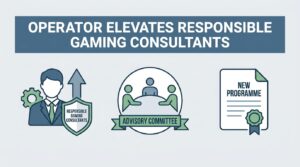
In a move that signals a deeper institutional commitment to player protection, an operator has transitioned the two responsible gaming consultants it brought on board earlier this year into formal advisory roles. The consultants now sit on the Advisory Committee of the operator’s newly established responsible gaming programme. While details about the programme’s full scope remain limited, the structural shift from external consultation to embedded governance suggests the operator is building a longer-term framework rather than treating responsible gaming as a compliance checkbox.
What This Structural Shift Tells Us About the Operator’s Strategy
Repositioning hired consultants into an advisory committee isn’t merely an organisational reshuffle. It carries specific implications for how the operator intends to govern its responsible gaming commitments going forward. Here’s what stands out:
- From project-based to governance-embedded: Moving consultants onto a standing committee transforms their role from delivering recommendations to shaping ongoing policy. That distinction matters for accountability.
- The creation of a dedicated responsible gaming programme implies the operator anticipates regulatory scrutiny or is proactively positioning itself ahead of tightening standards in its operating jurisdictions.
- Advisory committees carry reputational weight. Naming external experts to such bodies signals to regulators, partners, and the public that the operator is subjecting itself to independent oversight (a distinction regulators have been slow to enforce across the sector).
- Talent retention in a niche field: Responsible gaming expertise remains scarce. Locking consultants into a formal advisory structure reduces the risk of losing institutional knowledge to competitors.
Why Responsible Gaming Governance Is Gaining Urgency
The timing here is not incidental. Across multiple regulated markets, operators face mounting pressure to demonstrate that responsible gaming measures are more than surface-level. The UK Gambling Commission, for instance, has intensified its enforcement actions in recent years, issuing penalties that have reached into the tens of millions of pounds for social responsibility failures. And while not every jurisdiction moves at the same pace, the direction is unmistakable.
Operators that embed responsible gaming into their governance architecture, rather than bolting it on as an afterthought, arguably position themselves more favourably when licence renewals and market-access negotiations arise. Still, the gap between having an advisory committee and acting on its recommendations remains wide in practice. Whether this operator intends to grant its new committee genuine influence or treat it as a reputational shield is a question only its future actions will answer.
How Advisory Committees Function in Gaming Governance
For those outside the regulatory and compliance world, advisory committees in the gaming sector serve a specific function. They are not decision-making bodies in the executive sense. Instead, they provide structured, independent input on policy, risk, and operational practices related to player welfare. Their effectiveness depends almost entirely on two factors: the quality of their members and the degree to which the operator’s leadership actually listens.
The best-functioning committees tend to include a mix of clinical psychologists, former regulators, data scientists with behavioural analytics expertise, and consumer advocates. What remains less clear in this case is whether the two consultants will be joined by additional members with complementary skill sets, or whether the committee will operate as a two-person body. A narrow committee risks blind spots.
The Broader Industry Context: From Reactive to Proactive
This move fits within a broader pattern across the responsible gambling and harm prevention landscape. Several major operators have, over the past 18 months, announced dedicated responsible gaming divisions, appointed chief responsibility officers, or partnered with academic institutions to study gambling-related harm. The shift is partly regulatory, partly reputational, and partly commercial: operators increasingly recognise that sustainable revenue depends on customer longevity, not extraction.
But not all of these initiatives carry equal weight. Some amount to little more than press releases and org-chart adjustments. The operators that distinguish themselves tend to publish measurable outcomes: intervention rates, self-exclusion uptake, session-limit adoption, and reductions in markers of harm. Whether this particular operator plans to report such metrics publicly has not been disclosed.
Frequently Asked Questions
What does an advisory committee do in a responsible gaming programme?
It provides independent guidance on player protection policies, reviews operational practices, and recommends changes based on emerging research and regulatory developments. Its influence depends on how seriously the operator treats its input.
Why were the consultants moved rather than replaced?
Continuity matters. The consultants already possess institutional knowledge from their earlier engagement, making them more effective in an advisory capacity than new appointees would be at this stage.
Does this guarantee better player protection?
Not automatically. Structural changes are necessary but insufficient on their own. The real test lies in whether the committee’s recommendations translate into measurable operational changes and whether the operator reports on outcomes transparently.
What Operators Can Learn From This Approach
There is a practical lesson embedded in this decision that extends beyond any single company. Operators across the sector frequently engage consultants for short-term projects, extract a report, and move on. The institutional knowledge walks out the door. By converting that relationship into a standing advisory role, this operator retains expertise while also creating a visible governance mechanism that regulators and licensing bodies can point to during reviews.
The approach also reflects a growing recognition that responsible gaming is not a static compliance requirement. Player behaviours evolve, product designs change, and regulatory expectations shift. A standing committee, at least on paper, is better equipped to respond to these dynamics than a one-off consultancy engagement that produces a report destined for a shelf. The question now is execution: will this committee meet quarterly, publish findings, or operate behind closed doors? That gap between structure and substance is where most responsible gaming programmes quietly fail.



