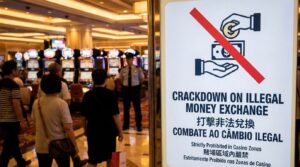
Macau’s law enforcement agencies, working in tandem with casino operators, have intensified efforts to suppress unlicensed money exchange activities proliferating around the territory’s gaming floors. The coordinated crackdown targets individuals and small networks operating outside the regulated financial system, offering currency conversion services to gamblers in violation of Macau’s banking and anti-money laundering regulations. Authorities say the joint approach has yielded measurable results, though the underlying demand that fuels these operations remains a persistent challenge for the world’s largest casino market.
What the Crackdown Signals for Macau’s Gaming Sector
The enforcement push reflects a broader regulatory posture that has reshaped Macau’s casino industry since Beijing began tightening oversight of cross-border capital flows and gaming-adjacent financial activity. Before diving into the specifics, here are the strategic takeaways worth tracking:
- Operational coordination between police and private casino security teams marks a shift toward shared enforcement responsibility, a model Macau had been slower to adopt compared to other major gaming jurisdictions
- The crackdown directly targets unlicensed money changers, not the gamblers themselves, suggesting regulators are focused on disrupting supply networks rather than penalising end users
- Continued enforcement pressure could affect VIP gaming volumes, particularly among players who relied on informal channels to move funds across the border
- Macau’s alignment with mainland China’s anti-money laundering priorities is no longer aspirational; it is operational, with real consequences for non-compliance
- Casino operators face reputational and licensing risk if unlicensed activity persists on or near their premises, even when they are not directly involved
How the Joint Operations Work
The mechanism is straightforward in concept but demanding in execution. Macau’s Judiciary Police and Public Security Police coordinate with casino surveillance and security departments to identify, monitor, and apprehend individuals conducting unauthorised currency exchanges. These operations typically occur in casino lobbies, adjacent hotel areas, and nearby public spaces where gamblers congregate.
Casino operators have installed additional monitoring infrastructure and trained staff to flag suspicious behaviour patterns consistent with illegal money changing. That includes repeated small-value transactions, loitering near ATM clusters, and the use of mobile payment platforms to facilitate conversions outside regulated banking channels.
Still, the scale of the problem is not trivial. Macau processes billions of dollars in gaming revenue annually, and the demand for informal currency services (a distinction regulators have been slow to fully eliminate) persists among a segment of visitors who either cannot or prefer not to use licensed exchange counters.
Regulatory Pressure and the Broader AML Landscape
Macau’s gaming regulator, the Gaming Inspection and Coordination Bureau (DICJ), has progressively tightened compliance requirements for the territory’s six licensed concessionaires. The bureau’s evolving regulatory framework now places explicit obligations on operators to prevent their premises from being used as venues for unlicensed financial activity.
This matters because Macau’s concession renewal process, completed in late 2022, embedded enhanced social responsibility and AML commitments into the new 10-year licences. Operators who fail to demonstrate active cooperation with law enforcement risk more than fines. They risk the political goodwill that underpins their ability to operate in a jurisdiction where government discretion carries enormous weight.
And while Macau’s legal framework treats unlicensed money exchange as a criminal offence, prosecution rates have historically lagged behind arrest numbers. Whether the current wave of enforcement translates into sustained judicial outcomes remains an open question.
The Economics Behind Informal Currency Exchange
Why do these networks persist despite repeated crackdowns? The answer sits at the intersection of capital controls and convenience.
Mainland Chinese visitors face strict limits on the amount of currency they can legally convert and carry across the border. The annual individual quota stands at USD 50,000 equivalent. For high-stakes gamblers, that ceiling is functionally irrelevant. Informal money changers fill the gap, offering competitive rates with none of the documentation requirements imposed by licensed exchange houses or banks.
| Channel | Documentation Required | Typical Rate Spread | Regulatory Status |
|---|---|---|---|
| Licensed Exchange Counter | ID verification, transaction records | 1.5–2.5% | Fully regulated |
| Bank Transfer | Full KYC, source of funds | 0.5–1.0% | Fully regulated |
| Informal Money Changer | None | 1.0–3.0% (variable) | Unauthorised |
The rate spread alone does not explain the demand. Speed and anonymity do. For a gambler looking to convert HKD 500,000 in a hotel lobby without producing identification, the informal channel is not just cheaper. It is the only option.
What Operators Stand to Lose
For Macau’s six concessionaires, the calculus has shifted. Tolerance of grey-market activity near gaming floors was once an unspoken accommodation. That era ended when Beijing signalled, through the 2021 arrest of junket king Alvin Chau and the subsequent overhaul of the junket licensing system, that intermediaries operating outside formal structures would no longer be tolerated.
Operators now face a dual bind. Aggressive enforcement may deter some VIP visitors who relied on informal financial channels, potentially dampening premium gaming revenue. But failure to cooperate with authorities carries far greater risk: regulatory sanction, public censure, or worse, being seen as out of step with Beijing’s priorities. No concessionaire can afford that perception during a period when Macau’s government is actively diversifying the economy away from gaming dependence.
Frequently Asked Questions
What constitutes illegal money exchange in Macau?
Any currency conversion service operated without a licence from Macau’s Monetary Authority qualifies as unauthorised. This includes individuals offering cash-for-cash exchanges in casino areas, hotel lobbies, or public spaces, regardless of the amounts involved.
Are gamblers themselves penalised for using unlicensed money changers?
Current enforcement actions have focused on the operators of these services rather than their customers. That said, individuals caught in possession of large undeclared sums may face separate scrutiny under Macau’s customs and anti-money laundering statutes.
How does this affect Macau’s gaming revenue outlook?
The short-term impact on mass-market gaming is likely minimal, since most casual visitors use licensed channels. VIP segment effects are harder to quantify, particularly given the structural changes already imposed by the junket overhaul. Arguably, the bigger variable is whether mainland economic conditions support discretionary travel spending at all.
Will enforcement intensify further?
Given the trajectory since 2021, sustained or escalating enforcement is the baseline expectation. Macau’s government has shown no indication of easing its alignment with Beijing’s financial oversight priorities.



