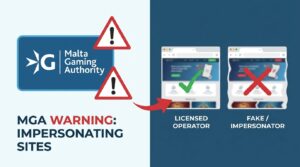
The Malta Gaming Authority (MGA) has issued a formal advisory alerting both the gambling industry and consumers to a growing threat: unauthorised websites impersonating licensed operators. The regulator flagged multiple instances where rogue sites have adopted the branding, logos, and even licence numbers of legitimate MGA-authorised companies to deceive players. This kind of identity theft in the iGaming space poses direct risks to consumer protection and to the reputational integrity of Malta’s regulated market.
What the MGA Advisory Signals for the Industry
The advisory is not a routine compliance reminder. It targets a specific and escalating pattern of fraud that sits at the intersection of consumer harm and regulatory enforcement. Before unpacking the broader implications, here are the core takeaways:
- Unauthorised gambling sites are actively copying the identities of MGA-licensed operators, including their licence credentials and visual branding
- The MGA is urging consumers to verify operator legitimacy through its official licence verification tools before depositing funds
- Licensed operators face reputational damage and potential liability exposure if impersonation goes undetected or unreported
- This advisory may foreshadow tighter enforcement measures, including enhanced domain monitoring and cross-border cooperation with hosting providers
- The broader European regulatory landscape is increasingly focused on combating unlicensed gambling activity, and Malta’s move aligns with that trajectory
How Impersonation Schemes Operate
The mechanics are deceptively simple. A rogue operator builds a site that mirrors the look and feel of a legitimate MGA-licensed platform. They copy logos, replicate page layouts, and in some cases display genuine MGA licence numbers that belong to other companies. Players, particularly those unfamiliar with verification procedures, deposit money believing they are engaging with a regulated entity. They are not.
What makes this particularly corrosive is the trust architecture it exploits. Malta’s gaming licence carries weight across European markets (a distinction the MGA has spent years cultivating). When fraudulent actors weaponise that trust, the damage extends beyond individual consumers to the credibility of the licensing framework itself.
Still, the question of how many players have actually been affected remains unanswered. The MGA has not published specific figures on complaints or financial losses tied to these impersonation schemes.
Verification as a First Line of Defence
The regulator has pointed consumers toward its official licence verification system maintained by the Malta Gaming Authority, which allows users to check whether a site holds a valid licence. But verification tools only work when players know to use them. And in practice, most casual gamblers do not cross-reference licence numbers before signing up.
That gap between available tools and actual consumer behaviour is arguably the central vulnerability here. Regulators can build robust verification infrastructure, yet its effectiveness depends entirely on awareness and adoption. The MGA’s advisory, by raising public attention, attempts to close that gap at least partially.
Obligations Falling on Licensed Operators
Licensed operators are not passive bystanders in this scenario. The MGA expects its licensees to actively monitor for impersonation and report any instances promptly. This creates a practical burden:
| Obligation | Practical Impact |
|---|---|
| Brand monitoring | Operators must invest in domain surveillance and trademark enforcement tools |
| Incident reporting | Timely notification to the MGA when impersonation is detected |
| Consumer communication | Proactive alerts to existing customers about fraudulent mirror sites |
| Cooperation with authorities | Sharing technical data with regulators and, where relevant, law enforcement across jurisdictions |
Smaller licensees, in particular, may find these requirements resource-intensive. Larger operators with dedicated compliance and legal teams are better positioned to absorb the cost, which raises questions about proportionality in enforcement expectations.
A Broader Pattern Across European Gambling Markets
Malta is not alone in confronting this problem. Regulators in the UK, Sweden, and the Netherlands have all grappled with unlicensed operators attempting to exploit the credibility of established licensing regimes. The UK Gambling Commission, for instance, maintains a public register of unauthorised sites and has pursued domain-blocking measures through internet service providers.
Yet cross-border enforcement remains fragmented. Rogue operators frequently host their sites in jurisdictions with limited regulatory cooperation, making takedowns slow and inconsistent. Even so, the direction of travel is clear: European regulators are moving toward more coordinated responses, and Malta’s advisory fits within that broader momentum.
Building Consumer Resilience Through Awareness
Beyond regulatory mechanics, there is a behavioural dimension worth examining. Consumers who fall victim to impersonation schemes often do so because of cognitive shortcuts. A familiar logo, a professional-looking website, and the presence of a licence number create a rapid sense of legitimacy. This is pattern recognition working against the user.
Effective consumer protection in this context requires more than verification tools. It demands sustained education campaigns that teach players to question surface-level signals of trust. Regulators and operators alike benefit from framing this not as a compliance exercise but as a shared investment in market integrity. When players trust the ecosystem, they engage more confidently with licensed platforms. When that trust erodes, the entire regulated market contracts.
The MGA could strengthen its position by publishing anonymised case studies of impersonation incidents, giving consumers concrete examples of what to look for. Pairing technical verification with narrative-driven awareness (stories of how specific scams unfolded, what red flags were missed) tends to produce stronger behavioural change than abstract warnings alone. This approach, grounded in how people actually process risk and make decisions, would complement the existing advisory rather than replace it.
Frequently Asked Questions
How can players verify whether a gambling site holds a valid MGA licence?
Players can use the MGA’s official online verification tool, which allows them to search by licence number or operator name. If the site in question does not appear in the registry, it should be treated as unauthorised regardless of what credentials it displays.
What should a licensed operator do if they discover a site impersonating them?
Report it to the MGA immediately and preserve evidence, including screenshots, URLs, and any communication from the fraudulent site. Operators should also notify their player base and consider engaging legal counsel for domain takedown proceedings.
Does the MGA have the power to shut down impersonating sites?
The MGA can issue public warnings and coordinate with hosting providers, but its direct enforcement authority is limited to entities operating under or seeking Maltese licences. Cross-border takedowns typically require cooperation with other jurisdictions and, in some cases, law enforcement involvement.



