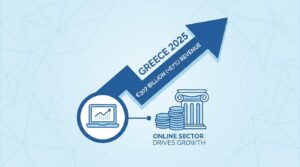
Greece’s regulated gambling market generated €307 billion in revenue during 2025, a staggering 67% increase compared to the previous year. The surge, driven overwhelmingly by online gambling expansion, signals a dramatic shift in how Greek consumers engage with licensed betting and gaming platforms. For an economy still navigating post-pandemic fiscal pressures, the scale of this growth raises questions about sustainability, regulatory capacity, and the broader implications for European gambling markets.
What Greece’s 67% Revenue Jump Means for the Market
The numbers demand attention. A 67% year-over-year increase in a mature European gambling jurisdiction is not incremental growth; it reflects structural change. Before examining the details, here are the strategic takeaways for industry stakeholders:
- Online gambling was the primary engine behind the revenue spike, consistent with broader European trends toward digital-first wagering
- Greece’s regulatory framework, which underwent significant reform in recent years, appears to be channelling consumer demand into licensed channels at an accelerating rate
- Revenue of this magnitude will likely intensify scrutiny from both domestic regulators and EU-level bodies concerned with consumer protection and anti-money laundering compliance
- Operators already licensed in Greece now sit on a far more valuable market position than they did 18 months ago
- The gap between Greece and other Southern European markets (Portugal, Italy) in per-capita online gambling spend may be narrowing faster than projected
Online Gambling: The Force Behind the Numbers
Online gambling’s contribution to the €307 billion total underscores a pattern visible across the continent but particularly pronounced in Greece. The country’s licensing regime, overhauled to bring offshore operators into compliance, has arguably succeeded in creating a regulated digital ecosystem that players trust enough to use at scale. Still, the speed of adoption raises a harder question: whether regulatory infrastructure can keep pace with a market growing this fast.
Greek players have gravitated toward sports betting and online casino products, both of which saw substantial volume increases. Mobile penetration, already high among Greek adults, has made placing a bet as frictionless as ordering food. That convenience factor, combined with aggressive marketing from licensed operators, has reshaped the competitive landscape.
The Hellenic Gaming Commission has been tasked with overseeing this expanding market, and its enforcement actions in recent quarters suggest awareness of the risks that accompany rapid growth.
How Greece Compares Across Southern Europe
| Market | 2024 Gambling Revenue (Est.) | 2025 Growth Trend | Online Share |
|---|---|---|---|
| Greece | ~€184 billion | +67% | Dominant and growing |
| Italy | Significantly higher base | Moderate single-digit growth | ~40% of total |
| Portugal | Smaller regulated market | Steady growth | Rising but below Greece’s trajectory |
| Spain | Mid-range European market | Stable | Established online segment |
What stands out is not Greece’s absolute size but its velocity. Italy’s market dwarfs Greece in raw terms, yet Greece’s growth rate outstrips nearly every EU member state with a mature licensing framework. Whether that pace holds through 2026 depends on factors no revenue chart can capture: political appetite for tighter advertising rules, tax rate adjustments, and the always-unpredictable behaviour of consumers who may be spending beyond sustainable levels.
Regulatory Pressure Will Follow the Money
Revenue growth of this magnitude does not arrive without consequences. Greek authorities face mounting pressure to demonstrate that consumer protection measures are keeping pace with operator revenues. Problem gambling rates, responsible gaming enforcement, and advertising standards are all areas where regulators will need to show results, not just intentions.
And while the licensed market expands, the unlicensed segment has not disappeared entirely. Channelisation rates (the share of total gambling activity captured by regulated operators) remain a critical metric that Greek regulators have not always disclosed with granularity. A 67% revenue increase in the regulated market could reflect genuine market expansion, migration from unlicensed platforms, or both. The distinction matters enormously for policy.
EU-level developments add another layer. The European Commission has signalled interest in harmonising certain aspects of gambling regulation, particularly around advertising and cross-border digital services. Greece’s booming market makes it a test case.
The Psychology of a Growing Market
Beyond the balance sheets, understanding why Greek consumers have embraced online gambling at this pace requires looking at behavioural drivers. Accessibility plays a role, obviously. But so does social normalisation: when sports betting advertisements saturate broadcast media and social feeds, the psychological barrier to placing a first bet drops considerably. This is not unique to Greece, yet the cultural affinity for sports, particularly football, creates fertile ground for operators who know how to align product with passion.
Trust in the regulatory system also functions as a behavioural catalyst. Players who previously used offshore or grey-market platforms have migrated to licensed operators partly because regulation signals safety. That perception, whether fully warranted or not, reduces the cognitive friction associated with depositing real money online. Operators have reinforced this by investing in localised customer support, Greek-language interfaces, and payment methods familiar to domestic users.
There is also a generational component. Younger Greek adults, digital natives comfortable with app-based transactions, represent a growing share of the player base. Their spending patterns differ from older demographics: smaller individual bets placed more frequently, often in-play during live sporting events. This micro-betting behaviour inflates transaction volumes and, by extension, operator revenues in ways that traditional pre-match wagering never could.
What remains less clear is whether the market’s psychological momentum can sustain itself once the novelty effect fades and responsible gambling interventions become more assertive.
Frequently Asked Questions
How much gambling revenue did Greece generate in 2025?
Greece’s regulated gambling market reached €307 billion in 2025, representing a 67% increase over 2024 figures.
What drove the increase in Greek gambling revenue?
Online gambling was the dominant growth driver. Mobile betting adoption, licensed operator marketing, and improved channelisation from unlicensed to regulated platforms all contributed. Sports betting and online casino products saw particularly strong uptake among Greek players.
Is Greece’s gambling growth sustainable?
That depends on several variables: regulatory decisions on advertising and taxation, consumer spending patterns, and whether problem gambling rates trigger policy intervention. Growth at 67% annually is unlikely to persist indefinitely.
Who regulates gambling in Greece?
The Hellenic Gaming Commission (EEEP) oversees Greece’s gambling market, including licensing, compliance, and enforcement against unauthorised operators.



