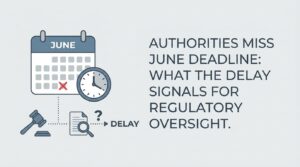
A missed June deadline by authorities has raised fresh questions about the pace and reliability of regulatory enforcement. While the specifics of which obligation went unfulfilled remain thinly detailed, the pattern itself carries weight: deadlines set by or for public bodies are not merely administrative markers. They shape market confidence, compliance timelines, and the credibility of the institutions behind them.
Why a Missed Regulatory Deadline Matters More Than It Appears
Regulatory deadlines exist to impose discipline on processes that would otherwise drift. When authorities fail to meet their own timelines, the ripple effects extend well beyond the immediate policy area. Before unpacking the broader implications, here are the core takeaways from this development:
- Credibility erosion: Each missed deadline chips away at the perceived seriousness of the regulatory framework, making future enforcement harder to sell to stakeholders.
- Compliance uncertainty: Businesses that aligned internal processes to the June timeline now face ambiguity about when (or whether) the expected action will materialise.
- Market participants may begin pricing in regulatory lag as a structural feature rather than an exception.
- Political exposure: Authorities that miss self-imposed or legislatively mandated deadlines invite scrutiny from oversight bodies, media, and industry groups alike.
- The delay could indicate resource constraints, inter-agency disagreements, or shifting political priorities beneath the surface.
The Pattern Behind the Delay
Missed deadlines in regulatory contexts rarely happen in isolation. They tend to cluster around moments of institutional strain: budget cycles, leadership transitions, or periods where the scope of a mandate outpaces the capacity to deliver. And while a single missed date might be forgiven, repeated slippage creates a compounding trust deficit that regulators struggle to recover from.
What makes this particular lapse notable is its timing. June deadlines in many jurisdictions coincide with mid-year fiscal reviews and legislative recesses, periods when institutional bandwidth narrows. Whether the delay stems from procedural bottlenecks or a more substantive disagreement over the direction of policy remains unclear (a distinction that authorities have so far declined to clarify publicly).
How Businesses Should Read This Signal
For companies operating in regulated sectors, a missed deadline is not an invitation to relax compliance efforts. Quite the opposite. The uncertainty it introduces often demands more vigilance, not less, because the eventual action, when it arrives, may come with compressed implementation windows designed to make up for lost time.
Firms that had budgeted for regulatory changes tied to the June date now face a practical dilemma. Do they maintain readiness at current levels, absorbing the cost of preparedness for an action that hasn’t landed? Or do they scale back, risking a scramble if authorities move abruptly? In practice, most compliance teams will hold their positions, but the carrying cost of that uncertainty is real and measurable.
Still, there is a strategic opening here. Companies that use the delay to deepen their understanding of the likely regulatory direction, rather than simply waiting, can position themselves ahead of competitors who treat the pause as dead time.
Reframing Regulatory Delays Through a Strategic Lens
The way organisations interpret regulatory signals often determines their competitive positioning more than the regulations themselves. Drawing from principles of cognitive reframing, the most effective compliance leaders treat ambiguity not as a threat but as an information-rich environment. Every delay carries embedded data about institutional priorities, political constraints, and the likely shape of eventual outcomes.
Consider the difference between two mental models. The first says: “The deadline was missed, so the process is broken.” The second says: “The deadline was missed, which tells us something specific about where friction exists in the system.” The second frame is more useful because it converts uncertainty into a diagnostic tool. Organisations anchored to the first model tend to react defensively, pulling back from engagement with regulators and adopting a wait-and-see posture that leaves them flat-footed when action finally comes.
By contrast, teams that actively map the reasons behind delays, whether through government transparency portals and public consultation records or through direct engagement with regulatory affairs channels, build a richer picture of the landscape. That picture becomes a genuine asset. The ability to anticipate not just what regulators will do, but when and how they will do it, separates organisations that merely comply from those that shape the terms of compliance itself.
Language matters here too. Internal communications that frame the delay as “regulatory uncertainty” tend to trigger risk-averse behaviour across departments. Reframing it as “an extended preparation window” shifts the organisational response toward proactive investment in readiness. The facts are identical; the framing changes everything.
What Happens Next?
Authorities have not publicly indicated a revised timeline, which itself is telling. The absence of a new date suggests either that the underlying work is further from completion than originally projected, or that the political appetite for the action in question has cooled. Neither scenario is reassuring for stakeholders who had planned around the June marker.
One question lingers without a clean answer: whether this delay reflects a temporary procedural hiccup or a more fundamental recalibration of regulatory ambition. The distinction matters enormously for long-term planning, and it is one that only the coming months will resolve.
Frequently Asked Questions
What happens when a regulatory authority misses a statutory deadline?
The consequences depend on the jurisdiction and the nature of the obligation. In some cases, missed deadlines trigger automatic review mechanisms or require the authority to report to a legislative oversight body. In others, particularly where the deadline was self-imposed rather than statutory, there may be no formal consequence beyond reputational damage.
Should businesses change their compliance plans because of this delay?
Not immediately. Most compliance advisors recommend maintaining readiness while monitoring for updated guidance. Scaling back prematurely can create larger problems if the regulation lands with a shortened implementation period.
How common are missed regulatory deadlines?
More common than most people assume. Regulatory bodies across multiple jurisdictions routinely miss implementation and review deadlines, though the frequency varies significantly by sector and by the political salience of the issue at hand. What distinguishes a routine delay from a meaningful one is whether it signals a change in direction or merely a change in pace.



