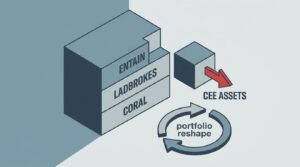
Entain, the parent company behind Ladbrokes and Coral, has taken a decisive step forward in offloading its Central and Eastern European operations. The move signals a broader strategic pivot for one of the world’s largest gambling groups, which has been under sustained pressure from investors and regulators alike to sharpen its focus on core markets. While the specifics of the divestment timeline remain partially undisclosed, the direction is unmistakable: Entain is shedding weight to run faster elsewhere.
What Entain’s CEE Exit Means for the Wider Gambling Sector
Before examining the details, it is worth framing what this divestment represents in strategic terms. Entain’s decision to pull back from Central and Eastern Europe is not an isolated portfolio trim. It reflects a recalibration that several major operators have been contemplating as regulatory complexity in the region grows and capital allocation priorities shift toward higher-margin digital markets.
- Portfolio discipline over geographic sprawl: Entain is signalling that breadth of presence matters less than depth of competitive advantage in select markets
- The CEE divestment frees up management bandwidth and capital that can be redirected toward the group’s US joint venture, BetMGM, and its growing online-only segments
- Regulatory arbitrage is losing its appeal: operating across fragmented CEE regulatory frameworks has become costlier, with compliance burdens rising in markets like the Czech Republic and Croatia
- Potential buyers of Entain’s CEE assets could include regional operators or private equity firms seeking exposure to regulated European gambling markets at a discount
- The timing coincides with broader M&A activity across the European gambling landscape, where consolidation and divestiture cycles are accelerating simultaneously
A Group in Transition
Entain has been navigating a period of considerable internal change. Leadership turnover, a rejected takeover approach from DraftKings in 2021, and ongoing scrutiny from the UK Gambling Commission have all shaped the company’s recent trajectory. Against that backdrop, the CEE exit looks less like a sudden pivot and more like the logical next chapter in a restructuring that has been underway for some time.
The group’s global operations span more than 30 regulated markets, but not all of those markets contribute equally. CEE operations, while profitable in aggregate, have arguably diluted the group’s narrative as a digitally focused, compliance-first operator. Shedding these assets allows Entain to present a cleaner story to investors who increasingly reward focus over diversification.
And yet, the question lingers: who benefits most from the other side of this deal?
Why Regional Buyers May See Opportunity Where Entain Sees Drag
For a company of Entain’s scale, CEE markets represent a relatively small share of group revenue. But for a mid-tier regional operator, acquiring established retail and digital assets across multiple CEE jurisdictions could be transformative. The infrastructure is built. The licences are in place. What changes is the ownership lens through which those assets are valued.
Private equity interest in European gambling assets has been notable over the past 18 months. Firms like CVC and Apollo have circled the sector, drawn by recurring revenue models and regulatory moats that (at least on paper) limit new entrants. Entain’s CEE portfolio could attract exactly this kind of buyer: one willing to operate with thinner margins and longer time horizons than a publicly listed multinational.
The Ladbrokes and Coral Factor
It is easy to forget that Entain’s identity, for many consumers and even some investors, remains anchored in its UK retail brands. Ladbrokes betting shops across the UK and the Coral chain still carry significant brand equity, even as the industry’s centre of gravity shifts online. The CEE divestment does nothing to change that retail footprint directly, but it does clarify where management attention will be concentrated.
Still, the UK retail estate carries its own challenges. Stake limits on fixed-odds betting terminals, rising property costs, and a regulatory review that could impose new affordability checks all weigh on the domestic business. Simplifying the international portfolio gives Entain fewer fires to manage simultaneously.
Regulatory Complexity as a Hidden Cost
One dimension of this story that deserves more attention is the sheer administrative burden of operating across CEE markets. Each jurisdiction maintains its own licensing regime, tax structure, advertising restrictions, and responsible gambling requirements. For a group already under intense regulatory scrutiny in the UK and facing compliance obligations tied to its US partnership, the marginal cost of maintaining CEE compliance teams and legal infrastructure adds up quickly.
| Factor | UK Market | CEE Markets |
|---|---|---|
| Regulatory framework | Single, well-established regime | Fragmented across multiple jurisdictions with varying maturity |
| Digital revenue share | High and growing | Mixed; retail still significant in several markets |
| Tax burden | 21% remote gaming duty | Varies widely, from competitive to punitive depending on jurisdiction |
| Strategic priority for Entain | Core | Non-core, now under active divestment |
How Operators Can Reframe Strategic Exits as Growth Moves
There is a broader lesson embedded in Entain’s approach that extends beyond gambling. In any industry where regulatory fragmentation creates operational drag, the decision to exit a market is often framed defensively. But the most effective operators reframe divestment as an offensive move, one that concentrates resources where competitive advantages are sharpest.
This kind of strategic reframing matters not just for investor communications but for internal culture. When teams in retained markets see that leadership is doubling down on their geography, it shifts motivation. Resources flow more freely. Decision-making speeds up. The psychological effect of focus, often underestimated in corporate strategy, can be as valuable as the financial effect. Entain’s leadership appears to understand this, even if the external narrative has been slower to catch up.
Organisations that communicate exits as deliberate choices rather than retreats tend to retain talent and investor confidence more effectively. The framing here is not spin; it is alignment between what a company says and what its capital allocation actually reveals.
Frequently Asked Questions
What is Entain divesting in Central and Eastern Europe?
Entain is in the process of selling its CEE operations, which include retail and digital gambling assets across multiple jurisdictions in the region. The divestment forms part of a broader portfolio simplification strategy.
Why is Entain exiting CEE markets?
The primary drivers appear to be regulatory complexity, the desire to concentrate capital and management focus on higher-priority markets like the UK and the US, and the opportunity to present a more streamlined business to investors. These markets, while profitable, no longer align with the group’s strategic direction.
Does this affect Ladbrokes or Coral shops in the UK?
No. The CEE divestment has no direct impact on Entain’s UK retail operations under the Ladbrokes and Coral brands.
Who might buy Entain’s CEE assets?
Potential acquirers could range from regional gambling operators looking to scale up, to private equity firms attracted by the recurring revenue characteristics of regulated gambling businesses. No buyer has been publicly confirmed at this stage.



