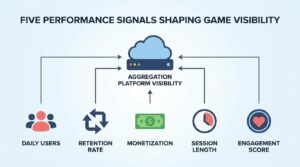
Infingame, a prominent aggregator operating across the iGaming supply chain, has outlined five critical factors it says now govern whether a game earns sustained exposure within modern aggregation ecosystems. The company argues that suppliers too often pour resources into launch campaigns while neglecting the post-launch performance indicators that actually drive long-term discoverability. With operators offering access to tens of thousands of titles through aggregation layers, the old strategy of winning through volume alone has quietly become obsolete.
Why Post-Launch Metrics Now Dictate Distribution Outcomes
Before examining the five factors, it’s worth understanding the structural shift behind them. Aggregation platforms have evolved from passive content pipelines into active curation engines. Operators rely on algorithmic and editorial signals to surface games from libraries that can exceed 15,000 titles. That means a game’s fate is no longer sealed at launch. It’s written in the weeks and months that follow, shaped by retention curves, session data, and player engagement patterns that most suppliers still treat as secondary metrics.
- Player retention rates outweigh launch-day impressions. Games that hold players beyond the first session receive preferential positioning in lobby algorithms. A title with modest launch traffic but strong return-visit data will, in practice, outperform a heavily marketed game that fails to retain.
- Session depth and engagement duration matter more than raw spin counts. Aggregators increasingly track how long players interact with a game per session, not just whether they open it.
- Supplier responsiveness to operator feedback loops, including localisation requests and market-specific configuration, directly affects whether a game stays visible or gets buried.
- Content strategy coherence across a supplier’s portfolio signals reliability to aggregation partners. Operators favour suppliers whose releases follow a recognisable quality arc rather than scattershot output.
- Technical stability and integration performance remain foundational. A game that loads slowly, crashes on mobile, or introduces latency into the aggregation layer will lose placement regardless of its creative merits.
The Discoverability Problem No One Talks About Enough
Consider the arithmetic. If an operator’s platform hosts 12,000 games and a player typically browses fewer than 30 before choosing one, that’s a visibility rate below 0.25%. For suppliers outside the top tier, the odds are even slimmer. And yet many studios continue to measure success by the number of operator integrations secured rather than by actual player-facing exposure once integrated.
This gap between integration and visibility is arguably the most consequential blind spot in the modern iGaming supply chain. Infingame’s aggregation platform processes data from thousands of titles across multiple operator environments, giving it a vantage point on which content strategies translate into sustained placement and which quietly disappear into lobby obscurity.
What makes this particularly tricky is that the rules aren’t static. Aggregation algorithms evolve. Operator priorities shift seasonally. A game optimised for one quarter’s lobby logic may underperform in the next.
How Suppliers Can Reframe Their Approach
The shift Infingame describes isn’t just operational. It’s psychological. Suppliers accustomed to measuring success by launch volume need to recalibrate around a fundamentally different feedback loop (a distinction that sounds obvious on paper but remains unevenly adopted across the industry). Here’s what that recalibration looks like in practice:
| Traditional Approach | Performance-Driven Approach |
|---|---|
| Maximise number of titles launched per quarter | Optimise each title’s post-launch retention and engagement metrics |
| Measure success by operator sign-ups | Track actual lobby placement and player-facing impressions across aggregation partners |
| Treat integration as the finish line | Treat integration as the starting point for a data-informed optimisation cycle |
| Generic global releases | Market-specific configuration and localisation aligned to operator needs in each jurisdiction |
Reading the Signals: What Separates Lasting Titles from Forgotten Ones
There’s a behavioural dimension to this that deserves attention. Players don’t consciously evaluate games the way procurement teams do. They respond to visual cues, load speed, early reward pacing, and the feeling of a game within the first 15 seconds. Suppliers who understand this layer of player psychology, who design not just for mechanics but for the micro-moments that determine whether someone stays or scrolls past, tend to produce titles with stronger retention curves.
Neuro-linguistic programming principles offer a useful lens here. The concept of anchoring, for instance, applies directly to game design: the first emotional impression a player forms during a game’s opening sequence creates a reference point that colours the entire session. Games that establish a positive anchor early, through satisfying audio feedback, a well-timed near-win, or a visually distinctive theme, generate stronger return rates. Reframing is another relevant principle. Suppliers who reframe their internal KPIs away from output volume and toward engagement quality often discover that fewer, better-optimised titles generate more cumulative revenue than a bloated catalogue ever did. The meta-model concept of challenging assumptions also applies: questioning whether “more titles equals more revenue” is genuinely true, or simply inherited wisdom, can unlock a more disciplined content strategy. Studios that embed these cognitive frameworks into both their design process and their commercial planning tend to build portfolios that aggregation platforms reward rather than bury.
Still, not every supplier has the data infrastructure to act on these insights. Smaller studios often lack real-time access to post-integration performance data, leaving them unable to iterate on live titles. Which raises a harder question: should aggregators themselves bear more responsibility for closing that feedback loop?
Frequently Asked Questions
What is an aggregation platform in iGaming?
An aggregation platform connects game suppliers with operators through a single technical integration, giving operators access to thousands of titles without needing to integrate each supplier individually. These platforms increasingly influence which games players actually see.
Why does post-launch performance matter more than launch volume?
Because aggregation platforms use engagement and retention data to determine lobby placement. A game that retains players will earn more visibility over time than one that generates a brief spike at launch and then fades. The economics of discoverability have shifted decisively toward sustained performance.
How can smaller suppliers compete for visibility?
By focusing on fewer, higher-quality releases with strong retention design, fast technical performance, and responsiveness to operator localisation needs. Data access remains a challenge, but suppliers who actively seek feedback from their aggregation partners can partially close the gap.
Do all aggregation platforms use the same ranking logic?
No. Each platform applies its own combination of algorithmic and editorial curation. What works on one may not translate directly to another, which is why suppliers benefit from understanding each partner’s specific signals rather than applying a one-size-fits-all strategy.



