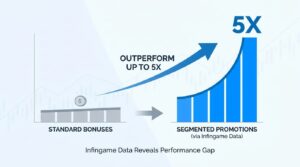
Infingame, a prominent aggregator in the iGaming space, has published new operational insights showing that the best-performing casino promotions generate up to five times higher player participation than conventional bonus-led campaigns. The findings point to a structural shift: operators who treat engagement as a data-driven lifecycle strategy are pulling sharply ahead of those still relying on blanket offers. The gap, according to Infingame, is not narrowing. It is accelerating.
What Infingame’s Operational Data Actually Shows
Before unpacking the strategic implications, here is what matters most from the aggregator’s findings. These takeaways distill the core patterns Infingame identified across operator activity:
- Segmented campaigns consistently outperform static promotions — tournaments and challenge-based formats built around player segments delivered participation rates up to five times higher than generic bonus drops
- Time-sensitive mechanics and real-time visibility emerged as critical engagement drivers, not just nice-to-have features
- Operators moving toward lifecycle-based engagement are widening the performance gap against those still running one-size-fits-all campaigns
- Clear progression structures within promotions (levels, milestones, visible tracking) correlated with sustained player activity rather than one-off spikes
- The data suggests that promotional design now functions as a competitive differentiator, not merely a retention tool
From Bonus Dumping to Behavioral Architecture
For years, the default operator playbook was straightforward: offer a deposit match, throw in free spins, hope for stickiness. That model is fraying. Infingame’s observations suggest that the operators seeing the strongest results have moved beyond transactional incentives and into what might be called behavioral architecture — designing promotional flows that respond to where a player sits in their lifecycle, not just whether they logged in today.
Segmentation sits at the heart of this shift. Rather than broadcasting a single promotion to an entire database, high-performing operators are slicing their player pools by activity level, game preference, deposit history, and engagement recency. The result: promotions that feel tailored rather than templated. And while the concept of segmentation is hardly new in digital marketing, its application in iGaming promotional strategy has been uneven at best (a distinction that Infingame’s data makes harder to ignore).
Tournament formats and challenge-based campaigns appear to benefit most from this approach. When players see a leaderboard that reflects their actual competitive tier, or a challenge calibrated to their play style, participation rates climb. Static bonuses, by contrast, tend to attract a burst of activity followed by rapid decay.
Why Time Pressure and Visibility Change the Equation
Two mechanical elements surfaced repeatedly in Infingame’s findings: time-sensitive structures and real-time progress tracking. Both tap into well-documented psychological drivers.
Time-limited promotions create urgency without requiring larger incentives. A 48-hour tournament costs the operator no more than a week-long one, yet the compressed window concentrates player attention. Real-time visibility — showing players exactly where they stand on a leaderboard or how close they are to a milestone — adds a feedback loop that sustains engagement across sessions. Players return not because they received a push notification, but because they have something unfinished.
This matters commercially. Sustained multi-session engagement is fundamentally more valuable than a single deposit spike triggered by a reload bonus.
The Psychology Behind High-Performing Promotions
What Infingame’s data hints at, arguably without stating explicitly, is that the most effective promotional strategies align with core principles of behavioral psychology and neuro-linguistic programming. Understanding how players perceive value, process information, and make decisions under uncertainty is no longer optional for operators who want to compete at the top tier.
Consider the principle of anchoring. When a player sees their position on a leaderboard relative to a prize threshold, that threshold becomes a cognitive anchor. Their behavior adjusts toward it. Progression mechanics exploit the goal-gradient effect — the closer someone perceives themselves to a reward, the more effort they invest. This is not manipulation; it is design literacy. Operators who understand these dynamics build promotions that feel engaging rather than extractive.
Framing matters too. A promotion described as “complete three challenges to unlock your reward” activates a different mental model than “deposit €50 to receive €25 free.” The first frames the player as an active participant with agency. The second frames them as a transaction. Even when the economic value is identical, the perceived experience diverges sharply. Operators working with iGaming aggregation platforms like Infingame are increasingly building campaigns that leverage these framing effects at scale.
Loss aversion plays a role as well. Time-limited campaigns implicitly signal that inaction has a cost. Not participating means missing out. But the effect only works when the promotion feels achievable. Calibration — matching difficulty to player segment — is what separates a compelling challenge from one that gets ignored.
Competitive Implications for Operators
The widening gap Infingame describes carries real strategic weight. Operators still running undifferentiated bonus campaigns are not just underperforming; they are training their player bases to be bonus-sensitive rather than brand-loyal. Every generic deposit match reinforces a transactional relationship. Every well-designed, segmented campaign builds something stickier.
| Promotion Type | Engagement Pattern | Player Retention Signal |
|---|---|---|
| Generic deposit bonus | Single-session spike, rapid decay | Weak — driven by incentive, not experience |
| Segmented tournament | Multi-session, sustained participation | Strong — players return to track progress |
| Time-limited challenge | Concentrated burst with higher intensity | Moderate to strong, depending on calibration and segment fit |
| Static free spins | Low-effort engagement, minimal behavioral shift | Weak |
Still, not every operator has the infrastructure to execute lifecycle-driven campaigns. Smaller brands often lack the data pipelines and segmentation tools required to move beyond basic CRM triggers. Whether aggregators and platform providers can democratize these capabilities remains an open question with significant market implications.
Frequently Asked Questions
What did Infingame’s data reveal about casino promotions?
Infingame found that segmented, data-driven campaigns — particularly tournaments and challenge-based formats — generated up to five times higher player participation than standard bonus-led promotions. The key differentiators were segmentation, progression mechanics, time sensitivity, and real-time visibility.
Why do segmented promotions outperform generic bonuses?
Because they match the offer to the player. A segmented promotion accounts for where someone sits in their lifecycle, what games they prefer, and how active they have been. Generic bonuses treat every player identically, which increasingly means they resonate with none of them particularly well.
How does time pressure affect promotional performance?
Compressed timeframes concentrate player attention and create urgency without requiring operators to increase the incentive value. The psychological cost of missing out drives participation in ways that open-ended promotions simply do not replicate.
Can smaller operators implement these strategies?
In theory, yes. In practice, it depends on access to segmentation tools, real-time data infrastructure, and promotional frameworks flexible enough to support lifecycle-based design. Aggregators and platform providers may play a growing role in closing that capability gap.



