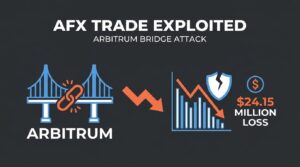
AFX Trade, a derivatives exchange that settles trades in USDC, lost approximately $24.15 million on July 22 when an attacker compromised a bridge the protocol operates on Arbitrum. Security firm Blockaid detected the exploit at 21:30 UTC and published its findings shortly after. The incident adds to a growing list of bridge-related vulnerabilities that continue to plague decentralized finance infrastructure, raising fresh questions about cross-chain security standards in an increasingly interconnected ecosystem.
What the $24.15 Million Bridge Exploit Reveals
Bridge attacks are not new. But they remain, arguably, the single most consequential attack vector in DeFi. Before diving into the specifics, here are the key strategic takeaways from this incident:
- Scale of loss: Approximately $24.15 million was drained, making this one of the larger bridge exploits recorded in 2025 so far.
- The exploit targeted a bridge operated by AFX Trade on the Arbitrum network, not the core exchange smart contracts themselves.
- Detection speed: Blockaid flagged the attack within what appears to be a narrow window, though the funds had already been extracted by the time the alert was published.
- USDC-settled derivatives protocols face heightened scrutiny as bridge infrastructure becomes a recurring weak point across Layer 2 ecosystems.
- The incident will likely intensify calls for standardized bridge auditing frameworks and insurance mechanisms within DeFi.
How the Attack Unfolded
According to Blockaid’s on-chain security monitoring platform, the exploit was identified at 21:30 UTC on July 22. The attacker targeted the bridge component that AFX Trade uses to facilitate cross-chain settlement on Arbitrum, a Layer 2 scaling solution built on Ethereum. Bridges, which lock assets on one chain and mint corresponding tokens on another, have historically been among the most vulnerable pieces of DeFi architecture.
What remains less clear is whether the vulnerability was in the bridge’s smart contract logic, its validator set, or some off-chain component. AFX Trade has not, at the time of this report, released a detailed post-mortem. That silence matters. In previous bridge exploits, the gap between incident and disclosure has often shaped both user confidence and regulatory response.
Why Bridges Keep Breaking
The pattern is by now familiar. Cross-chain bridges hold enormous pools of locked value, making them high-reward targets. Their security models often depend on multisignature schemes or validator networks that introduce trust assumptions most users never examine (a distinction regulators have been slow to enforce). The Ronin Bridge hack in 2022 cost over $600 million. Wormhole lost $320 million the same year. Nomad followed with $190 million.
And yet, bridge architecture has not undergone the kind of fundamental redesign these losses would seem to demand.
Part of the problem is structural. Bridges sit at the intersection of two or more blockchains, each with its own consensus mechanism and finality guarantees. Auditing a bridge means auditing not just the contract code but the assumptions about how each connected chain behaves under adversarial conditions. That complexity creates audit gaps. It also creates a false sense of security when a bridge passes a standard code review but fails under novel attack conditions.
Arbitrum’s Growing Security Footprint
Arbitrum has emerged as one of the most active Layer 2 networks, hosting billions in total value locked across lending, trading, and derivatives protocols. Its popularity makes it a natural target. More protocols deploying on Arbitrum means more bridges, more attack surface, and more capital at risk.
This is not a flaw in Arbitrum’s core design. The rollup itself inherits Ethereum’s security for transaction ordering and finality. But the bridges that connect Arbitrum-native protocols to other chains or to Ethereum mainnet operate outside that security umbrella. The distinction is critical, and frequently misunderstood by users who assume that deploying on a secure Layer 2 automatically means every component of their protocol shares that security.
What DeFi Participants Should Reassess
For institutional and retail participants alike, this exploit is a reminder that settlement infrastructure carries its own risk layer, separate from market risk or smart contract risk on the core protocol. Consider the following comparison of major bridge exploits:
| Incident | Year | Amount Lost | Network |
|---|---|---|---|
| Ronin Bridge | 2022 | $625M | Ronin / Ethereum |
| Wormhole | 2022 | $320M | Solana / Ethereum |
| Nomad | 2022 | $190M | Multiple chains |
| AFX Trade | 2025 | $24.15M | Arbitrum |
The dollar figure here is smaller than the headline-grabbing incidents of 2022. Still, $24.15 million is not a rounding error, and the persistence of bridge exploits three years later suggests the industry’s mitigation efforts have been insufficient at a systemic level.
Reframing Risk Perception in Cross-Chain DeFi
One underappreciated dimension of incidents like this is how they shape user psychology around decentralized systems. From a cognitive standpoint, repeated bridge failures create what behavioral researchers call “learned helplessness” in market participants. Users begin to accept exploits as inevitable rather than preventable, which in turn reduces the pressure on protocol teams to invest in robust security infrastructure. That cycle is self-reinforcing.
Breaking it requires a deliberate shift in how the DeFi community frames risk. Instead of treating bridge security as a binary question (audited or not audited), protocols and their users would benefit from adopting layered risk models. These models should account for validator trust assumptions, time-delay mechanisms on withdrawals, insurance coverage depth, and real-time monitoring capabilities like those AFX Trade’s derivatives settlement platform will now need to demonstrate it has strengthened.
Transparency plays a role here too. Protocols that publish detailed post-mortems within 48 hours of an incident tend to retain user trust more effectively than those that delay or obfuscate. The framing of the narrative around an exploit, whether it emphasizes accountability and remediation or deflects toward external factors, materially affects how capital flows respond in the weeks that follow. Perception, in DeFi as in traditional markets, is not separate from fundamentals. It shapes them.
Frequently Asked Questions
What exactly was exploited in the AFX Trade incident?
The attacker targeted a bridge that AFX Trade operates on the Arbitrum network, not the core derivatives exchange contracts. Bridges are cross-chain infrastructure components that lock and mint assets between networks, and they carry distinct security risks.
How much was stolen?
Approximately $24.15 million, according to security firm Blockaid.
Is Arbitrum itself compromised?
No. The exploit targeted a protocol-level bridge deployed on Arbitrum, not the Layer 2 rollup’s core infrastructure. Arbitrum’s consensus and finality mechanisms were not affected, though the incident highlights that applications built on secure networks can still carry independent vulnerabilities in their bridging components.
What should DeFi users do after an exploit like this?
Review exposure to any protocol that relies on the affected bridge. Monitor official channels for a post-mortem. And more broadly, evaluate whether the bridges you interact with have undergone recent audits, maintain bug bounty programs, and implement time-delayed withdrawal mechanisms that can limit damage during an active exploit.



