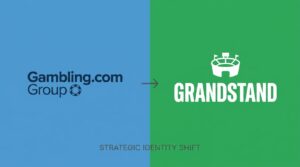
Gambling.com Group, the publicly listed performance marketing company specializing in online gambling affiliate services, has officially rebranded itself as Grandstand. The move signals a broader strategic repositioning for the company, which has built its reputation as one of the most recognized affiliate brands in the iGaming space. While the rebrand changes the corporate identity, the underlying business model and portfolio of digital properties remain intact. The timing suggests a deliberate effort to align the company’s name with an expanding scope of operations beyond its original gambling-centric roots.
What the Rebrand to Grandstand Actually Means for Stakeholders
Corporate rebrands in the affiliate marketing sector are rarely cosmetic. They tend to reflect shifts in market positioning, regulatory strategy, or investor messaging. Here’s what stands out about this particular move:
- The new name, Grandstand, distances the corporate brand from the word “gambling” at a time when regulatory scrutiny of gambling advertising and affiliate practices continues to intensify across multiple jurisdictions
- For investors, the rebrand may signal ambitions to diversify revenue streams into adjacent verticals such as sports media, fantasy sports, or broader entertainment
- Existing digital properties and affiliate websites operated under the group are expected to continue functioning under their established brand names
- The shift could improve the company’s positioning in markets where the word “gambling” carries stigma or triggers advertising restrictions
- Publicly traded affiliates face growing pressure to present themselves as technology and media companies rather than gambling-adjacent operators
A Name Change in Context
Rebranding is not new territory for iGaming affiliates. Several major players have undergone similar transformations over the past five years, shedding names that tied them too closely to gambling in favor of broader, more corporate-sounding identities. Better Collective, for instance, has long positioned itself as a sports media group rather than a pure-play affiliate. The pattern reflects an industry-wide recalibration.
But Grandstand carries a particular connotation worth noting. The word evokes spectacle, visibility, and a front-row seat, which arguably fits a company whose core business is directing consumer attention toward betting and gaming platforms. It’s a name that works across sports, entertainment, and digital media without boxing the company into a single vertical.
Still, whether the market reads this as substance or symbolism depends on what follows. A name alone doesn’t reshape a business.
Regulatory and Market Pressures Behind the Shift
The affiliate sector operates in an environment where advertising regulations are tightening year over year. The UK’s Gambling Commission has increased its focus on affiliate compliance. Italy and Spain have imposed strict rules on gambling advertising. And in the United States, where Grandstand has been expanding its affiliate footprint, state-level regulations vary dramatically, with some jurisdictions imposing outright bans on certain forms of gambling promotion.
Operating under a name that foregrounds “gambling” creates friction in these environments (a distinction regulators have been slow to formalize but marketers understand intuitively). Corporate names influence everything from banking relationships to advertising platform approvals. Google and Meta, for example, apply heightened scrutiny to gambling-related advertisers, and a corporate identity that reads as a media or technology brand may encounter fewer automated barriers.
| Factor | Under “Gambling.com Group” | Under “Grandstand” |
|---|---|---|
| Regulatory perception | Directly associated with gambling | Positioned as media/technology company |
| Ad platform compliance | Subject to heightened review triggers | Potentially smoother approval processes |
| Investor narrative | Niche gambling affiliate | Diversified digital performance marketing group |
| Expansion flexibility | Limited by name association | Broader scope for adjacent verticals, including sports media and entertainment content |
How Identity Shapes Strategic Perception
There’s a deeper layer to corporate rebranding that goes beyond regulatory convenience. The way a company names itself shapes how stakeholders, from institutional investors to potential acquisition targets, perceive its trajectory. Cognitive framing matters. When executives present to analysts under the banner of “Grandstand,” the conversation naturally gravitates toward growth, media scale, and platform strategy rather than defaulting to discussions about gambling regulation and compliance risk.
This principle extends to talent acquisition as well. The iGaming affiliate sector competes for software engineers, data scientists, and content strategists with mainstream tech and media companies. A corporate identity that reads as forward-looking and sector-agnostic removes a psychological barrier for candidates who might otherwise overlook the opportunity. In practice, the talent pipeline for a company called Grandstand looks different from one called Gambling.com Group, even if the job descriptions are identical.
And the effect compounds internally. Teams that see themselves as part of a performance marketing and media enterprise tend to think more expansively about product development, partnerships, and market entry. The rebrand, in this sense, functions as both an external signal and an internal catalyst. Whether leadership leverages that momentum into tangible diversification remains the open question.
Frequently Asked Questions
Does the rebrand affect Gambling.com Group’s existing websites?
No. The company’s portfolio of affiliate properties, including its flagship Gambling.com domain, continues to operate under their established names. The rebrand applies to the corporate parent entity.
Why did the company choose the name Grandstand?
The name positions the company more broadly across sports, entertainment, and digital media, reducing its association with a single vertical while retaining connotations of visibility and engagement.
Is this rebrand connected to any regulatory action?
The company has not indicated that the rebrand was prompted by any specific regulatory enforcement. It appears to be a proactive strategic decision aligned with broader industry trends toward corporate identity diversification among iGaming affiliates.
Will the company’s stock ticker change?
Details regarding any changes to the company’s Nasdaq listing or ticker symbol have not been confirmed at this stage.



