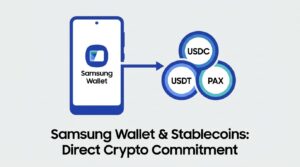
Samsung has signalled its entry into the stablecoin space. At the Galaxy Unpacked event held in London on July 22, Samsung product manager Lee Dinham confirmed that Samsung Wallet will expand to support stablecoins, marking the South Korean electronics giant’s first explicit commitment to the digital asset class. The announcement positions Samsung alongside a growing cohort of major technology firms integrating blockchain-based financial tools into consumer-facing products.
What Samsung’s Stablecoin Move Means for Digital Payments
Dinham’s remarks were brief but pointed. “Samsung Wallet will expand beyond cash and savings. It will embrace new forms of digital value,” he said during the event. That single sentence carries weight. It reframes Samsung Wallet not merely as a mobile payments app, but as a broader digital finance platform capable of handling tokenised assets.
Before unpacking the strategic implications, here are the core takeaways from the announcement:
- First formal crypto commitment: Samsung has experimented with blockchain features before (its Galaxy phones have included crypto wallet functionality since 2019), but this marks the company’s first public pledge to integrate stablecoins directly into its Wallet ecosystem.
- Consumer reach is massive: Samsung ships hundreds of millions of devices annually. Even modest adoption of stablecoin features across that installed base could move the needle for mainstream crypto usage.
- The timing aligns with a global regulatory push to define stablecoin frameworks, particularly in the EU under MiCA and in the United States where legislation remains in flux.
- Competitive pressure: Apple has deepened its financial services play through Apple Pay and the Apple Card. Samsung’s stablecoin integration could serve as a differentiator in markets where crypto adoption is already high, such as South Korea and parts of Southeast Asia.
Why Now?
Stablecoins have quietly become the most commercially viable segment of the crypto economy. Tether’s USDT and Circle’s USDC together process transaction volumes that rival some traditional payment networks. According to industry data, stablecoin transfer volumes exceeded $10 trillion in 2024. That kind of throughput has caught the attention of fintech incumbents and, increasingly, hardware manufacturers like Samsung.
And while Samsung’s blockchain experiments date back several years (a distinction worth noting, given how many firms have entered and exited crypto in that span), the company had never committed to a specific asset class until now. Previous efforts centred on the Samsung Blockchain Wallet, which supported select decentralised applications and token storage but remained a niche feature for crypto-native users.
Stablecoins represent something different. They sit at the intersection of traditional finance and decentralised infrastructure, which makes them a more palatable entry point for a consumer electronics company wary of the volatility associated with Bitcoin or Ethereum.
The Competitive Landscape Shifts
Samsung is not operating in a vacuum. PayPal launched its own stablecoin, PYUSD, in 2023. Visa and Mastercard have both expanded stablecoin settlement capabilities. Stripe recently re-entered the crypto payments space. The pattern is unmistakable: legacy financial infrastructure providers are building bridges to on-chain assets, and device manufacturers are following.
What remains less clear is how deep Samsung’s stablecoin wallet integration will go. Will users be able to send and receive stablecoins peer-to-peer? Will Samsung partner with a specific issuer like Circle or Tether? Will the feature be available globally, or restricted to markets with favourable regulatory conditions? Dinham’s comments at Galaxy Unpacked did not address these specifics.
Regulatory Timing and Strategic Positioning
The EU’s Markets in Crypto-Assets Regulation (MiCA) entered full application in late 2024, establishing clear licensing requirements for stablecoin issuers operating within the bloc. South Korea, Samsung’s home market, has also tightened its digital asset regulatory framework through the Virtual Asset Users Protection Act. Both developments arguably create a more predictable environment for a company like Samsung to operate in.
Still, regulatory clarity in some jurisdictions does not eliminate risk. The United States, one of Samsung’s largest markets, has yet to pass comprehensive stablecoin legislation. Any rollout there would need to navigate a patchwork of state-level money transmission laws and federal uncertainty. That tension between opportunity and regulatory fragmentation will likely shape Samsung’s go-to-market strategy.
How This Reshapes the User Experience
From a behavioural design standpoint, embedding stablecoin functionality into an app that hundreds of millions of people already use for contactless payments and loyalty cards lowers the cognitive barrier to adoption dramatically. Users do not need to download a separate crypto wallet, manage seed phrases, or interact with unfamiliar interfaces. The friction disappears.
This matters because adoption of new financial tools is rarely about technology alone. It hinges on trust, familiarity, and perceived simplicity. Samsung’s brand carries all three in consumer electronics. Translating that trust into financial services is the harder leap, but stablecoins (pegged to fiat currencies and relatively straightforward to explain) offer a smoother on-ramp than volatile tokens ever could.
Consider the framing Dinham used: “new forms of digital value.” Not “cryptocurrency.” Not “blockchain assets.” The language itself is a design choice, calibrated to normalise stablecoins within a broader digital finance narrative rather than positioning them as an alternative or speculative instrument. That linguistic framing, whether intentional or instinctive, mirrors how successful fintech products have historically crossed into mainstream adoption.
Frequently Asked Questions
Which stablecoins will Samsung Wallet support?
Samsung has not disclosed specific stablecoin partnerships or supported tokens. The announcement confirmed the category but left implementation details unaddressed.
When will stablecoin features launch in Samsung Wallet?
No timeline was provided at Galaxy Unpacked. Given the regulatory complexity involved, a phased rollout across select markets seems probable, though Samsung has not confirmed this approach.
Does this affect Samsung phone hardware?
Not directly. The integration targets Samsung Wallet, a software layer available across Samsung’s Galaxy device ecosystem. However, Samsung’s Knox security platform, which underpins device-level encryption, could play a role in securing stablecoin transactions.
How does this compare to Apple’s approach?
Apple has not announced stablecoin support for Apple Pay or Apple Wallet. Samsung’s move gives it a potential first-mover advantage among major device manufacturers, at least on paper.



