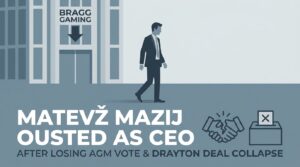
Bragg Gaming Group’s chief executive Matevž Mazij has been removed from his position after losing a shareholder vote at the company’s annual general meeting in June. The leadership shake-up arrived at a particularly turbulent moment for the B2B gaming supplier, coinciding with the unwinding of its proposed acquisition of Drayton International. The vote signals deep shareholder dissatisfaction with the strategic direction Mazij had charted, and it raises pointed questions about what comes next for a company caught between a failed deal and a leadership vacuum.
What Mazij’s Departure Means for Bragg Gaming’s Strategic Trajectory
The AGM result was not a routine governance exercise. Shareholders actively chose to deny Mazij the mandate to continue leading the company, a rare and decisive rebuke in the publicly traded gaming sector. Before unpacking the broader implications, here are the core takeaways from this leadership shift:
- Shareholder confidence collapsed visibly: Losing an AGM vote to continue as CEO is an unusually direct expression of investor discontent, one that bypasses the quieter mechanisms boards typically use to manage executive transitions.
- The Drayton International acquisition is effectively dead: The closure of the deal removes what had been positioned as a key growth lever for Bragg’s B2B portfolio.
- Bragg now faces a dual challenge of identifying new leadership while simultaneously recalibrating its M&A and organic growth strategy.
- Market perception risk is real: For a mid-cap gaming supplier, prolonged uncertainty at the top can erode partner confidence and complicate commercial negotiations already in progress.
The Drayton Deal: What Fell Apart
Bragg Gaming had pursued the Drayton International acquisition as a way to expand its operational footprint and diversify its revenue base. The deal, which had been in various stages of negotiation and due diligence, ultimately collapsed under circumstances that remain only partially disclosed. What the company has confirmed is that the transaction will not proceed.
That matters beyond the headline. Acquisitions in the iGaming B2B space are not just financial transactions; they carry integration assumptions, technology roadmaps, and client migration plans that take months to develop. When a deal of this nature falls through, the sunk costs extend well beyond advisory fees. Internal teams reallocate, product timelines shift, and the strategic narrative the company has been selling to investors suddenly needs rewriting.
Still, not every failed acquisition is a disaster. Some deals collapse because the acquirer’s board or shareholders correctly identify risks that management underweighted (a distinction that arguably applies here, given the AGM outcome).
Shareholder Revolt in the Gaming Sector: How Unusual Is This?
Losing an AGM vote as a sitting CEO is genuinely uncommon. Most executive departures in publicly listed gaming companies happen through board-level decisions, negotiated resignations, or quiet non-renewals. For shareholders to force the issue through a formal vote suggests that behind-the-scenes efforts to resolve the tension had already failed.
Bragg Gaming Group’s B2B platform serves multiple regulated markets, and its commercial relationships depend on perceived stability at the executive level. Partners evaluating long-term technology commitments want to know who they’re dealing with next quarter, not just this one. A contested leadership transition introduces friction into those conversations.
And while Bragg is not the first gaming company to experience boardroom turbulence, the timing here compounds the difficulty. Losing a CEO and a major acquisition in the same window narrows the company’s margin for error considerably.
What Bragg’s Next Move Likely Looks Like
The board will need to move quickly on two fronts: appointing interim leadership and clarifying the company’s revised strategic priorities. In practice, these decisions are deeply intertwined. The profile of the next CEO will signal whether Bragg intends to pursue further M&A, double down on organic product development, or explore a more fundamental restructuring of its business.
Several factors will shape that decision:
| Factor | Implication |
|---|---|
| Investor sentiment post-AGM | The board must demonstrate responsiveness to shareholder concerns or risk further activist pressure |
| Competitive positioning in B2B iGaming | Bragg competes against well-capitalised suppliers; leadership gaps can accelerate client attrition |
| Regulatory standing across markets | Licence holders in multiple jurisdictions face heightened scrutiny during governance transitions, and regulators may request additional disclosures |
| Cash position and deal pipeline | Without the Drayton acquisition, Bragg retains capital that could be redeployed, but the strategic rationale for deployment needs a new architect |
Reframing Leadership Transitions: The Psychology of Organisational Reset
Beyond the financial mechanics, leadership upheaval of this kind triggers a psychological recalibration across the entire organisation. Employees, partners, and investors all process uncertainty through different lenses, but the underlying pattern is consistent: when the person at the top changes involuntarily, every stakeholder re-evaluates their own position relative to the company.
For Bragg’s internal teams, the immediate question is whether the strategic projects they’ve been working on will survive the transition. Product managers building toward a roadmap shaped by Mazij’s priorities now face ambiguity about whether those priorities hold. This kind of uncertainty, if left unaddressed for even a few weeks, can slow decision-making at every level of the organisation. People wait. They hedge. They defer commitments that would otherwise move forward.
The board’s communication in the coming days will matter enormously. Clarity about interim governance, explicit reassurance to key commercial partners, and a defined timeline for permanent CEO appointment would go a long way toward stabilising sentiment. Yet what remains less clear is whether the board itself is aligned on direction, or whether the AGM vote exposed fractures that extend beyond the CEO role.
For the broader B2B gaming sector, this episode is a reminder that governance quality is not an abstract concern. It shows up in deal execution, in shareholder returns, and ultimately in whether a company can hold its position in an increasingly competitive market.
Frequently Asked Questions
Why did Matevž Mazij lose the AGM vote?
Shareholders voted against his continuation as CEO, reflecting dissatisfaction with the company’s strategic direction. The vote coincided with the collapse of Bragg’s acquisition of Drayton International, which likely intensified investor concerns about leadership effectiveness.
What happens to Bragg Gaming now?
The board is expected to appoint interim leadership while conducting a search for a permanent CEO. Strategic priorities, including whether to pursue further acquisitions or focus on organic growth, will likely be reassessed under new leadership.
Is the Drayton International deal completely off?
Yes. Bragg has confirmed the closure of the transaction. The capital that would have been deployed toward the acquisition remains available for redeployment, though the company has not yet outlined alternative plans.



