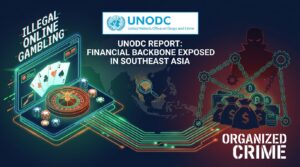
The United Nations Office on Drugs and Crime has published a sweeping threat assessment warning that unauthorised online gambling platforms across Southeast Asia have become central financial infrastructure for transnational organised crime. The report, titled An Interconnected Criminal Ecosystem: Transnational Organised Crime Threat Assessment for Southeast Asia 2026, maps how unregulated betting operations fuel illicit capital flows, exploit vulnerable populations, and resist enforcement at scale. What makes this assessment particularly urgent is its documentation of how predatory operators weaponise social media to recruit young users into debt spirals that feed directly into trafficking and forced labour networks.
What the UNODC Assessment Reveals About the Scale of the Problem
Before unpacking the strategic implications, it helps to understand the sheer breadth of what the UNODC’s transnational organised crime threat assessment covers. This is not a narrow gambling study. It frames illegal online betting as one node in a much larger criminal ecosystem spanning fraud, money laundering, human trafficking, and cyber-enabled crime. The convergence of these activities across the Mekong subregion and beyond has accelerated in ways that caught even seasoned analysts off guard.
- Unauthorised gambling platforms function as laundering vehicles: The report identifies unregulated betting sites as primary channels for moving illicit funds across borders, often exploiting weak regulatory frameworks in jurisdictions with limited digital enforcement capacity.
- Social media targeting of young demographics: Illegal operators use platforms like Telegram, Facebook, and TikTok to reach younger users with aggressive promotional tactics, pulling them into gambling habits that quickly escalate into unmanageable debt.
- Debt-trapped individuals are funnelled into criminal networks, including scam compounds where forced labour conditions have been extensively documented by international organisations.
- Cross-border enforcement remains fragmented: Despite bilateral agreements between several ASEAN member states, coordination gaps allow criminal syndicates to relocate operations with relative ease, often to special economic zones with minimal oversight.
- The financial throughput is enormous: While the UNODC has not released a single consolidated revenue figure for the region’s illegal gambling market, prior estimates from affiliated agencies have placed it in the tens of billions of dollars annually.
How Debt Cycles Become Trafficking Pipelines
One of the most disturbing threads in the report is the mechanism by which gambling debt converts into human exploitation. It works like this: a young person, often in their late teens or early twenties, encounters a gambling promotion on social media. The initial engagement is designed to feel low-risk. Small wins build confidence. Then the losses mount.
At that point, operators or affiliated recruiters offer a way out: employment abroad, typically in Cambodia, Myanmar, or Laos. What awaits is not employment but confinement in scam compounds where victims are forced to perpetrate online fraud against others. The cycle is self-reinforcing. Each new victim generates revenue that funds further recruitment.
This pattern has been corroborated by multiple investigations, including reporting from the BBC, Al Jazeera, and regional outlets. But the UNODC report is arguably the most systematic attempt to connect these dots at a policy level, linking gambling regulation failures directly to trafficking outcomes.
Why Traditional Enforcement Has Struggled
Part of the challenge is jurisdictional. Criminal syndicates operating illegal gambling platforms deliberately position themselves in areas where state authority is weak or contested. Myanmar’s border regions and certain special economic zones in Laos have become notorious hubs (a distinction regulators have been slow to enforce in practice). Even when one operation is shut down, the infrastructure migrates within weeks.
Digital enforcement adds another layer of difficulty. Many platforms operate through encrypted messaging apps and cryptocurrency payment rails, making transaction tracing resource-intensive. The report notes that while some Southeast Asian governments have invested in cyber-policing capabilities, the gap between state capacity and criminal sophistication continues to widen.
The Regulatory Landscape: Uneven and Under Pressure
Not every country in the region approaches the problem the same way. The Philippines, for instance, moved aggressively in 2024 to shut down Philippine Offshore Gaming Operators (POGOs), which had been linked to kidnapping, fraud, and money laundering. That crackdown displaced significant volumes of illegal activity, but much of it simply relocated rather than disappeared.
Cambodia banned online gambling in 2019. Yet enforcement has been inconsistent, and the country remains a major destination for scam compound operations. Vietnam and Thailand maintain strict prohibitions on most forms of gambling, but underground markets thrive.
| Country | Regulatory Stance | Key Challenge |
|---|---|---|
| Philippines | POGO ban enacted 2024 | Displacement of operations to neighbouring jurisdictions |
| Cambodia | Online gambling banned since 2019 | Persistent scam compound activity despite prohibition |
| Myanmar | Limited central authority in border zones | Criminal syndicates exploit governance vacuums in conflict-affected areas |
| Vietnam | Strict prohibition with limited licensed exceptions | Large underground market and cross-border digital access |
| Laos | Special economic zones with minimal oversight | SEZs function as de facto safe havens for illicit operators |
The asymmetry is stark. And it raises a harder question: can any single country’s crackdown succeed when the ecosystem operates regionally?
Reframing the Narrative: From Moral Panic to Structural Analysis
There is a tendency in public discourse to treat illegal gambling as a vice problem, something to be condemned and suppressed through willpower and policing. The UNODC report pushes back against that framing, at least implicitly. By situating gambling within a broader criminal economy that includes cyber fraud, money laundering, and human trafficking, the assessment demands a structural response.
That means investment in cross-border intelligence sharing, harmonised regulatory standards across ASEAN, and targeted disruption of the financial networks that make these operations profitable. It also means reckoning with the demand side. Young people across the region are drawn to these platforms not because they lack moral fibre, but because economic precarity and digital saturation create conditions ripe for exploitation.
Arguably, the most effective interventions will combine enforcement with economic opportunity. Shutting down a platform without addressing the vulnerability that drove users to it in the first place is a strategy with a short shelf life.
Frequently Asked Questions
What is the UNODC’s 2026 threat assessment about?
It examines how transnational organised crime operates across Southeast Asia, with a particular focus on how unauthorised online gambling platforms serve as financial engines for broader criminal networks including fraud, money laundering, and human trafficking.
Which countries are most affected?
Myanmar, Cambodia, Laos, the Philippines, and Vietnam feature prominently. Each faces distinct but interconnected challenges related to illegal gambling and associated criminal activity.
How does illegal gambling connect to human trafficking?
Operators use social media to lure young people into gambling debt. Once trapped, victims are recruited under false pretences to work abroad, where they end up confined in scam compounds and forced to commit online fraud. The connection is direct and well-documented.
Has any country successfully addressed the problem?
The Philippines’ POGO ban represents the most aggressive recent action, but displaced activity has surfaced in neighbouring countries. No single national approach has proven sufficient without regional coordination.



