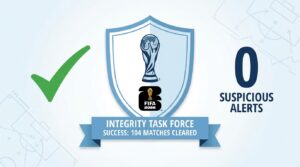
FIFA’s Integrity Task Force has wrapped up its operations for the 2026 World Cup, reporting zero instances of suspicious betting activity or match manipulation across all 104 fixtures of the expanded tournament. The task force monitored betting markets in real time across three host nations — Canada, Mexico, and the United States — while coordinating intelligence from law enforcement agencies, integrity monitoring firms, and regional confederations. For a competition that broke new ground with 48 participating teams, the clean bill of health carries weight far beyond a single tournament cycle.
What a Clean Integrity Record Means for the Expanded Format
Before the key findings, some context. The 2026 World Cup was the first to feature 48 teams, up from 32, which meant more matches, more participating federations, and arguably more surface area for integrity risks. That FIFA’s monitoring apparatus detected nothing suspicious across this larger footprint is not just a procedural footnote. It signals that the expanded surveillance framework scaled effectively, at least on paper.
- No suspicious betting patterns were flagged in any of the 104 matches, a result that covers group stages through the final
- Real-time market surveillance operated continuously across all three host countries, each with distinct regulatory environments for sports betting
- Intelligence was centralised from international law enforcement, private integrity firms, and all six regional confederations
- The task force’s mandate was broader than any previous World Cup cycle, reflecting the scale of the 48-team format
- FIFA’s integrity infrastructure now has a benchmark for future multi-host, expanded-format tournaments
How the Monitoring Architecture Actually Worked
The task force didn’t operate in isolation. Its structure relied on layered intelligence sharing between public and private entities, a model that has been refined over successive FIFA tournaments but never tested at this scale. Betting market data flowed in from licensed operators and monitoring partners, while on-pitch analysis flagged anomalies in player behaviour, substitution patterns, and scoring sequences. These streams were cross-referenced against intelligence from Interpol, national police forces, and confederation-level integrity officers.
What made the 2026 setup distinct was the tri-national hosting arrangement. The United States, Canada, and Mexico each maintain different legal frameworks for sports wagering. In the U.S. alone, the post-PASPA landscape means state-by-state regulation, which complicates any centralised monitoring effort. Yet FIFA’s integrity and compliance division managed to harmonise data collection across these jurisdictions without reported gaps.
Still, a question lingers beneath the surface: does the absence of detected activity mean the absence of activity itself?
The Betting Market Dimension
Global sports betting handle on the World Cup has grown substantially with each edition. The 2022 tournament in Qatar generated an estimated $35 billion in wagers worldwide, according to industry analysts. With 104 matches in 2026 (compared to 64 in 2022), the total handle almost certainly exceeded that figure, though official numbers have not yet been released.
| Tournament | Teams | Total Matches | Host(s) | Integrity Alerts |
|---|---|---|---|---|
| 2018 Russia | 32 | 64 | Russia | None reported |
| 2022 Qatar | 32 | 64 | Qatar | None reported |
| 2026 North America | 48 | 104 | USA, Canada, Mexico | None reported |
Three consecutive clean tournaments is a notable streak. But the regulated market represents only a fraction of total global wagering. Unregulated and offshore operators, which handle a significant share of World Cup bets in Asia and parts of Africa, remain harder to monitor (a distinction regulators have been slow to enforce uniformly).
Why Integrity Frameworks Shape Commercial Confidence
Broadcasting rights, sponsorship deals, and licensed betting partnerships all depend on one underlying assumption: that the competition is genuine. A single confirmed case of match-fixing at a World Cup would trigger cascading reputational and financial consequences across FIFA’s commercial ecosystem. The task force’s clean report, then, functions as more than compliance paperwork. It underwrites billions of dollars in contractual value.
And while FIFA’s commercial revenues for the 2023–2026 cycle were projected to exceed $11 billion, the integrity of the product is what keeps that number defensible. Sponsors and broadcasters negotiate on the premise that sporting outcomes are authentic. Any erosion of that premise reprices everything.
Reframing Integrity as Organisational Intelligence
There is a deeper pattern worth examining here, one that connects to how organisations build trust through structured transparency. In neuro-linguistic programming terms, FIFA’s integrity communication follows a strategy of anchoring — associating the World Cup brand with verified, data-backed assurances of fairness. Each clean tournament report reinforces a cognitive frame: this competition can be trusted.
That framing matters because trust is not binary. It accumulates through repeated signals. When FIFA publishes specific numbers — 104 matches, zero alerts, three host nations, six confederations consulted — it activates what NLP practitioners call representational specificity. Vague claims erode confidence. Precise ones build it. The task force report, by offering granular detail rather than broad reassurance, operates at a level designed to satisfy sceptical stakeholders: regulators, law enforcement, and commercial partners who need evidence, not rhetoric.
There is also a rapport-building dimension. By sharing intelligence bilaterally with national agencies and confederations, FIFA positions itself not as a unilateral authority but as a collaborative node in a larger network. This distributed model of credibility is harder to dismiss than top-down declarations. It mirrors what behavioural researchers describe as social proof at an institutional scale — the more independent parties validate the outcome, the stronger the collective belief in its legitimacy.
Whether this approach will hold under greater scrutiny as betting markets expand into new jurisdictions remains an open question. But for now, the architecture appears to be functioning as designed.
Frequently Asked Questions
Did FIFA detect any match-fixing at the 2026 World Cup?
No. The Integrity Task Force confirmed that no suspicious betting activity or indications of match manipulation were identified across any of the 104 fixtures.
How many matches were monitored during the tournament?
All 104 matches were subject to real-time surveillance, covering the entire tournament from group stages through the final.
Which organisations contributed to the integrity monitoring?
The task force drew intelligence from international law enforcement agencies, private integrity monitoring firms, and all six FIFA regional confederations. It was a layered, multi-jurisdictional effort — not a single-entity operation.
Does a clean report guarantee no manipulation occurred?
Not definitively. The report confirms that no suspicious patterns were detected through the monitoring systems in place. Unregulated betting markets, which fall outside the task force’s direct surveillance, remain a persistent blind spot for any integrity framework.



