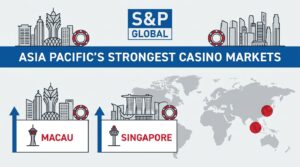
S&P Global Ratings has positioned Macau and Singapore at the pinnacle of its Asia Pacific casino market rankings, citing robust revenue recovery, regulatory stability, and concentrated operator strength. The assessment, which evaluates gaming jurisdictions across the region on credit fundamentals and market resilience, underscores how these two territories have pulled ahead of competitors in the post-pandemic landscape. For industry executives and investors tracking capital allocation across Asian gaming, the ranking carries weight well beyond symbolic status.
What S&P’s Regional Assessment Signals for Gaming Operators
Before diving into the specifics, it helps to frame what this ranking actually measures. S&P Global doesn’t simply tally gross gaming revenue. Its methodology layers in regulatory predictability, operator creditworthiness, market concentration risk, and the trajectory of tourism-driven demand. That composite lens makes the ranking a useful proxy for where institutional capital is likely to flow next.
- Macau’s gaming revenue rebound has outpaced most regional forecasts, with mass-market segments now driving a larger share of total GGR than before the pandemic
- Singapore’s duopoly structure (Marina Bay Sands and Resorts World Sentosa) continues to deliver high margins and stable cash flows, reinforcing its credit profile
- Jurisdictions with newer or less mature regulatory frameworks, including the Philippines and emerging markets in Southeast Asia, ranked lower on S&P’s scale
- The ranking implicitly favours markets where government policy and operator strategy are aligned on long-term capital investment
- Credit conditions for top-ranked markets suggest favourable refinancing environments for major operators heading into 2025
Macau’s Structural Shift Is the Real Story
Macau’s placement at the top is not surprising on the surface. But what makes this ranking notable is the underlying composition of its recovery. The territory’s gaming revenue mix has shifted decisively toward mass-market and premium mass segments, a transformation that began before COVID but accelerated through the concession renewal process in 2022–2023. VIP junket revenue, once the backbone of Macau’s GGR, has contracted sharply following regulatory crackdowns on junket operators and tighter capital controls from mainland China.
That shift arguably makes Macau a more stable credit story than it was five years ago. Mass-market revenue is less volatile, less dependent on a handful of high-rollers, and more closely tied to broad tourism trends. S&P’s framework rewards exactly this kind of structural de-risking. And while Macau’s total GGR has not yet fully recovered to 2019 levels, the margin profile and revenue quality have improved in ways that matter more to ratings agencies than headline numbers.
Still, risks remain. Macau’s near-total dependence on mainland Chinese visitors is a concentration vulnerability that no ranking methodology can fully neutralise. A slowdown in Chinese consumer spending or a tightening of travel policy could compress revenue quickly. Whether S&P has adequately weighted that tail risk is a question worth sitting with.
Singapore: Quiet Dominance Through Discipline
Singapore’s position alongside Macau reflects a different kind of strength. The city-state operates just two integrated resorts, yet generates per-property revenue figures that rival much larger markets. Marina Bay Sands, operated by Las Vegas Sands, and Resorts World Sentosa, under Genting Singapore, benefit from a tightly controlled licensing regime that limits supply and protects pricing power.
Both properties are in the midst of significant expansion projects. Marina Bay Sands is investing approximately $8 billion in a fourth tower, while Resorts World Sentosa has committed over S$6.8 billion to its RWS 2.0 redevelopment. These capital commitments, backed by strong balance sheets, signal operator confidence in long-term demand. S&P’s ranking reflects this forward investment posture as a credit positive (a distinction not every jurisdiction earns).
The regulatory environment in Singapore is predictable, transparent, and enforced with consistency. For ratings agencies, that predictability reduces the discount rate applied to future cash flows.
Where Other Asia Pacific Markets Stand
The Philippines, Australia, Japan, and South Korea all feature in S&P’s regional assessment, though none matched the top-tier positioning of Macau and Singapore. Each faces distinct headwinds:
| Market | Key Strength | Primary Risk Factor |
|---|---|---|
| Philippines | Growing tourist arrivals and expanding IR capacity | Regulatory framework still maturing; POGO-related reputational concerns |
| Australia | Established market with deep domestic demand | Ongoing regulatory upheaval following Crown and Star inquiries, creating uncertainty for operators |
| Japan | Massive untapped market potential | Only one IR project (Osaka) advancing; timeline and cost risks persist |
| South Korea | Foreigner-only casinos with stable revenue base | Limited growth catalysts and restricted domestic participation |
Australia’s situation is particularly instructive. What was once considered a blue-chip gaming jurisdiction has seen its credit narrative complicated by enforcement actions, licence reviews, and management upheaval at its two largest operators. S&P’s methodology penalises exactly this kind of regulatory turbulence.
How Capital Markets Will Read This Signal
Ratings agency assessments like this one don’t exist in a vacuum. They influence bond pricing, refinancing terms, and investor sentiment in measurable ways. For Macau’s six concessionaires, a strong jurisdictional ranking from S&P supports tighter credit spreads at a time when several operators are carrying elevated debt loads from the pandemic period. Sands China, Galaxy Entertainment, and Melco Resorts all stand to benefit from improved market perception, even if their individual credit profiles vary.
In Singapore, the implications are more straightforward. Both operators already carry investment-grade ratings, and the jurisdictional endorsement reinforces an existing narrative rather than creating a new one.
Frequently Asked Questions
What criteria does S&P use to rank Asia Pacific casino markets?
S&P evaluates a combination of revenue recovery trends, regulatory stability, operator credit profiles, market concentration, and forward capital investment commitments. It’s a composite view, not a single-metric ranking.
Why did Macau rank above larger markets like Australia?
Macau’s revenue recovery trajectory, its structural shift toward mass-market gaming, and the stability provided by the 2022 concession renewals all contributed. Australia, by contrast, faces significant regulatory uncertainty following high-profile enforcement actions against major operators.
Does this ranking affect how investors price gaming bonds?
Yes. Jurisdictional assessments from S&P feed into sovereign and corporate credit analysis. A top-tier ranking can support tighter spreads for operators domiciled in that market, particularly during refinancing windows.
Is Japan expected to rise in future rankings?
Potentially, but not soon. The Osaka IR project remains years from opening, and until a licensed property generates actual revenue, Japan’s ranking will reflect potential rather than performance.