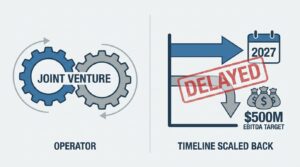
A joint venture operator has revised its strategic roadmap for reaching US$500 million in EBITDA by 2027, signalling a recalibration of growth expectations amid shifting market dynamics. The adjustment reflects both internal operational reassessments and external pressures that have forced the company to temper its original projections. While the target figure itself remains unchanged, the pathway to achieving it now looks markedly different from what was initially laid out. Stakeholders across the venture’s partner organizations are watching closely as the revised plan takes shape.
What the Revised EBITDA Plan Signals for Stakeholders
The decision to revise rather than abandon the US$500 million EBITDA goal carries a specific message: management still believes in the underlying business thesis, but acknowledges the original assumptions were too aggressive. Before unpacking the strategic detail, here are the core takeaways for executives and investors tracking this development:
- Timeline adjustment, not target reduction: The US$500 million figure stands, but the operational milestones required to reach it have been restructured around more conservative volume and margin assumptions.
- Capital allocation under review: Spending priorities are being reshuffled, with greater emphasis on cost discipline and selective reinvestment rather than broad expansion.
- Market conditions, including commodity price volatility and demand softness in key segments, appear to have driven the recalibration more than any single internal factor.
- Partner alignment remains intact: Joint venture partners have reportedly endorsed the revised plan, which suggests the revision was collaborative rather than contentious.
- Execution risk has shifted from growth-related challenges to efficiency and margin preservation, a distinction that matters for how analysts model the venture’s near-term performance.
Why the Original Plan Needed Reworking
When the US$500 million EBITDA target was first announced, it rested on a set of assumptions about market growth, pricing power, and operational scale-up that, in practice, proved optimistic. That gap between projection and reality is not unusual for joint ventures operating in capital-intensive sectors. But the speed at which conditions shifted caught several industry players off guard.
Commodity markets have been particularly unforgiving. Price swings over the past 18 months eroded margins in ways that static financial models failed to anticipate. And while demand in certain geographies held up, others underperformed relative to baseline forecasts. The cumulative effect: a plan that looked achievable on paper began to show stress fractures in execution.
Still, management’s willingness to revise publicly rather than quietly defer milestones suggests a degree of transparency that markets tend to reward (a distinction regulators have been slow to enforce across the broader sector).
Operational Levers the Venture Is Pulling
The revised plan reportedly centres on three operational priorities. First, a sharper focus on high-margin product lines, with lower-margin segments either scaled back or restructured. Second, procurement and supply chain optimization aimed at extracting cost savings without compromising output quality. Third, a more disciplined approach to capital expenditure, with projects now subject to higher return thresholds before approval.
Each of these levers carries its own risk profile. Concentrating on high-margin products, for instance, can expose the venture to demand concentration risk. And supply chain optimization, while conceptually straightforward, often runs into friction when multiple joint venture partners have competing supplier relationships.
What remains less clear is whether the venture plans to pursue any strategic acquisitions or bolt-on deals to accelerate its path to the target. Management has not ruled this out, but neither has it signalled active deal-making.
How the Financial Trajectory Compares
| Metric | Original Plan | Revised Plan |
|---|---|---|
| EBITDA Target | US$500m by 2027 | US$500m by 2027 (unchanged) |
| Revenue Growth Assumption | Double-digit annual growth | Mid-to-high single digits |
| Capex Approach | Aggressive expansion | Selective, ROI-gated investment |
| Margin Strategy | Volume-driven | Mix-driven, favouring higher-margin segments |
| Cost Reduction Target | Not specified in original plan | Reportedly 8–12% reduction across key cost centres |
Reading Between the Lines: Strategic Framing and Market Perception
How a company frames a revision matters almost as much as the revision itself. In this case, the joint venture operator has positioned the change as an evolution of strategy rather than a retreat. That framing is deliberate. Investors and partners respond differently to a narrative of “adaptive management” than they do to one of “missed targets.” The language used in internal communications and public disclosures will shape how capital markets price the venture’s equity and debt instruments going forward.
From a behavioural standpoint, this kind of reframing taps into a well-understood principle: certainty, even around a slower trajectory, reduces anxiety more effectively than ambiguity around an ambitious one. By anchoring the conversation to the unchanged US$500 million figure while adjusting the supporting assumptions, management preserves the aspirational signal while grounding it in credibility. That balance is difficult to strike. Many operators in similar positions have either clung to unrealistic targets too long or overcorrected into conservatism that depressed investor confidence.
The venture’s ability to maintain joint venture partner alignment through a strategic pivot also speaks to governance maturity. Disagreements over revised plans are a leading cause of JV friction globally, and the apparent consensus here suggests the partnership structure is functioning as designed.
Frequently Asked Questions
Has the US$500 million EBITDA target been reduced?
No. The target remains at US$500 million by 2027. What has changed is the operational and financial pathway to reaching it, with more conservative growth assumptions and a heavier emphasis on margin improvement over volume expansion.
What caused the revision?
A combination of commodity price volatility, softer-than-expected demand in certain markets, and an internal reassessment of capital allocation priorities. No single event triggered the change.
Does this affect the joint venture’s partnership structure?
Partners have reportedly endorsed the revised plan. There are no public indications of structural changes to the venture itself, though governance dynamics in multi-partner JVs can shift quickly when financial targets come under pressure.
What are the biggest risks to the revised plan?
Demand concentration from a narrower product focus, execution challenges in supply chain restructuring, and the possibility that even the revised growth assumptions prove too optimistic if macro conditions deteriorate further. Arguably, the margin-first strategy also leaves less room for error on pricing.



