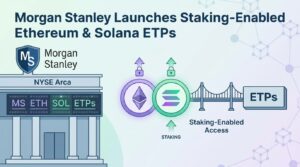
Morgan Stanley Investment Management has entered the spot crypto exchange-traded product arena with two new offerings: the Morgan Stanley Ethereum Trust and the Morgan Stanley Solana Trust, both listed on NYSE Arca. What sets these products apart from the growing field of crypto ETPs is their built-in staking mechanism, allowing portions of the underlying holdings to generate yield. The move signals a significant deepening of the Wall Street giant’s commitment to digital assets and positions the firm alongside a small but growing cohort of traditional finance players embracing on-chain yield strategies.
Why Morgan Stanley’s Crypto ETP Launch Matters for Institutional Investors
The listing of two staking-enabled spot crypto products by one of the world’s largest investment banks is not a routine product launch. It carries weight across several dimensions, from regulatory signaling to competitive positioning in an increasingly crowded digital asset management space.
- Staking as a differentiator: By incorporating staking into the trust structure, Morgan Stanley offers investors passive yield on top of price exposure, a feature most existing spot crypto ETFs in the U.S. have yet to integrate
- The choice of Solana alongside Ethereum reflects growing institutional appetite for assets beyond Bitcoin and ETH, broadening the investable crypto universe for traditional portfolios
- Regulatory confidence: Launching on NYSE Arca suggests the firm has navigated the compliance landscape with enough certainty to bring staking-enabled products to a regulated exchange (a distinction that matters given the SEC’s historically cautious stance on staking)
- Competitive pressure: Other asset managers offering spot crypto ETPs will now face pressure to match or exceed the yield component Morgan Stanley is building into its products
- The launch cements Morgan Stanley’s position as arguably the most aggressive traditional finance institution in the crypto ETP space
Staking Inside an ETP: What It Actually Means
Staking, in the context of proof-of-stake blockchains like Ethereum and Solana, involves locking up tokens to help validate network transactions. In return, stakers receive rewards, typically paid in the native token. For an ETP wrapper, this means the trust can generate additional returns for holders without requiring them to interact with blockchain infrastructure directly.
That sounds straightforward. But the mechanics inside a regulated trust structure are anything but simple. The trust must manage validator selection, slashing risk, liquidity constraints during unstaking periods, and the tax treatment of staking rewards. Still, the potential upside is clear: Ethereum staking yields have hovered between 3% and 4% annually, while Solana staking rewards have at times exceeded 6%.
For institutional allocators who already hold crypto exposure through ETPs, the addition of staking yield could meaningfully improve risk-adjusted returns over time.
How This Reshapes the Competitive Landscape
The U.S. spot crypto ETP market has expanded rapidly since the approval of spot Bitcoin ETFs in early 2024. Firms like BlackRock, Fidelity, and Grayscale have dominated headlines. But none of the major spot ETH ETFs currently approved in the U.S. include staking functionality, largely because the SEC had signaled discomfort with the feature during the initial approval process.
Morgan Stanley’s decision to launch with staking baked in suggests the regulatory winds may be shifting. Whether through formal guidance or informal signaling, the firm evidently concluded that the compliance risk was manageable. That calculation will not go unnoticed by competitors.
And while Morgan Stanley’s investment management division has been building crypto capabilities for several years, including offering Bitcoin fund access to wealth management clients as early as 2021, this launch represents a qualitative leap. Spot ETPs with yield are a different product category entirely.
The Solana Bet Deserves Its Own Scrutiny
Ethereum’s inclusion is expected. Solana’s is not, at least not from a firm of this size and regulatory profile. The Solana network has faced questions about decentralization, network outages, and its association with speculative memecoin activity. Yet its transaction throughput, low fees, and growing DeFi ecosystem have made it the second-most-watched Layer 1 blockchain after Ethereum.
By listing a Solana trust alongside Ethereum, Morgan Stanley is implicitly endorsing SOL as an institutional-grade asset. Whether the broader market agrees remains an open question.
Broader Implications for Digital Asset Adoption
Institutional adoption of crypto has followed a predictable arc: custody solutions first, then passive exposure products, and now yield-bearing instruments. Each step reduces the friction between traditional capital markets and blockchain-native financial infrastructure. Morgan Stanley’s latest move sits squarely at the frontier of that progression.
There are downstream effects worth tracking. Advisory platforms connected to Morgan Stanley’s wealth management network could begin recommending these trusts to high-net-worth clients. Pension funds and endowments with existing Morgan Stanley relationships may find it easier to justify crypto allocations when the product comes from a known counterparty with staking yield attached.
Frequently Asked Questions
What are the Morgan Stanley Ethereum Trust and Solana Trust?
They are spot exchange-traded products listed on NYSE Arca that hold Ethereum and Solana respectively, with a portion of holdings staked to generate additional yield for investors.
How does staking work within these ETPs?
The trusts lock a portion of their crypto holdings into proof-of-stake validation on the respective blockchains. Rewards earned through this process accrue to the trust, benefiting holders. Investors don’t need to manage any blockchain interaction themselves.
Is this the first U.S. crypto ETP with staking?
It is among the first from a major Wall Street institution. The regulatory environment around staking in ETP structures has been uncertain, making this launch particularly notable.
Why did Morgan Stanley include Solana?
Solana’s high throughput and growing ecosystem have attracted institutional interest despite concerns about network reliability. Its inclusion signals that Morgan Stanley views SOL as viable for regulated investment products, though not all market participants share that assessment.



