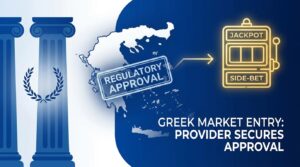
A side-bet jackpot specialist has reached a significant regulatory milestone by obtaining approval to offer its flagship product in Greece, one of Europe’s more tightly regulated gaming jurisdictions. The certification clears the path for the company to distribute its progressive jackpot solution across licensed operators in the Greek market. While the company’s name and specific product details remain limited in the source material, the move signals growing appetite among European regulators to accommodate innovative jackpot mechanics within their licensing frameworks.
What This Greek Certification Means for the Jackpot Sector
Securing regulatory clearance in Greece carries weight beyond a single market entry. The Hellenic Gaming Commission has historically maintained strict technical standards for gaming products, and approval there often serves as a credibility marker for operators evaluating new suppliers. Here’s what stands out from a strategic perspective:
- Market access in a growing jurisdiction: Greece’s regulated online gaming market has expanded steadily since its 2020 licensing overhaul, with operator revenues climbing year over year
- Side-bet jackpot products occupy a niche that sits between traditional table games and slot-style progressives, a category Greek regulators had not widely certified until recently
- Supplier diversification signal: Licensed Greek operators now have another tool to differentiate their live casino offerings, potentially driving higher player engagement metrics
- The certification could accelerate similar approvals in other Southern European markets where regulatory frameworks share structural similarities with Greece’s model
Greece’s Regulatory Landscape and Why Timing Matters
Greece overhauled its gambling regulatory framework in 2019–2020, replacing an older interim licensing regime with a permanent structure overseen by the Hellenic Gaming Commission (EEEP). Since then, the commission has granted licenses to a select group of online operators and imposed rigorous technical certification requirements on game suppliers. The bar for entry is not trivial.
That context makes this approval more than routine paperwork. Suppliers seeking Greek certification must demonstrate compliance with specific responsible gaming protocols, random number generation standards, and reporting obligations that align with EU-wide trends but carry Greece-specific implementation details (a distinction that has tripped up more than one aspiring market entrant). The fact that a side-bet jackpot product cleared these hurdles suggests the EEEP is becoming more comfortable with hybrid game mechanics that blend elements of traditional casino play with progressive pooled prize structures.
Still, questions linger about how quickly operators will integrate the product into their Greek-facing platforms.
How Side-Bet Jackpots Fit Into the Broader European Picture
Progressive jackpot products tied to side bets on live dealer games have gained traction across multiple European markets over the past three years. The mechanic is straightforward: players place an optional wager alongside their main bet, contributing to a pooled jackpot that triggers based on predefined outcomes. But the regulatory treatment of these products varies considerably from one jurisdiction to another.
In some markets, side-bet jackpots fall under standard table game certification. Others classify them as a separate product category requiring distinct approval. Greece, at least on paper, appears to have evaluated the product under its broader online gaming technical standards framework, which could simplify the path for similar products seeking entry.
| Market | Regulatory Approach to Side-Bet Jackpots | Status |
|---|---|---|
| Greece | Certified under EEEP technical standards | Newly approved |
| UK | Covered under existing Gambling Commission remote gaming rules | Active across multiple operators |
| Malta | Evaluated as part of MGA supplier licensing | Widely available |
| Italy | Subject to ADM certification with specific jackpot contribution transparency requirements | Selectively approved |
| Spain | DGOJ review required; limited precedent for hybrid products | Under evaluation for some suppliers |
Player Engagement and the Psychology Behind Jackpot Mechanics
From a behavioural standpoint, side-bet jackpots tap into well-documented cognitive patterns that drive player engagement. The optional nature of the wager creates what behavioural economists call a “low-cost lottery effect,” where the perceived value of a small additional stake is amplified by the possibility of a disproportionately large return. This asymmetry between risk and reward activates anticipation circuits that keep players engaged across longer sessions.
Operators have noticed. Internal data from several European-facing platforms suggests that tables offering side-bet jackpots see measurably higher average session durations compared to identical tables without the feature. And the effect compounds: visible jackpot tickers create social proof, signalling to other players that the prize pool is real and growing. That visual cue arguably does more for conversion than any banner ad.
Yet responsible gaming considerations remain front and centre. Regulators across Europe increasingly require that jackpot products include clear disclosure of contribution rates, win probabilities, and opt-out mechanisms. Greece’s approval likely came with such conditions attached, though the specific requirements have not been publicly detailed. The tension between engagement-driving mechanics and player protection obligations is one the industry has not fully resolved, and each new market entry reopens the conversation.
Frequently Asked Questions
What is a side-bet jackpot in live casino gaming?
A side-bet jackpot allows players to place an optional wager alongside their main bet on a live dealer game. Contributions from these side bets feed into a progressive prize pool that pays out when specific game outcomes occur. It adds a layer of excitement without altering the core game mechanics.
Why does Greek regulatory approval matter for gaming suppliers?
Greece maintains strict technical certification standards through the Hellenic Gaming Commission. Gaining approval there demonstrates a product meets rigorous compliance benchmarks, which can ease entry into other regulated European markets and build credibility with operators evaluating new suppliers.
How does Greece’s gaming regulation compare to other EU markets?
Greece’s 2020 regulatory overhaul brought its framework broadly in line with EU norms, though implementation details differ. Certification requirements are demanding, and the number of licensed operators remains relatively small compared to markets like the UK or Malta. That selectivity, however, means approved products carry a certain stamp of quality among industry participants.



