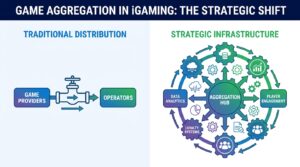
Game aggregation in the iGaming sector has quietly outgrown its original purpose. What began as a straightforward content distribution layer between studios and operators now functions as something closer to strategic infrastructure, shaping how platforms compete, retain players, and manage regulatory complexity across multiple jurisdictions. The shift carries real implications for operators evaluating their technology stack and for studios seeking efficient market access.
Why Aggregation’s Role in iGaming Demands a Second Look
The aggregation model has matured in ways that aren’t always visible from the outside. Below are the core strategic takeaways for operators, studios, and platform decision-makers navigating this space in 2025.
- Aggregation is no longer just about volume. The competitive edge now lies in data intelligence, compliance tooling, and personalisation capabilities bundled into the integration layer.
- Operators increasingly treat aggregators as compliance partners, not merely content pipelines, particularly in markets with fragmented licensing regimes.
- Studio economics are shifting. Smaller game developers gain access to dozens of operators through a single integration, but the terms of that access vary significantly depending on the aggregator’s market reach and negotiation leverage.
- Platform stickiness has become a key metric. Aggregators that offer engagement analytics and player behaviour insights are pulling ahead of those that simply catalogue games.
- The line between aggregation and platform technology is blurring, with some aggregators now offering full back-office functionality alongside content delivery.
From Catalogue to Control Layer
A decade ago, an aggregator’s value proposition was simple: plug in once, access hundreds of games. That pitch still holds, but it barely scratches the surface of what modern aggregation platforms deliver. Today’s leading aggregators provide real-time analytics dashboards, geo-targeted content filtering, and automated compliance checks that adjust game availability based on jurisdictional requirements. The transformation is less about adding features and more about repositioning the aggregator as a decision-making layer within the operator’s ecosystem.
And while the technology has matured, the business model has shifted in parallel. Revenue-sharing structures now often include performance-based tiers, where studios that generate higher player engagement receive preferential placement. This creates a feedback loop: better-performing content gets more visibility, which drives more engagement, which reinforces the aggregator’s value to both sides of the marketplace.
Regulatory Complexity as a Growth Driver
Here’s what often gets overlooked. The proliferation of regulated markets across Europe, Latin America, and parts of Asia hasn’t just created compliance headaches. It has made aggregators more essential. Each new jurisdiction brings its own technical standards, responsible gambling requirements, and content restrictions. For a mid-sized operator trying to launch in, say, Ontario and Brazil simultaneously, building direct integrations with 40 or 50 studios while satisfying two entirely different regulatory frameworks is prohibitively expensive.
Aggregators absorb that complexity. The best ones maintain jurisdiction-specific compliance modules that automatically filter content, enforce stake limits, and generate audit-ready reporting. That capability (a distinction regulators have been slow to formally recognise) turns the aggregator into a de facto compliance intermediary.
Not every aggregator delivers on this promise equally. Some still operate with a relatively thin compliance layer, leaving operators to handle the heavy lifting themselves. The gap between top-tier and mid-tier aggregators is widening precisely along this axis.
What Studios Actually Get From the Relationship
For game developers, aggregation solves a distribution problem that would otherwise require significant commercial and technical resources. A studio with a strong product but limited business development capacity can reach operators across multiple continents through platforms like those offered by SOFTSWISS game aggregation solutions, which bundle integration, compliance, and market access into a single relationship.
But the trade-off is real. Studios cede a portion of their revenue and, arguably more importantly, a degree of control over how their games are positioned and promoted. The aggregator’s algorithm decides visibility. That dynamic mirrors what happened in mobile app distribution years ago, where platform gatekeepers shaped which products reached consumers regardless of intrinsic quality.
Data, Personalisation, and the Next Competitive Frontier
The aggregators pulling ahead in 2025 are those investing in player-level data analytics. By tracking engagement patterns across thousands of game sessions, these platforms can recommend content mixes tailored to specific player segments. This goes beyond simple “players who liked X also liked Y” logic. Advanced aggregation platforms now model churn risk, session duration trends, and bonus sensitivity at a granular level.
Operators benefit because they receive actionable intelligence without building proprietary data science teams. Studios benefit because their games get matched to the audiences most likely to engage with them. The aggregator, sitting at the intersection, captures value from both directions.
Still, questions linger about data ownership.
Who controls the behavioural data generated through aggregated content? In practice, most aggregation contracts give the platform significant rights over anonymised player data, which it can then use to refine recommendations across its entire network. Whether studios and operators fully appreciate the long-term implications of that arrangement remains less clear.
Frequently Asked Questions
What is game aggregation in iGaming?
Game aggregation refers to a technology and business model where a single platform integrates content from multiple game studios and delivers it to operators through one unified API. It simplifies technical integration, reduces time-to-market, and increasingly includes compliance and analytics capabilities.
Why are aggregators becoming more important in regulated markets?
Each regulated jurisdiction imposes distinct technical and legal requirements on gaming content. Aggregators that maintain jurisdiction-specific compliance modules allow operators to enter new markets faster and with lower overhead than building direct studio integrations. The regulatory fragmentation across global markets has made this capability a genuine differentiator rather than a convenience.
Do game studios lose control by working through aggregators?
To some extent, yes. Studios trade direct operator relationships and full revenue capture for broader distribution and reduced commercial complexity. The degree of control retained depends heavily on the specific aggregation contract and the studio’s negotiating position.
How does aggregation affect player experience?
Players rarely interact with the aggregation layer directly. But behind the scenes, aggregation platforms influence which games appear in an operator’s lobby, how content is personalised, and how quickly new titles reach the market. The impact is indirect but substantial.



