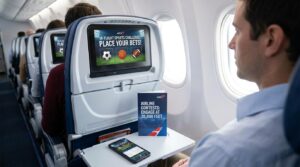
A growing number of airlines are rolling out in-flight sports prediction contests, giving passengers a new way to stay entertained and engaged during travel. The initiative taps into the intersection of live sports fandom and captive-audience marketing, offering carriers a fresh revenue and loyalty lever. While seatback screens and Wi-Fi have long defined the in-flight experience, this latest move signals a shift toward interactive, gamified content that treats passengers less like viewers and more like participants.
Why In-Flight Sports Engagement Matters for Airlines Right Now
The economics of passenger attention have changed. Streaming killed the advantage airlines once held as one of the few places people would watch curated content without distraction. In-flight entertainment systems now compete with personal devices loaded with downloaded shows and podcasts. That erosion of attention has made airlines rethink what their screens and connectivity platforms are actually for.
Sports contests offer something a pre-downloaded Netflix episode cannot: real-time interaction tied to live events. Here’s what makes this development strategically significant for the aviation and sports industries:
- Passenger dwell time becomes monetizable. Airlines can partner with sportsbooks, fantasy platforms, and sponsors to generate ancillary revenue from a captive audience averaging three to five hours per flight.
- Loyalty program integration. Contests tied to frequent flyer programs give carriers another tool to deepen customer stickiness without discounting fares.
- The model sidesteps regulatory complexity around actual gambling by framing participation as free-to-play prediction games rather than wagering.
- Brand partnerships unlock new sponsorship inventory. Sports leagues, teams, and consumer brands gain access to a premium demographic: travellers with disposable income and time to engage.
How the Model Works in Practice
The concept is deceptively simple. Passengers access a contest interface through the airline’s entertainment system or onboard Wi-Fi portal. They predict outcomes of live or upcoming sporting events, accumulate points, and compete against other passengers on the same flight or across the airline’s network. Prizes range from upgrades and lounge access to partner-branded merchandise.
What separates this from a standard trivia game is the emotional hook. Sports prediction activates a different kind of engagement (a distinction behavioural economists have studied extensively). Passengers aren’t passively consuming; they’re investing cognitive effort and emotional stake into outcomes. That investment translates into longer screen time, higher brand recall for sponsors, and a more memorable flight experience.
Still, execution matters enormously. Latency on in-flight Wi-Fi remains a constraint for truly live scoring. Some implementations work around this by focusing on pre-match predictions rather than in-play updates, which reduces bandwidth dependency while preserving the competitive element.
The Behavioural Science Behind Gamified Travel
Gamification in travel isn’t new. Hotel chains have used point-based reward tiers for decades, and ride-hailing apps deploy surge pricing psychology daily. But applying game mechanics to the in-flight environment draws on specific behavioural principles that make it particularly effective.
From a neuro-linguistic programming perspective, the contest framework activates several key mental patterns. The act of making a prediction triggers what psychologists call the “commitment and consistency” bias: once a passenger has made a pick, they become emotionally invested in the outcome, which sustains attention far longer than passive entertainment. The leaderboard mechanic, meanwhile, leverages social proof and competitive anchoring. Seeing other passengers’ scores creates a reference point that motivates continued participation.
There’s also a framing effect at work. By positioning the contest as a complimentary perk rather than a product, airlines bypass the mental resistance passengers feel toward being sold to mid-flight. The experience feels like a gift, not an ad. That reframing is critical for sponsor recall: brands embedded in a positive, voluntary experience benefit from associative conditioning that traditional seatback ads simply cannot replicate.
Language patterns matter too. Prompts like “Can you beat the cabin?” or “Predict the final score before landing” use embedded commands and presuppositions, subtly guiding passengers toward action without overt persuasion. These linguistic structures, well-documented in NLP research, reduce friction and increase opt-in rates. Airlines that calibrate their copy carefully will see measurably higher participation than those relying on generic “Play now” calls to action.
Regulatory and Market Considerations
One question airlines haven’t fully answered: where does a free prediction contest end and a gambling product begin? Jurisdictional complexity is real. A flight departing Las Vegas and landing in Dubai crosses multiple regulatory frameworks in a matter of hours. Most operators are navigating this by keeping contests strictly free-to-play, with no entry fee and no cash prizes.
But the line could blur. If international aviation trade bodies don’t establish clearer guidance, individual carriers risk patchwork compliance obligations that could limit scalability.
| Feature | Traditional IFE | In-Flight Sports Contest |
|---|---|---|
| Engagement type | Passive viewing | Active participation |
| Revenue model | Licensing fees to studios | Sponsorship and ancillary revenue |
| Personalisation | Limited genre selection | Sport and team preferences |
| Loyalty integration | Minimal | Points, upgrades, and tier credits |
| Bandwidth requirement | High (streaming) | Low to moderate (data-light interfaces) |
What Comes Next for Airlines and Sports Platforms
The early movers in this space will likely set the template. Airlines with strong existing Wi-Fi infrastructure and established sports media partnerships are best positioned. Carriers that already offer live TV channels onboard have the content pipeline; the contest layer is an incremental build, not a ground-up investment.
And while the immediate focus is on major leagues like the NFL, Premier League, and NBA, niche sports could prove surprisingly effective on international routes where passenger demographics skew toward cricket, rugby, or Formula 1 audiences. Personalisation at that level would be a genuine differentiator.
Whether this becomes a standard feature or a novelty depends on one thing airlines can actually measure: does it change booking behaviour? If passengers begin choosing carriers partly because of the in-flight contest experience, the model moves from entertainment line item to competitive advantage. That’s the threshold worth watching.
Frequently Asked Questions
Do passengers need to pay to participate in in-flight sports contests?
Most current implementations are free-to-play, designed as a complimentary perk rather than a paid product. Airlines avoid entry fees to steer clear of gambling regulations across jurisdictions.
Is live Wi-Fi required for these contests to work?
Not necessarily. Many platforms use pre-match prediction formats that require minimal connectivity. Real-time scoring updates depend on bandwidth, but the core experience can function with intermittent connections.
Can frequent flyer points be earned through these games?
Some airlines are exploring loyalty program integration, where contest participation or high leaderboard finishes earn bonus miles or tier credits. The specifics vary by carrier and are still evolving.



