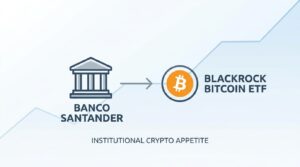
Banco Santander, one of Europe’s largest banking groups with over $16 billion in disclosed U.S. equity holdings, has reported a position in BlackRock’s iShares Bitcoin Trust (IBIT) for the first time. The disclosure, contained in a 13F filing submitted to the Securities and Exchange Commission on Wednesday, reveals 129,615 shares held by the Spanish lender. The move places Santander alongside a growing roster of traditional financial institutions quietly building exposure to spot Bitcoin ETFs, and it raises pointed questions about how quickly legacy banking is warming to digital asset products.
What Santander’s Bitcoin ETF Filing Actually Reveals
The 13F filing is a mandatory quarterly disclosure required of institutional investment managers overseeing more than $100 million in qualifying assets. Santander’s reported stake in IBIT, while modest relative to its total portfolio, carries outsized symbolic weight. This is not a fintech startup or a crypto-native fund. It is a 167-year-old bank headquartered in Madrid, operating across Europe, Latin America, and the United States.
At current market prices, the 129,615 shares represent a position worth several million dollars. Not transformative on its own. But the signal matters more than the size.
BlackRock’s iShares Bitcoin Trust has emerged as the dominant vehicle among spot Bitcoin ETFs approved by the SEC in January 2024, attracting tens of billions in net inflows within its first year. BlackRock’s digital assets division has positioned IBIT as the institutional-grade entry point for Bitcoin exposure, and Santander’s filing suggests that pitch is landing with exactly the audience it was designed for.
Why a Legacy Bank’s Crypto Exposure Deserves Scrutiny
European banks have historically been more cautious than their American counterparts when it comes to cryptocurrency-adjacent products. Regulatory frameworks across the EU, including the Markets in Crypto-Assets (MiCA) regulation that took full effect in late 2024, have created compliance guardrails that make direct crypto holdings cumbersome for traditional lenders. Spot Bitcoin ETFs, however, sit in a different regulatory category: they are SEC-regulated securities, traded on established exchanges, and custodied by familiar counterparties.
That distinction matters enormously. For a bank like Santander’s global operations, buying shares of IBIT is operationally no different from buying shares of any other U.S.-listed ETF. The compliance burden is minimal compared to holding Bitcoin directly. And the reputational risk, once considered prohibitive, has diminished as peers across the industry have taken similar steps (a shift that would have been nearly unthinkable two years ago).
Still, the filing does not clarify whether this position reflects proprietary trading, client-driven activity, or a strategic allocation decision made at the group level. That ambiguity is worth watching.
Institutional Momentum Behind Spot Bitcoin ETFs
Santander joins a lengthening list of institutional 13F filers disclosing Bitcoin ETF positions. Previous quarters have seen disclosures from sovereign wealth funds, pension systems, hedge funds, and major banks. The pattern is consistent: allocations tend to start small, often appearing as exploratory positions before scaling in subsequent quarters.
- BlackRock’s IBIT has accumulated the largest share of institutional inflows among all spot Bitcoin ETFs, surpassing $40 billion in assets under management
- 13F filings from Q1 2025 show a measurable increase in the number of institutional holders compared to Q4 2024
- European banks, previously absent from these filings, are now appearing with greater frequency
- The SEC’s approval of spot Bitcoin ETFs in January 2024 removed the single largest regulatory barrier to institutional participation
Strategic Implications for European Banking
When a bank of Santander’s scale takes even a small position in a Bitcoin-linked product, it creates permission structures for peers. Risk committees at comparable institutions will note the filing. Compliance teams will study the precedent. And portfolio managers who previously lacked internal approval to touch crypto-adjacent instruments may find the conversation easier to initiate.
This dynamic is not theoretical. It played out in the U.S. market throughout 2024, where early movers like Morgan Stanley’s wealth management division opened the door for broader adoption across wirehouses and RIAs. The European cycle appears to be following a similar trajectory, albeit with a lag measured in quarters rather than years.
Yet the competitive landscape in Europe is different. MiCA creates a unified regulatory framework that could, paradoxically, accelerate adoption once banks develop compliant infrastructure. What remains less clear is whether European regulators will view ETF-based crypto exposure with the same equanimity as their American counterparts, or whether additional guidance will follow.
Reading Between the Lines of a 13F
A 13F filing is a snapshot, not a strategy document. It tells you what an institution held at the end of a quarter, not why it held it or whether it still does. Positions can be hedged, offset, or liquidated the day after the reporting date. Analysts who treat these filings as definitive statements of conviction often overread them.
That said, the filing’s timing is notable. Bitcoin prices have shown renewed strength in 2025, and institutional appetite for regulated crypto exposure products has arguably never been higher. Santander’s disclosure lands in a market environment where the narrative around Bitcoin has shifted from speculative curiosity to portfolio diversification tool, at least on paper.
Frequently Asked Questions
What is a 13F filing?
It is a quarterly report that institutional investment managers with at least $100 million in qualifying assets must file with the SEC, disclosing their U.S. equity holdings.
How significant is Santander’s IBIT position?
In dollar terms, the 129,615-share stake is relatively small against Santander’s $16 billion-plus U.S. equity portfolio. Its significance lies more in what it signals about institutional comfort with Bitcoin ETF products than in the position’s absolute size.
Does this mean Santander is bullish on Bitcoin?
Not necessarily. A 13F filing reveals holdings at a point in time but does not disclose intent, strategy, or whether the position has since been adjusted. It could reflect proprietary interest, hedging activity, or client-related positioning.
Are other European banks making similar moves?
Increasingly, yes. While U.S. institutions led the early wave of spot Bitcoin ETF adoption, European banks have begun appearing in 13F filings with greater regularity since late 2024.



