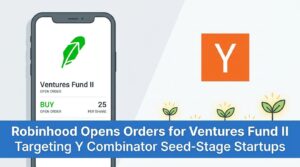
Robinhood began accepting orders on Monday for Robinhood Ventures Fund II, a closed-end fund priced at an expected $25 per share that channels retail investor capital into seed-stage startups emerging from Y Combinator’s accelerator pipeline. The move marks a deliberate escalation of the brokerage’s private-markets strategy, shifting from late-stage pre-IPO names toward far earlier, higher-risk venture bets. For an investor base historically locked out of institutional venture capital, the fund represents something genuinely uncommon: direct exposure to YC-backed companies through a regulated brokerage account.
What Robinhood Ventures Fund II Signals for Retail Access to Private Markets
Before parsing the mechanics, it’s worth stepping back to consider what this product actually tells us about where the retail brokerage industry is headed. Robinhood has spent the past two years layering on asset classes beyond equities and options. Crypto, retirement accounts, and now venture-stage private equity have each arrived in sequence. Fund II isn’t an experiment. It’s a thesis.
- Seed-stage exposure via a brokerage account: Retail investors can now participate in the earliest institutional funding rounds of Y Combinator startups without needing accredited investor status through traditional VC channels.
- Pricing at $25 per share lowers the nominal barrier to entry, though the closed-end fund structure means liquidity will be constrained compared to publicly traded ETFs.
- The Y Combinator connection provides a built-in deal-flow filter that institutional VCs have relied on for over a decade, lending the fund a sourcing advantage that most retail-facing products lack entirely.
- Robinhood’s shift from late-stage to seed-stage private companies suggests the firm sees sustained demand for venture-like returns among its user base, even at the cost of higher volatility and longer time horizons.
- Competitive positioning: Few if any major retail brokerages currently offer a comparable product, giving Robinhood a first-mover window in a segment that could attract regulatory scrutiny as it scales.
From Late-Stage to Day One: A Riskier Bet by Design
Robinhood’s first venture fund concentrated on later-stage private companies, the kind approaching IPO readiness with established revenue lines and institutional backing already in place. Fund II abandons that relative safety net. Seed-stage companies, by definition, operate with minimal revenue, unproven business models, and failure rates that dwarf those of Series B or C firms. The median YC startup doesn’t become a unicorn. Most don’t survive five years.
Yet the upside math is what draws institutional capital to seed investing in the first place. A single breakout from a diversified seed portfolio can return the entire fund many times over. That asymmetry has historically been reserved for accredited investors and venture partnerships with minimum commitments measured in six or seven figures.
Whether retail investors fully grasp the illiquidity and loss profile embedded in this structure remains an open question (and one regulators will almost certainly revisit as the product gains traction).
Y Combinator’s Role as Deal-Flow Engine
The fund’s connection to Y Combinator’s startup accelerator program is arguably its most distinctive feature. YC has produced companies including Stripe, Airbnb, DoorDash, and Coinbase. Its twice-yearly batches generate hundreds of startups, and the accelerator’s brand alone attracts founders who might otherwise bypass traditional incubators.
For Robinhood, tapping into this pipeline solves a problem that plagues most retail-facing venture products: sourcing. Without a credible deal-flow mechanism, closed-end venture funds risk filling portfolios with second-tier opportunities that institutional investors passed on. The YC affiliation doesn’t guarantee returns, but it does guarantee access to a curated, competitive startup cohort.
How the Closed-End Structure Shapes Investor Experience
Unlike open-end mutual funds or ETFs, closed-end funds issue a fixed number of shares during an offering period and do not continuously redeem them. Investors looking to exit before the fund’s lifecycle concludes would need to find a buyer, potentially at a discount to net asset value. This illiquidity premium is standard in venture capital but unfamiliar territory for many Robinhood users accustomed to instant trade execution on public equities.
The $25 share price keeps the entry point accessible. Still, the real cost isn’t the ticket price. It’s the time commitment and the possibility that capital remains locked while underlying portfolio companies either grow or fail over a multi-year horizon.
Broader Market and Regulatory Implications
Robinhood’s private-markets expansion arrives during a period of heightened regulatory attention to retail investor protections. The SEC has signaled ongoing interest in how platforms market complex or illiquid products to non-accredited investors. Fund II, structured as a closed-end vehicle rather than a direct startup investment, navigates some of those concerns by offering a pooled, diversified exposure rather than single-company risk.
But the seed-stage focus introduces a wrinkle. Early-stage venture portfolios carry inherent valuation uncertainty; markdowns and write-offs are routine, not exceptional. How Robinhood’s platform communicates these risks to its predominantly younger, mobile-first user base will likely shape regulatory responses as much as the fund’s actual performance does.
| Feature | Robinhood Ventures Fund I | Robinhood Ventures Fund II |
|---|---|---|
| Stage Focus | Late-stage private companies | Seed-stage (Y Combinator ecosystem) |
| Expected Share Price | Varied | $25 |
| Structure | Closed-end fund | Closed-end fund |
| Deal-Flow Source | Broader private market | Y Combinator accelerator batches |
| Risk Profile | Moderate-to-high | High, with significant illiquidity and failure rate exposure |
What This Means for the Democratization of Venture Capital
The language around “democratizing finance” has been overused to the point of meaninglessness in fintech marketing. And yet, Fund II does something concrete that most democratization rhetoric doesn’t: it places institutional-grade deal flow inside a consumer brokerage wrapper. The question isn’t whether demand exists. Robinhood’s user base has repeatedly demonstrated appetite for novel asset classes, from meme stocks to crypto to IPO access. The question is whether the product’s structure adequately protects investors whose experience with illiquid, high-failure-rate assets may be limited.
Venture capital’s historical returns have been driven by power-law distributions. A small number of outsized winners subsidize a large number of losses. Retail investors entering this dynamic for the first time through a $25-per-share fund may find the experience psychologically different from anything else in their portfolio. Patience, tolerance for paper losses, and a multi-year outlook aren’t traits the platform has traditionally needed to cultivate in its users.
Frequently Asked Questions
Who can invest in Robinhood Ventures Fund II?
The fund is available to Robinhood users through the platform’s order window. Specific eligibility requirements, including any accreditation thresholds, have not been fully detailed in the initial announcement, though the product’s retail positioning suggests broad accessibility.
How does the Y Combinator connection benefit the fund?
Y Combinator provides a curated pipeline of seed-stage startups that have passed through one of the most competitive accelerator programs globally. This gives Fund II a sourcing advantage over generic venture products, though it does not guarantee individual company success.
What are the liquidity constraints?
As a closed-end fund, shares are not redeemable on demand. Investors who wish to exit before the fund’s lifecycle ends would need to sell their shares, potentially at a price below net asset value. This is a fundamental difference from trading public equities on the same platform.
Is this fund suitable for all investors?
Seed-stage venture investing carries substantial risk, including total loss of capital in individual portfolio companies. The fund’s diversified structure mitigates single-company risk, but the asset class itself demands a long time horizon and comfort with significant uncertainty.



