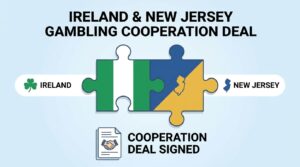
The Gambling Regulatory Authority of Ireland (GRAI) has entered into its first cooperation agreement with a US gambling regulator, formalising a partnership with New Jersey’s Division of Gaming Enforcement (DGE). The memorandum of understanding, announced in late May 2025, establishes a framework for information sharing, joint regulatory dialogue, and cross-border cooperation between the two jurisdictions. For Ireland’s still-maturing regulatory body, the agreement marks a deliberate step toward embedding itself within the global network of gambling oversight authorities.
What This Transatlantic Regulatory Pact Signals for the Industry
Cross-border cooperation agreements between gambling regulators are not new, but the pairing here is worth examining closely. Ireland’s regulatory framework for gambling is relatively young, with the GRAI only recently assuming its expanded mandate under the country’s reformed gambling legislation. New Jersey, by contrast, has operated one of the most active and commercially significant regulated online gambling markets in the United States since 2013. The asymmetry in experience is precisely the point.
- Regulatory intelligence exchange: Both authorities can now share compliance data, enforcement actions, and market intelligence, reducing the information gaps that operators sometimes exploit across jurisdictions.
- Operator accountability tightens: Companies licensed in both Ireland and New Jersey face a more connected oversight environment, making it harder to maintain inconsistent compliance standards between markets.
- The agreement positions GRAI to accelerate its own institutional learning by drawing on a decade of US online gambling regulation.
- Precedent for further deals: This is GRAI’s first US agreement, but it signals appetite for additional bilateral arrangements with other state-level regulators or international counterparts.
Why New Jersey, and Why Now?
New Jersey’s DGE has long served as a benchmark for US state-level gambling regulation. Its online gambling market generated over $2.3 billion in revenue in 2024, and the state has been a proving ground for regulatory technology, responsible gambling protocols, and enforcement mechanisms that other jurisdictions study closely. The New Jersey Division of Gaming Enforcement has also been proactive in signing cooperation agreements with regulators in the UK, Spain, and several other European markets.
For Ireland, the timing aligns with a critical phase of regulatory buildout. The GRAI has been working to establish its operational credibility since the passage of the Gambling Regulation Act. Signing a cooperation agreement with a regulator of New Jersey’s stature lends institutional weight to that effort. And while the agreement itself is a framework document rather than a binding enforcement treaty, the practical implications are real: it opens channels for regulators to flag problematic operators, share audit findings, and coordinate on emerging risks like unlicensed offshore platforms targeting both markets.
How Cross-Border Agreements Reshape Operator Strategy
Operators with licences in both jurisdictions should take note. In practice, these agreements mean that a compliance failure in one market can surface faster in the other. A pattern of consumer complaints in New Jersey, for instance, could prompt GRAI to scrutinise the same operator’s Irish operations, and vice versa. That kind of regulatory feedback loop didn’t exist before.
Still, the enforcement teeth of such agreements vary. Memoranda of understanding are not mutual legal assistance treaties. They facilitate cooperation but do not compel it. What they do accomplish is something subtler: they create a reputational and procedural expectation that regulators will talk to each other. For operators accustomed to treating each jurisdiction as a siloed compliance exercise, that shift matters.
| Aspect | Ireland (GRAI) | New Jersey (DGE) |
|---|---|---|
| Regulatory maturity | Early-stage; expanded mandate under recent legislation | Established since 2013 for online gambling; decades-long casino oversight |
| Market revenue (2024) | Figures not yet publicly consolidated under new framework | Over $2.3 billion in online gambling revenue |
| International agreements | First US cooperation deal | Multiple bilateral agreements with European and other regulators |
| Key regulatory focus | Building enforcement capacity, responsible gambling frameworks | Market integrity, anti-money laundering, platform compliance |
The Broader Architecture of Global Gambling Oversight
This agreement fits within a wider trend. Gambling regulators worldwide have been moving toward networked oversight models, recognising that the operators they regulate frequently hold licences across multiple jurisdictions. The International Association of Gaming Regulators (IAGR) has encouraged this kind of bilateral cooperation for years, and the proliferation of agreements (particularly between European and US state-level regulators) reflects a shared understanding that fragmented oversight creates exploitable gaps.
But not all cooperation agreements carry equal weight. Some remain largely ceremonial. Others, like the UK Gambling Commission’s arrangements with several US states, have led to tangible enforcement coordination. Where GRAI’s agreement with New Jersey lands on that spectrum will depend on how actively both parties use the channels it creates.
One question lingers beneath the surface: as Ireland’s gambling market matures and attracts more international operators, will the Gambling Regulatory Authority of Ireland’s cooperation framework expand quickly enough to match the pace of market entry?
What Operators and Stakeholders Should Watch For
The immediate practical effects of this agreement may be modest. The longer-term implications are harder to dismiss. Operators expanding into Ireland from the US market (or the reverse) now operate under a regulatory canopy that, at least on paper, connects their compliance records across the Atlantic. Investors evaluating multi-jurisdictional gambling companies should factor in the growing density of these regulatory networks when assessing compliance risk.
For GRAI, the agreement also functions as a credibility signal to the European regulatory community. Demonstrating that it can engage as a peer with an established regulator like New Jersey’s DGE strengthens its hand in future negotiations with bodies like the Malta Gaming Authority or the UK Gambling Commission.
Frequently Asked Questions
What does the GRAI-New Jersey cooperation agreement actually cover?
The memorandum of understanding establishes a framework for sharing regulatory information, coordinating on enforcement matters, and facilitating dialogue between the two authorities. It does not create binding legal obligations but opens formal communication channels that previously did not exist.
Does this affect operators licensed in both jurisdictions?
Yes, though the impact is indirect. Operators holding licences in both Ireland and New Jersey should expect greater regulatory visibility across markets. Compliance issues flagged in one jurisdiction could prompt scrutiny in the other.
Is this GRAI’s only international agreement?
This is its first cooperation agreement with a US regulator. Whether GRAI has finalised similar arrangements with European counterparts has not been widely detailed, though the authority has signalled interest in building a broader network of bilateral partnerships.
Why is this agreement significant for Ireland’s gambling sector?
Ireland’s gambling regulatory framework is still in its early stages. Partnering with a regulator as experienced as New Jersey’s DGE accelerates institutional development and sends a clear message to the market about GRAI’s intent to operate at an international standard.