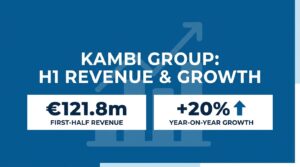
Kambi Group, the Stockholm-listed B2B sports betting technology provider, reported first-half 2024 revenue of €121.8 million, a 20 per cent increase compared to the same period last year. The growth reflects expanding operator demand for the company’s turnkey sportsbook platform across regulated markets in Europe, the Americas, and beyond. With major sporting events driving handle volumes and new client integrations coming online, the result positions Kambi among the stronger performers in the B2B betting infrastructure space this cycle.
What Kambi’s First-Half Numbers Signal for the B2B Betting Sector
A 20 per cent revenue jump in a maturing sports betting supply chain is not trivial. It speaks to both organic volume growth and the commercial traction of Kambi’s modular product offering, which allows operators to customise their sportsbook while relying on Kambi’s core pricing and risk management engine. Here are the strategic takeaways worth watching:
- Revenue hit €121.8m for H1, suggesting the company is on pace to challenge or exceed its full-year 2023 figures if second-half momentum holds
- The growth rate outpaces several publicly listed competitors in the B2B sportsbook segment, reinforcing Kambi’s positioning as a tier-one supplier
- Operator diversification across jurisdictions appears to be insulating the company from single-market regulatory risk
- Event-driven seasonality, particularly around Euro 2024 and Copa América, likely contributed to elevated handle volumes during Q2
- Whether this trajectory is sustainable beyond a major sporting calendar year remains an open question for investors
Revenue Drivers: More Than Just a Busy Calendar
It would be easy to attribute the uptick entirely to a packed summer of football. But that reading misses something. Kambi has spent the past 18 months deepening integrations with existing partners and onboarding new operators in markets where regulatory frameworks have recently stabilised. The Americas, in particular, continue to represent a growth corridor as US states and Latin American jurisdictions formalise their licensing regimes.
The company’s sports betting technology platform serves operators who prefer not to build proprietary trading and odds-compilation infrastructure from scratch. That value proposition has sharpened as the cost of in-house sportsbook development has climbed, and as regulators have tightened compliance expectations around pricing integrity and responsible gambling tools.
Still, not all of the tailwind is structural. A significant portion of H1 revenue correlates with turnover-based fees tied to major tournaments. The real test arrives in H2, when the sporting calendar thins and operator retention becomes the primary growth lever.
How Kambi Stacks Up Against Competitors
| Metric | Kambi (H1 2024) | Industry Context |
|---|---|---|
| Revenue | €121.8m | Among the highest for pure-play B2B sportsbook suppliers |
| Growth Rate | 20% YoY | Outperforms the estimated 10–14% sector average for B2B betting tech |
| Key Markets | Europe, Americas, select APAC | Broader geographic spread than most mid-tier rivals |
| Client Model | Turnkey + modular sportsbook | Increasingly common, though Kambi’s depth of trading capability remains a differentiator |
One cell in that table deserves emphasis. The modular approach (a distinction that separates Kambi from fully managed service providers) gives operators the flexibility to layer their own front-end experience on top of Kambi’s back-end engine. In practice, this has proven attractive to mid-size operators who want brand differentiation without the capital expenditure of a proprietary build.
Regulatory Landscape and Strategic Positioning
Kambi’s multi-jurisdictional footprint is arguably its most durable competitive advantage. Operating across dozens of regulated markets means the company has already absorbed the compliance costs that newer entrants are only beginning to face. And while regulatory fragmentation across the US and Europe creates operational complexity, it also raises the barrier to entry for would-be competitors.
The company has historically been cautious about entering grey or unregulated markets, a posture that limits short-term revenue upside but reduces exposure to enforcement actions or licence revocations. Whether that conservatism will hold as shareholder pressure for growth intensifies is worth monitoring.
The Psychology of Platform Dependence in B2B Betting
Beyond the financials, Kambi’s growth illuminates a broader behavioural pattern in the operator ecosystem. Choosing a B2B sportsbook provider is not purely a technical procurement decision. It involves anchoring bias, where early adoption of a platform creates switching costs that compound over time, both technically and psychologically. Operators who have built their trading workflows, reporting dashboards, and compliance processes around Kambi’s infrastructure face significant friction if they consider migrating to a competitor.
This dynamic creates what behavioural economists call an endowment effect: operators overvalue what they already have relative to alternatives, even when a rival platform might offer marginal improvements. For Kambi, this translates into high client retention rates and predictable recurring revenue, two metrics that matter enormously to institutional investors evaluating the stock.
Yet the same psychology cuts both ways. Operators locked into a single supplier may eventually resent the dependency, particularly if pricing power shifts. The most sophisticated operators are already hedging by maintaining parallel relationships with secondary providers or investing selectively in proprietary capabilities for high-margin sports. Kambi’s challenge is to keep the value equation compelling enough that the anchoring effect works in its favour rather than becoming a source of friction.
There is also a framing effect at play in how Kambi presents its growth narrative. A 20 per cent revenue increase sounds robust. Framed against the backdrop of a once-in-four-years European football championship, the number invites a different question: what does normalised growth look like without the tournament tailwind?
Frequently Asked Questions
What does Kambi Group do?
Kambi provides B2B sports betting technology, including odds compilation, risk management, and trading services, to licensed operators worldwide. It does not operate consumer-facing sportsbooks.
Why did Kambi’s revenue grow 20 per cent in H1 2024?
The increase reflects a combination of new operator integrations, geographic expansion into recently regulated markets, and elevated betting volumes driven by major sporting events such as Euro 2024. Disentangling the structural growth from the event-driven spike will require a closer look at H2 performance.
Is Kambi profitable?
Kambi has historically reported positive EBITDA margins, though profitability fluctuates with investment cycles and client onboarding costs. Specific H1 2024 profit figures were not detailed in the initial revenue disclosure.
Which markets does Kambi operate in?
The company holds licences or serves operators across Europe, multiple US states, and parts of Latin America and the Asia-Pacific region.



