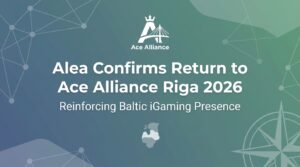
Alea has confirmed its participation at Ace Alliance Riga for the second consecutive year, marking a continued push into the Baltic and Northern European iGaming corridor. The event, scheduled for August 2026 in Barcelona, will once again serve as a meeting point for platform providers, operators, and regulatory stakeholders across the region. For Alea, the return signals more than routine conference attendance; it reflects a deliberate strategy to deepen commercial ties in a market segment that has seen accelerating regulatory maturation and operator demand.
What Alea’s Repeat Presence at Ace Alliance Riga Signals for the Industry
Returning to a regional event like this carries a different weight than showing up at a mega-conference. It suggests the company found tangible value in last year’s edition and sees the Baltic corridor as commercially viable enough to warrant sustained investment. Here’s what matters most:
- Strategic positioning in the Baltics: Alea is clearly betting that the Baltic and Nordic markets will continue to open up for B2B platform providers, particularly as Latvia, Lithuania, and Estonia refine their licensing frameworks.
- Relationship-driven growth: Ace Alliance Riga is a smaller, more curated event compared to ICE or SBC Summit. Repeat attendance points toward relationship continuity rather than broad lead generation.
- The timing, set against a backdrop of increasing regulatory harmonisation across the EU, gives platform providers like Alea a window to position themselves before compliance costs rise further.
- Competitive signalling: By committing early and publicly, Alea puts competitors on notice that it views this geography as core, not peripheral.
The Baltic iGaming Market: Why It Keeps Drawing Attention
Latvia’s gambling regulator, the Lotteries and Gambling Supervisory Inspection Board, has been progressively tightening and clarifying its licensing regime over the past three years. Lithuania and Estonia have followed similar trajectories. The result: a market caught between two frameworks, one legacy and one emerging, where operators need agile technology partners who understand local compliance nuances.
Gross gaming revenue across the three Baltic states has grown steadily, with Latvia alone reporting year-on-year online gambling revenue increases that have outpaced several Western European markets. That growth hasn’t gone unnoticed by B2B suppliers. And while the total addressable market remains modest compared to the UK or Germany, the margins and regulatory clarity make it attractive for mid-sized platform providers seeking less crowded verticals.
Still, not every supplier can compete here. The technical requirements around responsible gambling tools, player verification, and real-time reporting demand platforms built with compliance at the core rather than bolted on afterward (a distinction regulators have been slow to enforce uniformly, but one that separates serious entrants from opportunistic ones).
Ace Alliance Riga as a Regional Catalyst
Events like Ace Alliance Riga play a particular role in the iGaming ecosystem. They aren’t designed to generate thousands of leads. They exist to concentrate decision-makers in a room where deals move faster because the context is shared. For a company like Alea’s iGaming platform solutions, that environment arguably delivers more per-meeting value than a sprawling expo floor.
The 2025 edition reportedly drew a mix of Tier 1 operators with Baltic licenses and emerging brands exploring market entry. If the 2026 edition follows the same pattern, expect the conversation to shift toward cross-border licensing strategies and the technical infrastructure required to operate across multiple Baltic jurisdictions simultaneously.
How Platform Providers Can Frame Their Baltic Strategy
Beyond the event itself, Alea’s move raises a broader question about how B2B iGaming companies should think about regional market entry. The playbook that works in Malta or Gibraltar doesn’t automatically translate to Riga or Tallinn. Language, payment preferences, regulatory cadence, and player behaviour all differ in ways that demand localisation at the platform level.
Providers entering or expanding in the Baltics should consider several operational realities:
| Factor | Baltic Market Reality |
|---|---|
| Licensing timeline | Varies by jurisdiction; Latvia typically 3–6 months for established applicants |
| Payment methods | Bank transfers and local e-wallets dominate over card payments |
| Responsible gambling requirements | Increasingly prescriptive, with real-time session limits gaining traction |
| Language localisation | Essential; English-only platforms face significant adoption barriers |
| Tax structures | Competitive relative to Western Europe, though subject to periodic revision |
What remains less clear is whether the current wave of B2B interest will translate into long-term infrastructure investment or whether suppliers will treat the Baltics as a stepping stone toward the larger Scandinavian markets.
The Psychology of Market Commitment
There’s a behavioural dimension worth examining here. In NLP terms, Alea’s public recommitment to Ace Alliance Riga functions as a form of anchoring. By associating its brand repeatedly with a specific regional event, the company creates a mental shortcut for operators evaluating potential partners in the Baltic space. The repetition itself builds perceived authority.
This kind of strategic framing matters more than most suppliers acknowledge. Operators selecting technology partners don’t just evaluate feature sets; they assess commitment signals. Showing up once could be exploratory. Showing up twice communicates conviction. And conviction, in a market where switching costs are high and integration timelines stretch across quarters, carries real commercial weight.
The principle extends beyond event attendance. Companies that consistently reinforce their presence through localised content, regulatory engagement, and visible partnerships create what behavioural economists call a “mere exposure effect.” Familiarity breeds preference, particularly in B2B contexts where trust thresholds are high and vendor evaluation cycles are long. Alea’s approach, whether fully intentional or partly instinctive, aligns with this pattern. Each touchpoint in the Baltic market compounds the next.
But commitment signalling only works if it’s backed by operational substance. The gap between perceived presence and actual delivery capability is where reputations fracture.
Frequently Asked Questions
What is Ace Alliance Riga?
Ace Alliance Riga is a regional iGaming conference focused on the Baltic and Northern European markets. It brings together operators, platform providers, and regulatory professionals for focused networking and commercial discussions.
Why is Alea returning for a second year?
The company appears to view the Baltic corridor as a strategically important growth market. Repeat attendance suggests the 2025 edition delivered sufficient commercial value to justify continued investment in the event and the region.
Is the Baltic iGaming market growing?
Yes. Online gambling revenues across Latvia, Lithuania, and Estonia have shown consistent year-on-year growth, driven by regulatory clarity and increasing digital adoption among players. The market remains smaller than Western European counterparts but offers competitive margins and less supplier saturation.



