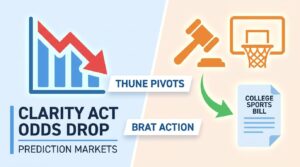
Prediction-market traders have sharply reduced the probability that the CLARITY Act will become law in 2025 after Senate Majority Leader John Thune sidestepped the crypto market structure bill on Tuesday night. Instead of filing cloture on the motion to proceed with the legislation, Thune filed cloture Wednesday morning on a college sports bill, signalling that crypto regulation has slipped down the Senate’s legislative priority list. The move sent a clear message to market participants tracking the bill’s trajectory on decentralized prediction platforms.
What the Senate’s Scheduling Shift Means for Crypto Legislation
The CLARITY Act, which aims to establish a comprehensive regulatory framework for digital asset market structure in the United States, had been gaining momentum in recent weeks. Traders on prediction markets had priced in a meaningful chance of passage this congressional session. But Thune’s decision to prioritize a college sports measure over crypto legislation caught many off guard, and the repricing was swift.
This isn’t just a procedural footnote. Filing cloture is the mechanism by which the Senate moves to end debate and advance a bill to a vote. When the Majority Leader chooses not to file cloture on a particular piece of legislation, it effectively stalls that bill’s path forward (a distinction that carries real weight in a chamber where floor time is a finite and fiercely contested resource).
- Prediction-market odds for the CLARITY Act’s passage this year dropped noticeably within hours of Thune’s scheduling decision becoming public
- The Senate’s pivot to a college sports bill suggests crypto market structure is not among the chamber’s near-term legislative priorities
- Industry stakeholders now face renewed uncertainty about when, or whether, a comprehensive digital asset framework will reach the Senate floor in this Congress
- The delay could affect ongoing regulatory postures at the SEC and CFTC, both of which have been operating in a legislative vacuum on crypto jurisdiction
- Prediction markets themselves have become a real-time barometer for legislative risk, offering a faster signal than traditional lobbying intelligence
Why Floor Time Matters More Than Rhetoric
Washington has produced no shortage of rhetoric around crypto regulation. Hearings, markup sessions, bipartisan statements of intent. Yet none of that translates into law without floor time in the Senate, and floor time is what Thune just redirected elsewhere.
The CLARITY Act would, at least on paper, delineate which digital assets fall under SEC jurisdiction and which belong to the CFTC. That jurisdictional question has been the central unresolved tension in U.S. crypto policy for years. Without legislative clarity, enforcement actions continue to serve as de facto rulemaking, a pattern that has drawn criticism from both industry participants and some members of Congress.
Still, the bill’s supporters argue the delay is tactical rather than terminal. Senate leadership may be sequencing legislation to build coalitions or avoid contentious votes ahead of other priorities. Whether that optimism holds depends on how the next several weeks unfold on the Senate calendar.
Prediction Markets as Legislative Intelligence
One underappreciated dimension of this story is the role prediction markets now play in pricing political risk. Platforms like Polymarket’s decentralized prediction trading platform have become increasingly sophisticated gauges of legislative probability, aggregating the collective judgment of traders who put capital behind their assessments.
The speed at which CLARITY Act odds moved tells us something. Traditional lobbying channels and policy newsletters might take days to fully digest a scheduling change. Prediction markets repriced within hours. For institutional players in the digital asset space, these platforms are arguably becoming essential tools for regulatory risk management.
How Stakeholders Should Read This Moment
For crypto firms, exchanges, and legal teams navigating the U.S. regulatory landscape, the signal here is uncomfortable but not catastrophic. Legislative delays are the norm in Washington, not the exception. And the CLARITY Act has not been shelved or voted down. It has simply been deprioritized, which is a different thing entirely.
That said, the practical consequences of delay compound. Every month without a market structure framework is another month of regulatory ambiguity, another month where firms must hedge against enforcement risk without knowing the rules they’re supposed to follow. The SEC’s approach to classifying tokens, the CFTC’s jurisdiction over spot markets: these questions remain open, and they remain expensive.
| Factor | Before Thune’s Decision | After Thune’s Decision |
|---|---|---|
| Prediction-market odds of CLARITY Act passage (2025) | Moderately favorable | Notably reduced |
| Senate floor time allocation for crypto bills | Expected near-term | Uncertain; displaced by college sports bill |
| Regulatory clarity for digital asset firms | Anticipated improvement | Status quo persists; enforcement-driven environment continues |
| Industry lobbying posture | Cautiously optimistic | Recalibrating strategy and timeline expectations |
The Broader Pattern Worth Watching
This episode fits a recurring pattern in crypto’s relationship with Congress. Momentum builds, expectations rise, and then some other legislative priority absorbs the oxygen. It happened with stablecoin legislation earlier. It happened with prior iterations of market structure bills. Each time, the industry recalibrates and the regulatory vacuum persists a little longer.
What makes this instance different, arguably, is the maturity of the prediction-market signal. Traders are not just speculating on outcomes; they are synthesizing procedural intelligence, vote counts, and scheduling dynamics into a single price. That price dropped. And when capital moves, it tends to be right more often than commentary.
Whether Thune circles back to the CLARITY Act later this session remains an open question. The bill’s sponsors have not signalled retreat. But in a chamber where attention is the scarcest commodity, losing your spot in the queue carries real cost.
Frequently Asked Questions
What is the CLARITY Act?
The CLARITY Act is proposed U.S. legislation designed to establish a market structure framework for digital assets, primarily by clarifying jurisdictional boundaries between the SEC and CFTC over different types of crypto tokens and trading activities.
Why did prediction-market odds change?
Senate Majority Leader John Thune chose not to file cloture on the CLARITY Act and instead advanced a college sports bill. Prediction-market traders interpreted this as a deprioritization signal, reducing the perceived likelihood of passage this year. The repricing happened within hours.
Does this mean the CLARITY Act is dead?
No. The bill has not been withdrawn or voted down. It has been delayed procedurally, which is common in the Senate. Its prospects depend on future scheduling decisions and whether leadership finds floor time later in the session.
How do prediction markets track legislation?
Traders on platforms like Polymarket place bets on whether specific legislative outcomes will occur by a given date. The resulting odds function as a crowd-sourced probability estimate, often reflecting procedural and political intelligence faster than traditional analysis.



