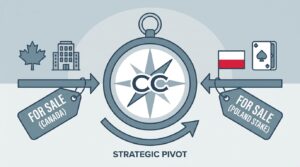
Century Casinos has put its Canadian casino portfolio and majority stake in Polish gaming operations on the block, signaling a potentially dramatic reshaping of the company’s geographic footprint. The Colorado-based operator disclosed the strategic review in connection with its latest quarterly earnings, citing a desire to streamline operations and reduce leverage. If completed, the divestitures would mark a decisive retreat from two international markets that have defined Century’s identity for decades. The timing coincides with mounting pressure on mid-cap gaming operators to sharpen capital allocation amid rising interest costs.
What Century’s Potential Divestitures Mean for Its Future
The announcement carries implications that stretch well beyond a simple asset sale. Century Casinos has long operated as one of the more geographically diversified small-cap casino companies, with properties spanning North America and Europe. Shedding Canada and Poland would concentrate the business almost entirely on its U.S. operations, a bet that domestic markets offer better risk-adjusted returns. Here’s what stands out from a strategic and financial perspective:
- Debt reduction is the primary driver. Century has flagged deleveraging as a core motivation, suggesting the company’s current capital structure limits its flexibility in a higher-rate environment.
- Canada’s gaming landscape is shifting. Provincial regulatory frameworks and increasing competition from online operators have complicated the economics for brick-and-mortar casinos in Alberta, where Century holds key assets.
- The Polish operations, while profitable, sit in a regulatory environment that has grown more restrictive over the past decade, particularly around slot machine and electronic gaming access.
- A U.S.-focused Century would likely trade at a different multiple, potentially unlocking value if investors view the remaining portfolio as simpler to model and less exposed to currency risk.
- Execution risk remains real. Finding buyers willing to pay a fair price for regional Canadian casinos and a Polish gaming stake is not guaranteed in today’s M&A climate.
The Canadian Portfolio: What’s Actually on the Table
Century’s Canadian footprint centers on properties in Alberta, including Century Casino & Hotel in Edmonton and Century Casino St. Albert, among others. These are mid-market regional casinos, not destination resorts. They serve local and repeat customers, which provides revenue stability but caps upside.
Alberta’s gaming market operates under the oversight of the Alberta Gaming, Liquor and Cannabis Commission (AGLC), which controls the allocation of gaming terminals and sets operational parameters. That regulatory structure means operators have limited ability to differentiate through product innovation. And while Century Casinos’ North American operations have generated steady cash flow, the Canadian segment faces headwinds from iGaming expansion in other provinces and a consumer spending environment that has softened in western Canada.
Still, regional casinos with established customer bases and real estate components do attract private equity interest. The question is price.
Poland: A Long History, a Complicated Exit
Century’s Polish operations represent one of the longest-standing international commitments by any U.S.-listed gaming company. The company has operated casinos in Poland for roughly three decades, navigating successive waves of regulatory tightening that have reshaped the country’s gambling sector.
Poland’s 2017 gambling law amendments significantly restricted the operation of slot machines outside casinos, consolidating the market but also limiting growth vectors. Century holds a majority interest in its Polish subsidiary, which operates several casino locations across the country. Profitability has held up, but growth has been constrained by regulatory ceilings on new licenses and gaming positions. Whether a European operator or investment group sees value in acquiring these assets depends heavily on their read of Poland’s regulatory trajectory (a distinction that has historically divided potential buyers).
How This Fits the Broader Mid-Cap Gaming Trend
Century is not alone in rethinking its portfolio. Across the mid-cap gaming sector, operators have been pruning international and non-core assets to focus capital on higher-margin domestic opportunities. Rising interest rates have made leverage more expensive, and investors have rewarded companies with cleaner, more concentrated stories.
That shift matters because it changes the competitive dynamics in the markets being exited. A sale of Century’s Canadian properties could introduce a new operator with different capital priorities, or it could consolidate ownership among existing provincial players. In Poland, the buyer’s identity could influence how aggressively the remaining assets are managed.
What remains less clear is whether Century’s U.S. portfolio alone generates enough scale to support the company’s public listing costs and corporate overhead. The company operates casinos in Missouri, West Virginia, and Colorado, along with newer operations acquired in recent years. These are solid regional assets, but they are not large.
Financial Context and What Comes Next
| Segment | Key Markets | Strategic Status | Primary Challenge |
|---|---|---|---|
| Canada | Alberta (Edmonton, St. Albert) | Under strategic review for sale | Regulatory constraints, iGaming competition |
| Poland | Multiple cities | Majority stake under review for sale | License caps, regulatory tightening since 2017 |
| United States | Missouri, West Virginia, Colorado | Core continuing operations | Scale relative to overhead and public company costs |
Century has not disclosed a timeline for completing any transaction, nor has it named advisors publicly. The company indicated that the review process is ongoing and that no outcome is assured. In practice, these processes can take six to twelve months from announcement to close, assuming a willing buyer emerges at acceptable terms.
Frequently Asked Questions
Why is Century Casinos considering selling its Canadian and Polish assets?
The company has cited deleveraging and operational simplification as primary motivations. Reducing debt in a higher interest rate environment and concentrating on U.S. operations are the stated goals, though the full strategic calculus likely involves investor pressure for a cleaner equity story as well.
Would Century Casinos remain publicly listed after the sales?
Century has not indicated any plans to go private. Its remaining U.S. casino portfolio would form the basis of its continuing operations, though questions about scale and overhead efficiency would likely intensify.
Who might buy these assets?
Potential acquirers could range from Canadian provincial gaming operators and private equity firms for the Alberta properties to European gaming groups for the Polish stake. No buyers have been publicly identified.
When could a deal be finalized?
No timeline has been disclosed. Based on comparable transactions in regional gaming, a process of this nature typically spans several quarters from announcement to regulatory approval and closing.