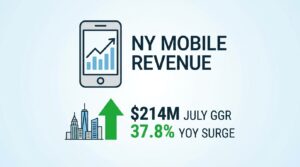
New York’s licensed mobile sportsbooks collectively generated $214.37 million in gross gaming revenue during July 2026, a 37.8% increase compared to the same month last year. The figure underscores the state’s continued dominance as the highest-grossing legal sports betting market in the United States. With handle volumes climbing and operator competition intensifying, the July numbers offer a revealing snapshot of where the market stands heading into the NFL preseason cycle.
What July’s Revenue Spike Signals for New York’s Betting Market
A nearly 38% year-over-year jump in GGR doesn’t happen in a vacuum. Several structural and seasonal factors converged in July 2026 to push revenue well above the prior-year baseline, and the implications extend beyond a single month’s performance.
- Handle growth outpacing expectations: Total wagers placed through mobile platforms rose significantly, suggesting deeper user engagement rather than simply more sign-ups
- Operator hold rates appear to have stabilized at levels favorable to the books, a trend that began in late 2025
- Tax revenue windfall: At New York’s 51% tax rate on mobile GGR, the state likely collected upwards of $109 million from July alone
- Summer betting activity, historically softer than fall and winter months, is showing structural resilience as bettors diversify into baseball, golf, and international soccer markets
- Competitive dynamics are shifting: The gap between top-tier operators and smaller entrants continues to widen, concentrating market share among a handful of platforms
The Tax Equation New York Can’t Ignore
New York’s 51% tax rate on mobile sports betting revenue remains the steepest in the country (a distinction that has drawn criticism from operators since launch). At $214.37 million in GGR, the state’s July tax haul likely exceeded $109 million before adjustments. That single-month figure rivals what some states collect in an entire quarter.
Yet the tax rate itself has become a point of tension. Operators have repeatedly argued that the rate compresses margins to a point where sustainable investment in the New York market becomes difficult. FanDuel and DraftKings, the two dominant platforms nationally, have both flagged New York’s tax structure in earnings calls as a drag on profitability. Still, neither has shown any inclination to exit. The volume is simply too large to walk away from.
Whether Albany revisits the rate structure remains an open question. Legislative appetite for change appears limited when the current framework delivers nine-figure monthly tax receipts.
How Operators Are Performing
Market concentration in New York has followed a pattern familiar across U.S. jurisdictions. FanDuel’s sportsbook platform and DraftKings together account for the vast majority of handle and revenue. Caesars, BetMGM, and other licensed operators compete for the remainder, though their combined share has been gradually shrinking.
| Metric | July 2026 | July 2025 | Change |
|---|---|---|---|
| Gross Gaming Revenue | $214.37M | ~$155.6M | +37.8% |
| Estimated State Tax (51%) | ~$109.3M | ~$79.4M | +37.8% |
| Market Leaders | FanDuel, DraftKings continue to hold dominant share | ||
One detail worth watching: smaller operators are increasingly relying on promotional spending to maintain visibility, which erodes their already-thin margins under New York’s tax regime. The math gets harder every quarter for platforms outside the top two.
Seasonal Patterns Are Evolving
July has traditionally been one of the quieter months on the U.S. sports calendar. No NFL. No March Madness. No NBA playoffs. And yet New York’s mobile books posted their strongest July on record.
Part of the explanation lies in product diversification. Operators have expanded their offerings into live betting, same-game parlays, and micro-markets that keep users engaged even during periods without marquee domestic sporting events. MLB remains the backbone of summer handle, but international soccer tournaments and golf majors are contributing meaningful volume that didn’t exist at this scale two years ago. The bettor base is maturing, and its appetite is broadening.
Reframing What Growth Means in a Maturing Market
A 37.8% year-over-year revenue increase sounds like a market still in its growth phase. But context matters here. New York launched mobile sports betting in January 2022, meaning the market is now more than four years old. Growth rates of this magnitude in a post-launch environment suggest something beyond novelty-driven adoption.
What’s arguably happening is a deepening of engagement among existing users rather than a flood of new ones. Average revenue per user metrics, while not publicly disclosed by most operators, are believed to be climbing. Bettors are wagering more frequently and across more event types. That behavioral shift carries implications for responsible gambling frameworks, which regulators have been slower to update than the market itself has evolved.
And while New York’s numbers command attention, they also raise a harder question for other states considering legalization: can any jurisdiction replicate this trajectory without New York’s unique combination of population density, disposable income, and brand-driven operator competition?
Frequently Asked Questions
How much tax does New York collect from mobile sports betting?
New York imposes a 51% tax on gross gaming revenue from mobile sportsbooks. Based on July 2026’s $214.37 million in GGR, the estimated tax collection for the month was approximately $109 million.
Which operators lead New York’s mobile sports betting market?
FanDuel and DraftKings hold the dominant share. Other licensed operators including Caesars Sportsbook and BetMGM compete for a smaller portion of the market, though their combined share has been contracting.
Why is July revenue significant if it’s traditionally a slow sports month?
It signals that the market is less dependent on the NFL and basketball postseason than it once was. Expanded betting products and growing interest in MLB, golf, and international soccer have reshaped seasonal patterns in ways that benefit operators year-round.
Is New York’s 51% tax rate likely to change?
There’s no active legislative effort to reduce it. Operators have lobbied for relief, but the state’s substantial monthly tax receipts make any reduction politically difficult to justify.



