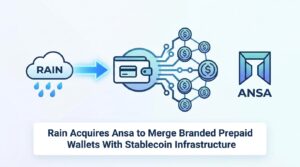
Stablecoin card issuer Rain has acquired Ansa, a startup that built software enabling merchants to operate their own branded prepaid wallets. The deal brings a fiat-native product into Rain’s crypto-adjacent ecosystem, pairing dollar-denominated stored-value wallets with stablecoin payment rails. Ansa’s technology allows customers to load dollar balances in advance and spend them exclusively at the issuing brand. Neither company has disclosed the financial terms of the transaction.
What Rain’s Ansa Acquisition Signals for Prepaid and Stablecoin Convergence
This acquisition sits at a crossroads that few players in either fintech or crypto have attempted to occupy directly. By absorbing Ansa’s merchant-facing wallet infrastructure, Rain gains a product that already operates in the traditional payments world, one that doesn’t require consumers to understand or even interact with blockchain technology. The strategic logic is worth unpacking:
- Fiat meets stablecoin plumbing: Rain now controls both a stablecoin card issuance layer and a fiat prepaid wallet product, creating optionality for merchants who want to start with dollars and potentially migrate to stablecoin settlement later.
- Merchant stickiness increases: Branded wallets lock in consumer spending at specific retailers. That closed-loop dynamic gives Rain a distribution channel that pure crypto card issuers typically lack.
- The deal positions Rain to serve merchants who aren’t yet ready for crypto but want the operational benefits of programmable money infrastructure.
- Competitive moat deepens: Combining stored-value wallets with stablecoin rails creates a hybrid offering that neither legacy prepaid providers nor crypto-native card issuers currently replicate at scale.
How Ansa’s Prepaid Wallet Model Works
Ansa built a platform that lets brands issue their own digital wallets, essentially white-labeled stored-value accounts. Customers deposit funds, and those balances can only be spent with the merchant that issued the wallet. Think of it as a modernized gift card system, but with reload capability, real-time balance tracking, and tighter integration into a brand’s loyalty ecosystem.
The model thrives on a simple behavioral insight: consumers who pre-commit funds to a brand spend more frequently and with less friction than those paying per transaction. That pre-commitment also reduces interchange costs for merchants, since wallet-funded transactions bypass traditional card networks. It’s a compelling value proposition for mid-market and enterprise retailers looking to cut payment processing expenses while deepening customer engagement.
Why This Matters Beyond the Crypto Narrative
Rain’s move isn’t just about adding a product line. It reflects a broader pattern in fintech where the boundary between traditional stored-value instruments and programmable digital currencies is dissolving. Stablecoins like USDC and USDT already function as dollar-pegged digital assets, and Rain’s stablecoin-powered card infrastructure has been designed to make spending those assets as seamless as swiping a Visa.
But here’s where Ansa changes the calculus. Most consumers don’t hold stablecoins. They hold dollars. By acquiring a product that already manages fiat balances in a closed-loop wallet, Rain can onboard merchants and their customers without requiring any crypto literacy at all. The stablecoin layer becomes invisible backend plumbing rather than a consumer-facing feature (a distinction that arguably determines whether crypto payments ever achieve mainstream adoption).
And while the crypto industry has spent years trying to convince retailers to accept digital assets directly, Rain appears to be approaching the problem from the opposite direction: start with what merchants already understand, then gradually introduce stablecoin settlement where it creates measurable cost savings.
The Behavioral Economics Behind Branded Wallets
Prepaid branded wallets tap into well-documented cognitive patterns that shape consumer spending. The mental accounting principle, first described by economist Richard Thaler, explains why money earmarked for a specific purpose gets spent differently than fungible cash. When a customer loads $50 into a coffee chain’s wallet, that money is psychologically “already spent.” The result: higher visit frequency and larger average order values.
This framing effect works in the merchant’s favor in another subtle way. Loaded balances create a sense of commitment. Customers who carry a wallet balance feel a pull to return and use it, reducing churn without requiring aggressive discounting. For Rain, integrating this behavioral layer into its payment stack means the company isn’t just processing transactions. It’s shaping purchasing patterns at the point where intent forms.
There’s also an anchoring dynamic at play. When consumers see a wallet balance, it anchors their spending expectations around that number. A $30 balance doesn’t just represent available funds; it frames the next purchase decision. Merchants who understand this can design reload incentives, bonus credits, and tiered rewards that exploit anchoring to drive incrementally higher spend per visit. Rain’s ability to layer programmable logic onto these wallets could make such strategies significantly more sophisticated than what legacy prepaid platforms offer.
What Remains Uncertain
Neither Rain nor Ansa has revealed whether Ansa’s existing merchant clients will be migrated to Rain’s infrastructure, or whether the two products will operate in parallel. The regulatory treatment of hybrid wallets that could theoretically hold both fiat and stablecoin balances also remains an open question, particularly as state money transmitter laws and federal stablecoin legislation continue to evolve in the United States.
Still, the acquisition’s timing is notable. It arrives as stablecoin transaction volumes hit record levels and as major payment networks explore their own stablecoin settlement capabilities. Rain’s bet seems to be that the winning position in this market won’t belong to the company with the best crypto product or the best fiat product, but to whoever stitches the two together most invisibly.
Frequently Asked Questions
What does Rain do?
Rain is a stablecoin card issuer that enables users to spend digital dollar assets through traditional card networks, bridging crypto wallets and everyday retail payments.
What was Ansa’s core product?
Ansa developed software allowing merchants to launch branded prepaid wallets where customers could load, store, and spend dollar balances exclusively with the issuing brand. Think of it as programmable gift cards with real-time infrastructure underneath.
Will consumers need to use stablecoins with Ansa’s wallets?
No indication suggests that. The acquisition appears designed to let Rain offer fiat-native wallet experiences on the front end while potentially using stablecoin rails on the back end, keeping the crypto layer invisible to consumers.
How does this affect merchants currently using Ansa?
That hasn’t been disclosed yet. Migration plans, if any, remain unannounced.



