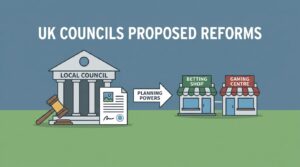
Local authorities across England could soon exercise significantly more control over where betting shops and adult gaming centres open, following proposed changes to planning regulations. The UK government has signalled its intent to repeal the permitted development rights that currently allow these premises to open without requiring a full planning application. While the move has been broadly welcomed by campaigners and local government bodies, the gambling industry warns it could create an uneven regulatory patchwork across the country.
What the Proposed Planning Changes Actually Mean for High Streets
The reforms under consideration target a specific planning mechanism that has long frustrated councils. Under current rules, a premises can convert from one use class to a betting shop or adult gaming centre without needing planning permission, provided it falls within the same use class category. This is known as permitted development rights. The proposed repeal would strip away that automatic entitlement, forcing operators to submit full planning applications before opening new venues.
That distinction matters more than it might appear on paper.
Full planning applications give councils the ability to assess factors like the concentration of gambling premises in a given area, proximity to schools, and the broader socioeconomic profile of the neighbourhood. At present, councils can only intervene reactively, often after a premises has already opened. The change would shift the balance of power decisively toward local planning authorities, giving them a gatekeeping role they have long requested. Whether every council has the capacity and resources to exercise that role effectively is a question the policy does not yet answer.
Strategic Implications for the UK Gambling Sector
Before unpacking the broader consequences, here are the core takeaways from the proposed reforms:
- Operators face a higher barrier to entry in new locations, with each site requiring individual planning approval rather than relying on automatic conversion rights
- Councils in areas with high gambling premises density could use the new powers to effectively cap the number of betting shops on their high streets
- Existing premises are unlikely to be affected, as the changes target new openings and conversions rather than retrospectively altering current licences
- The reforms align with a broader government agenda around community-led planning and public health considerations in land use decisions
- Industry groups have raised concerns about inconsistency, arguing that planning decisions could vary dramatically between neighbouring boroughs
Why Councils Have Pushed for This Change
For over a decade, local authorities have argued that permitted development rights undermine their ability to shape the character and wellbeing of their communities. In some London boroughs and northern English towns, clusters of betting shops have become a visible flashpoint in debates about high street decline, problem gambling, and deprivation. Councils like Newham and Haringey have previously attempted to use Article 4 directions to remove permitted development rights locally, but the process is cumbersome, time-consuming, and can expose councils to compensation claims from operators.
A national repeal would eliminate the need for that workaround entirely. And while the gambling industry has pointed to declining shop numbers as evidence that market forces are already addressing concentration, campaigners counter that the remaining shops are disproportionately located in lower-income areas (a pattern that planning data has consistently supported but that national policy has been slow to address).
How Gambling Operators Are Likely to Respond
Major operators such as William Hill’s parent company Evoke and Entain have already been shifting their strategic focus toward digital channels, where growth margins are substantially higher than in retail. The proposed planning changes could accelerate that pivot. Still, retail betting shops remain a meaningful revenue stream and serve as customer acquisition points for online platforms.
Smaller independent operators may feel the squeeze more acutely. Without the legal teams and planning consultants that larger firms can deploy, navigating a full planning application process for each new site adds cost and delay. The result: a market that arguably tilts further toward consolidation.
Retail vs. Digital: A Shifting Balance
| Factor | Retail Betting Shops | Online Platforms |
|---|---|---|
| Planning permission required | Yes (under proposed rules) | Not applicable |
| Customer acquisition cost | Higher per location | Variable, often lower at scale |
| Regulatory exposure | Local planning + Gambling Commission | Gambling Commission + digital-specific rules |
| Growth trajectory | Flat or declining | Expanding, particularly mobile |
| Community impact scrutiny | Significant and growing | Increasing but less geographically visible |
The Broader Regulatory Context Shaping This Moment
These planning proposals do not exist in isolation. They arrive alongside the UK government’s ongoing implementation of the Gambling Act review white paper, which has already introduced tighter affordability checks, stake limits for online slots, and enhanced data-sharing requirements between operators and the Gambling Commission’s regulatory framework. Taken together, the direction is unmistakable: a regulatory environment that is tightening across both physical and digital channels simultaneously.
Yet the planning dimension adds something the licensing regime alone cannot deliver. Licensing decisions made by the Gambling Commission focus on operator fitness and individual premises standards. Planning decisions, by contrast, allow councils to consider cumulative impact, neighbourhood character, and strategic land use priorities. The two systems address different questions, and arguably, both were needed all along.
What Communities and Stakeholders Should Watch For
The practical impact of these reforms will depend heavily on implementation details that remain unconfirmed. Several questions deserve close attention as the policy develops:
- Will the government provide transitional provisions for operators who have already committed to new sites under existing rules?
- How will councils resource the additional planning workload, particularly in areas with already-stretched planning departments?
- Could operators challenge refusals through planning appeals, and what precedent would early decisions set?
Community groups and public health advocates have framed the proposed changes as an overdue correction. For the gambling industry, the reforms represent another layer of friction in an operating environment that has grown markedly more complex since 2018’s FOBT stake reduction. Whether the planning system proves to be a blunt instrument or a precision tool will depend on how individual councils choose to wield it.
Frequently Asked Questions
Will existing betting shops be forced to close under the new rules?
No. The proposed changes apply to new openings and conversions. Premises already operating with valid licences and planning consent would not be retroactively affected.
Do these reforms apply across the entire UK?
The planning system in question is specific to England. Scotland, Wales, and Northern Ireland have devolved planning frameworks and would need to introduce separate measures if they wished to follow a similar path.
How long would a full planning application take for a new betting shop?
Standard planning applications in England typically take eight weeks for a decision, though contested applications or those requiring committee review can take considerably longer. Operators should factor in pre-application consultation time as well.
What role does the Gambling Commission play in planning decisions?
The Commission handles licensing, not planning. These are separate regulatory processes. A premises could, in theory, hold a valid gambling licence but be refused planning permission by the local authority, or vice versa.



