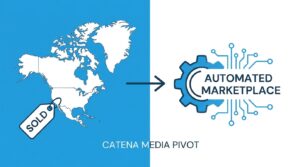
Catena Media, the Malta-headquartered performance marketing company, has announced plans to build an automated marketplace that will connect publishers directly with advertisers. The move follows the company’s divestiture of its North American sports and casino affiliate assets, a transaction that fundamentally reshaped its portfolio and strategic direction. With the proceeds and a leaner operational footprint, Catena is betting that automation and platform economics can replace the revenue streams it sold off. Whether that bet pays off depends on execution speed and market appetite for yet another ad-tech intermediary.
What Catena’s Marketplace Strategy Signals for Affiliate Marketing
The decision to construct an automated marketplace represents a sharp departure from Catena Media’s legacy model of owning and operating affiliate websites. Rather than generating leads through proprietary content properties, the company now aims to position itself as infrastructure, facilitating transactions between third-party publishers and advertisers at scale.
This matters for several reasons:
- Catena is shifting from an asset-heavy affiliate model to a platform-based, asset-light approach, reducing its exposure to Google algorithm changes and content depreciation
- The marketplace model could unlock recurring technology revenue, a more predictable income stream than performance-based commissions
- Publishers who previously competed with Catena’s own sites may now view the company as a neutral partner rather than a rival
- Advertisers gain access to a consolidated pool of traffic sources through a single integration point, potentially lowering customer acquisition costs
- The timing coincides with broader consolidation in the iGaming affiliate sector, where margins have tightened and regulatory costs have risen
The North American Exit: Context and Consequences
Catena Media’s sale of its North American assets was not a quiet retreat. The company had invested heavily in building a presence across U.S. and Canadian regulated markets, acquiring sports betting and online casino comparison sites during the post-PASPA expansion wave. But profitability proved elusive at the scale the company needed.
By divesting these properties, Catena freed up capital and management bandwidth. Still, the sale also removed the company’s most visible growth engine in what remains the world’s fastest-expanding legal gambling market. That tension sits at the heart of the marketplace pivot: can a technology platform generate the kind of returns that direct asset ownership in North America could not?
The company has not disclosed the full financial terms of the North American divestiture, though prior filings indicated the assets carried significant goodwill on Catena’s balance sheet. Impairment risks had been flagged in earlier earnings reports, suggesting the book value may have exceeded what the market was willing to pay.
How the Automated Marketplace Would Work
Details remain sparse, but the broad architecture follows a familiar ad-tech blueprint. Publishers would list their available inventory (traffic, leads, content placements) on the platform, while advertisers would set targeting parameters and bid for access. Automation handles matching, pricing, and reporting.
Think of it as a programmatic layer for affiliate marketing, a segment that has historically relied on manual negotiations, individual contracts, and relationship-driven deal-making. If Catena Media’s automated marketplace can reduce friction in that process, it could carve out a defensible niche (though the affiliate industry’s track record with similar platforms is mixed at best).
Key technical challenges include fraud prevention, traffic quality verification, and compliance with jurisdiction-specific advertising regulations. In regulated gambling markets, where advertising rules vary dramatically between states and countries, automating compliance is arguably the hardest engineering problem the platform will face.
Competitive Landscape and Market Positioning
Catena enters a crowded field. Established affiliate networks, ad exchanges, and SaaS platforms already serve portions of the publisher-advertiser relationship. Companies like Better Collective, Gambling.com Group, and various programmatic advertising platforms occupy adjacent territory.
| Factor | Catena Media Marketplace | Traditional Affiliate Networks |
|---|---|---|
| Revenue Model | Platform fees and transaction-based pricing | Revenue share or CPA commissions |
| Publisher Relationship | Neutral intermediary; no competing owned sites | Often operate competing properties |
| Automation Level | Fully automated matching and reporting | Varies; many rely on manual account management |
| Regulatory Compliance | Built-in compliance layer (planned) | Typically handled per-deal by individual parties |
| Scalability | High, if technology delivers on promise | Limited by human relationship capacity and operational overhead |
What remains less clear is whether Catena’s brand, which publishers have historically associated with direct competition, can credibly reposition as a neutral marketplace operator. Trust takes longer to build than technology.
Strategic Framing: Why Platform Thinking Reshapes Affiliate Economics
The affiliate marketing industry has long operated on a model where individual operators build content, drive traffic, and negotiate terms one advertiser at a time. This approach works, but it does not scale efficiently. And it concentrates risk: a single algorithm update or regulatory shift can wipe out months of revenue overnight.
Platform models distribute that risk differently. By aggregating supply and demand, a marketplace creates network effects. Each additional publisher makes the platform more attractive to advertisers, and vice versa. The operator captures value through facilitation rather than direct content creation. In practice, this means lower marginal costs per transaction as volume grows.
For Catena, the psychological shift may prove as significant as the operational one. The company’s leadership must move from thinking like a publisher, where editorial quality and SEO dominance drive outcomes, to thinking like an infrastructure provider, where reliability, neutrality, and developer experience determine adoption. These are fundamentally different organizational muscles. Companies that attempt both simultaneously often struggle with neither.
The affiliate sector’s evolution toward platform economics also reflects broader patterns in digital advertising. Fragmentation creates demand for aggregation. Aggregation creates demand for automation. Automation creates demand for trust and transparency. Each layer builds on the last, and the companies that control the connective tissue between buyers and sellers tend to extract durable margin.
Yet the graveyard of ad-tech startups that promised to “automate” relationship-driven industries is well populated. Catena’s advantage, if it has one, lies in its deep domain expertise in iGaming and its existing relationships on both sides of the transaction. Whether that institutional knowledge translates into a viable technology product is the question the next twelve months will answer.
Frequently Asked Questions
What is Catena Media’s new marketplace?
It is a planned automated platform designed to connect publishers who have advertising inventory with advertisers seeking traffic and leads, primarily in the iGaming and sports betting sectors. The system would handle matching, pricing, and compliance through technology rather than manual negotiation.
Why did Catena Media sell its North American assets?
The company divested its North American sports and casino affiliate properties to refocus its business model. Profitability challenges and balance sheet pressures, including potential goodwill impairments, contributed to the decision to exit direct asset ownership in the region.
How does this affect publishers currently working with Catena?
Publishers may actually benefit. Because Catena will no longer operate competing affiliate websites, it can position itself as a neutral platform partner. That said, the marketplace has not launched yet, and specific terms, fee structures, and onboarding timelines have not been publicly detailed.
When will the marketplace launch?
No official launch date has been announced. The company has indicated it is in the development phase, and further details are expected in upcoming earnings communications and investor updates.