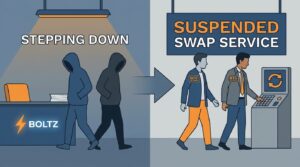
The original founding team behind Boltz, a non-custodial Bitcoin swap protocol, has exited the project after suspending operations due to security vulnerabilities. An unnamed group described only as “veteran Bitcoiners” has agreed to assume control of the platform, bringing fresh capital and engineering capacity to the effort. The transition, announced Wednesday, marks a rare and dramatic leadership change in the Bitcoin infrastructure space, where trust and continuity are tightly linked to founding teams.
What the Boltz Leadership Change Signals for Bitcoin Infrastructure
Swap services like Boltz occupy a specific niche in the Bitcoin ecosystem: they enable users to move funds between Bitcoin’s base layer and the Lightning Network without relying on a custodian. That function, while technically narrow, carries outsized importance for Lightning adoption and privacy-conscious users. A brief introduction to the strategic stakes before the key points:
- Founder departure under pressure: The original Boltz team stepped down amid unresolved security concerns, suggesting the vulnerabilities were serious enough to warrant a full leadership reset rather than a patch-and-continue approach.
- Anonymous successors raise questions: The incoming operators have not been publicly identified. In a space built on cryptographic trust, the absence of named individuals could slow user confidence recovery.
- Capital and engineering commitments from the new team indicate an intent to rebuild, not simply maintain.
- Service remains suspended: Work to identify and remediate vulnerabilities is ongoing, with no public timeline for resumption.
- Precedent for protocol governance: This handover could become a reference case for how small, critical Bitcoin services manage existential crises without a formal governance framework.
Why This Happened Now
Boltz had been operating as a relatively lean project, providing atomic swaps between on-chain Bitcoin and Lightning channels. The non-custodial Bitcoin swap platform carved out a loyal user base precisely because it avoided holding user funds. But lean operations also mean thin margins for error.
When vulnerabilities surfaced, the founding team chose to suspend the service entirely. That decision, while disruptive, likely prevented a worse outcome. Still, the founders’ subsequent departure suggests the technical debt or reputational damage (or both) exceeded what they were willing or able to absorb.
The identity of the incoming operators remains undisclosed. The company’s announcement characterized them as experienced participants in the Bitcoin ecosystem, but offered no verifiable credentials. Whether this anonymity reflects operational security norms common in Bitcoin circles or something less reassuring is a question the market will answer with its behaviour once the service relaunches.
The Mechanics of a Protocol Handover
Unlike a corporate acquisition with regulatory filings and shareholder votes, this transfer appears to have been negotiated privately. There is no indication of a token sale, equity transaction, or formal merger. The new operators are contributing capital and engineering talent in exchange for control of the codebase and brand.
That informality is both a feature and a vulnerability of Bitcoin-native projects. Speed and flexibility come at the cost of transparency. And while Boltz’s non-custodial architecture means user funds were never directly at risk from the leadership change itself, the suspended service has left a gap in the Lightning Network’s tooling layer that competitors may already be filling.
Competitive Landscape
| Service | Type | Custodial | Status |
|---|---|---|---|
| Boltz | Atomic Swap (BTC ↔ Lightning) | No | Suspended |
| FixedFloat | Multi-asset Swap | Partial | Operational |
| PeerSwap | Lightning Channel Rebalancing | No | Active (limited scope) |
| Deezy | Lightning-to-on-chain | No | Active, though narrower feature set than Boltz at peak |
Trust, Perception, and the Psychology of Recovery
Rebuilding user trust after a security incident is never purely technical. It requires deliberate communication, visible accountability, and, arguably most important, time. The psychology here follows patterns well understood in behavioural frameworks: users anchor their perception of risk to the most recent negative event, and that anchor shifts slowly regardless of how thorough the remediation is.
For the new Boltz operators, the challenge is compounded by their anonymity. Trust in open-source Bitcoin projects typically flows through one of two channels: reputation of named contributors, or verifiable code quality over extended periods. The incoming team starts with neither, at least publicly. They will need to establish credibility through action before the community extends the benefit of the doubt.
One approach that could accelerate this process is radical transparency around the vulnerability audit. Publishing detailed post-mortem findings, inviting independent security reviews, and maintaining open communication channels would signal competence more effectively than any announcement. Users in this segment tend to be technically literate; they respond to evidence, not reassurance. The framing matters too. Positioning the relaunch as a hardened, battle-tested iteration rather than a recovery from failure shifts the narrative from weakness to resilience. That distinction, subtle as it sounds, can meaningfully influence adoption curves.
There is also a social proof dimension. If respected figures in the Bitcoin development community publicly endorse the new team or contribute to the audit process, the trust deficit narrows considerably. Without that, the project risks becoming a cautionary tale rather than a comeback story.
What Remains Unresolved
Several questions hang over this transition. The nature of the vulnerabilities has not been publicly detailed. Whether the original founders retain any advisory role, intellectual property rights, or financial interest in the project is unclear. And the timeline for service resumption remains open-ended.
For Lightning Network users who depended on Boltz for trustless swaps, the immediate concern is practical: where to go in the interim. For the broader Bitcoin infrastructure community, the deeper issue is structural. Small, critical services with no formal governance model are single points of fragility, even when they are not single points of failure.
Frequently Asked Questions
What does Boltz do?
Boltz provides non-custodial atomic swaps between Bitcoin’s main chain and the Lightning Network, allowing users to move funds without trusting a third party with custody.
Are user funds at risk?
Because Boltz operates on a non-custodial model, user funds are not held by the platform. The suspension relates to protocol-level vulnerabilities, not a loss of deposited assets. That said, any funds mid-swap at the time of suspension could face delays.
Who are the new operators?
They have not been publicly identified. The announcement describes them as veteran Bitcoiners with capital and engineering resources, but no names or track records have been shared.
When will Boltz resume operations?
No timeline has been given. The service will remain suspended until the vulnerabilities are fully identified and resolved.



