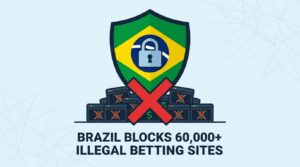
Brazil’s Ministry of Finance has shut down more than 60,000 unauthorised betting websites in what amounts to the country’s most aggressive crackdown on unlicensed online gambling operations to date. The enforcement push extends beyond simple domain blocking, targeting payment processors and advertising networks that sustain illegal operators. With the regulated sports betting market now live since January 2025, authorities are drawing a hard line between licensed platforms and the sprawling grey market that had flourished during years of regulatory ambiguity.
What Brazil’s Betting Crackdown Signals for Operators and Investors
The scale of this enforcement action reveals how deeply unlicensed gambling had penetrated the Brazilian market before regulation took effect. For licensed operators, payment providers, and international stakeholders watching Latin America’s largest economy, the implications cut several ways at once.
- Market consolidation is accelerating: With tens of thousands of domains removed, licensed operators stand to capture traffic and revenue that previously leaked to unauthorised sites.
- Payment infrastructure is now a regulatory target. The Ministry of Finance is not limiting enforcement to domains alone; financial intermediaries facilitating transactions with unlicensed platforms face scrutiny.
- Advertising networks that served illegal betting sites are under pressure to implement compliance filters or risk being swept into enforcement actions themselves.
- International operators without Brazilian licences face a narrowing window. The regulatory environment has shifted from permissive to punitive in under six months.
- Consumer protection arguments are gaining traction politically, giving the Finance Ministry cover to expand enforcement further
How the Enforcement Machinery Works
Brazil’s approach differs from the piecemeal blocking strategies seen in some European jurisdictions. Rather than targeting individual domains reactively, the Finance Ministry has coordinated with internet service providers, payment gateways, and Brazil’s national telecommunications agency (Anatel) to execute large-scale takedowns. That coordination is what makes the 60,000-plus figure possible (a distinction worth noting, since many countries struggle to block even a fraction of that number annually).
The legal foundation rests on Law 14.790, enacted in late 2023, which established the framework for regulated sports betting and iGaming in Brazil. Operators that failed to secure licences by the January 2025 deadline now operate in clear violation of federal law. And while some blocked domains will inevitably resurface under new URLs, the disruption to payment channels arguably inflicts more lasting damage on illegal operations than domain blocking alone.
Still, questions linger about enforcement capacity. Sixty thousand is a staggering number, but the internet’s architecture makes permanent suppression difficult. Whether Brazil can sustain this pace of action through 2025 and beyond will determine how much of the unlicensed market actually migrates to regulated channels.
The Regulated Market Takes Shape
Licensed operators now navigating Brazil’s Finance Ministry regulatory framework include both domestic companies and major international brands. The licensing regime requires operators to meet capitalisation thresholds, implement responsible gambling tools, and submit to ongoing compliance audits. Tax obligations include a gross gaming revenue levy that funds social programmes and sports development initiatives.
For the licensed players, the crackdown represents a competitive windfall. Unlicensed sites had been undercutting regulated operators on odds and bonuses precisely because they bore none of the compliance costs. Removing that asymmetry levels the playing field, at least on paper.
But not every licensed operator views the situation with optimism. Some have raised concerns that the regulatory burden itself is too heavy, particularly for smaller Brazilian companies competing against well-capitalised international groups. The licensing fees, technology requirements, and tax rates create barriers that favour scale.
Why Latin America’s Largest Betting Market Matters Globally
Brazil’s population of over 210 million people, combined with a deeply sports-oriented culture, makes it arguably the most significant regulated betting market to emerge in the last decade. Estimates from industry analysts have placed the potential annual gross gaming revenue in the range of $3 billion to $7 billion once the market matures, though wide variance in those projections reflects genuine uncertainty about how much activity will migrate from informal to formal channels.
International operators and investors have been positioning for this moment for years. The enforcement wave validates a thesis that Brazil intends to protect its licensed market aggressively, which in turn de-risks investment for companies that have committed capital to obtaining licences and building local operations.
Frequently Asked Questions
How many illegal betting sites has Brazil blocked?
More than 60,000 unauthorised betting domains have been taken down as part of the Finance Ministry’s enforcement campaign, making it one of the largest single-country crackdowns on illegal online gambling globally.
What law authorises Brazil’s betting enforcement?
Law 14.790, signed in late 2023, established the legal framework for regulated sports betting and online gambling. Operators without valid licences under this law are subject to domain blocking and financial sanctions.
Does blocking domains actually stop illegal gambling?
Domain blocking alone has limited long-term effectiveness, since operators can register new URLs. Brazil’s strategy of simultaneously targeting payment processors and advertising networks is designed to address that weakness, though the durability of these measures remains to be tested at scale.
Who benefits from the crackdown?
Licensed operators benefit most directly, as consumer traffic shifts toward regulated platforms. The Brazilian government also gains through increased tax revenue and greater oversight of gambling-related financial flows.
Reframing the Narrative: What Operators Should Internalise
Beyond the regulatory mechanics, there is a psychological dimension to this enforcement wave that deserves attention. Markets respond not just to rules but to perceived intent. When a government blocks 60,000 domains in a coordinated sweep, it sends a signal that transcends the specific action: this jurisdiction is serious, and the cost of non-compliance will escalate.
For operators weighing market entry, the framing matters. Brazil has moved from a jurisdiction where gambling regulation was theoretical to one where enforcement is tangible and measurable. That shift changes the internal calculus for compliance teams, legal departments, and boardrooms. The question is no longer whether regulation will be enforced but how aggressively and how consistently.
Licensed operators should also consider how they communicate this moment to their own customers. Trust is a currency in regulated markets, and the ability to say “we are licensed, verified, and operating within the law” carries more weight when the alternative has been visibly dismantled. Consumer confidence in regulated platforms tends to increase after high-profile enforcement actions, a pattern observed in markets from the United Kingdom to Colombia.
Yet the deeper strategic lesson may be about timing. Companies that secured licences early and invested in compliance infrastructure before the crackdown are now positioned to capture market share during a period of maximum disruption for their unlicensed competitors. Those that delayed face a more crowded licensed market and a regulatory environment with diminishing patience for late entrants.



