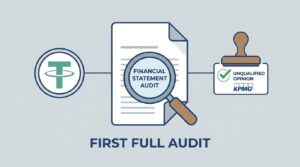
Tether, the issuer behind the world’s largest stablecoin by market capitalization, announced Thursday that KPMG U.S. has delivered an unqualified opinion on the financial statements of Tether International, S.A. de C.V. for the fiscal year ending December 31, 2025. The milestone marks the first full financial statement audit in the company’s history. An unqualified opinion represents the highest level of assurance an auditor can provide, signaling that the financial statements are materially accurate and conform to applicable accounting standards. For a company that has faced years of scrutiny over its reserves and transparency practices, the timing and substance of this development carry considerable weight.
Why a Clean Audit Opinion Matters for Tether’s Credibility
Before unpacking the strategic implications, it helps to understand what changed and why industry stakeholders should pay attention. Tether has long published periodic attestation reports, but those are narrower in scope than a full-year audit. The distinction is not trivial (a point critics have hammered for years). Attestations typically confirm a snapshot of reserves at a single point in time, while a comprehensive audit evaluates financial statements across an entire reporting period, including revenue recognition, liabilities, internal controls, and accounting policies.
That KPMG, one of the Big Four accounting firms, conducted this engagement adds a layer of institutional credibility that previous attestation providers could not match at the same scale. Still, whether this fully resolves the transparency debate around Tether remains an open question among market participants and regulators alike.
Strategic Signals From Tether’s KPMG Audit
The audit does not exist in a vacuum. Here is what matters most from a business and regulatory standpoint:
- First-ever full audit: Tether has operated since 2014 without submitting to a comprehensive financial statement audit. Completing one now, with an unqualified opinion, removes a longstanding criticism that competitors and regulators have leveraged against the company.
- Big Four involvement signals institutional readiness: Engaging KPMG U.S. rather than a smaller firm suggests Tether is positioning itself for deeper engagement with traditional financial institutions and potentially preparing for regulatory frameworks that may require audited financials.
- The unqualified opinion covers Tether International, S.A. de C.V. specifically, which raises questions about whether other Tether entities will undergo similar scrutiny.
- Competitive positioning: Circle, the issuer of USDC, has long pointed to its own audit and attestation practices as a differentiator. Tether’s move narrows that gap considerably.
- Arguably, the audit’s greatest value is not what it reveals but what it forecloses: the argument that Tether refuses independent verification.
The Regulatory Backdrop: Timing Is Everything
This audit arrives as stablecoin regulation gains momentum across multiple jurisdictions. In the United States, proposed legislation such as the GENIUS Act and the STABLE Act would impose reserve transparency and audit requirements on stablecoin issuers. The European Union’s Markets in Crypto-Assets (MiCA) regulation, which took full effect in late 2024, already mandates reserve disclosures and regulatory compliance for stablecoin operators serving EU markets.
By securing a clean audit opinion now, Tether’s stablecoin operations appear better positioned to meet incoming compliance thresholds, at least on paper. Whether the audit scope and methodology satisfy every regulator’s expectations is a different matter entirely.
And while Tether has historically operated from jurisdictions with lighter regulatory oversight, the company’s recent moves suggest a deliberate pivot toward legitimacy in the eyes of Western financial regulators. That pivot, if sustained, could reshape how institutional capital interacts with USDT.
How Does This Compare to Industry Standards?
A useful frame of reference:
| Issuer | Stablecoin | Audit Status | Auditor |
|---|---|---|---|
| Tether | USDT | First full audit completed (2025) | KPMG U.S. |
| Circle | USDC | Annual audits since 2022 | Deloitte |
| Paxos | PYUSD / BUSD | Monthly attestations; regulated entity | WithumSmith+Brown |
| First Digital | FDUSD | Attestation reports published | Varies by period |
Circle’s head start on audited financials has been a selling point in conversations with banks and asset managers. Tether closing that gap with a Big Four firm could shift the calculus for institutions that previously viewed USDT’s transparency record as a dealbreaker.
What the Market Should Watch Next
The audit itself answers one set of questions while opening others. Will Tether publish the full audited financial statements, or only reference the opinion? How will regulators in the U.S. and EU weigh this against their own emerging requirements? And perhaps most critically, will this become an annual commitment or a one-time exercise designed to quiet critics?
In practice, the stablecoin market has operated for years on varying degrees of trust and verification. Tether’s dominance, with USDT commanding roughly $140 billion in circulating supply as of mid-2025, means that any shift in its transparency posture ripples across the entire digital asset ecosystem. Exchanges, DeFi protocols, and institutional trading desks all carry USDT exposure, making the quality of Tether’s financial disclosures a systemic concern rather than a company-specific one.
Frequently Asked Questions
What is an unqualified audit opinion?
It means the auditor found the financial statements to be free of material misstatement and prepared in accordance with the relevant accounting framework. In plain terms, it is the best outcome a company can receive from an audit.
Why hadn’t Tether completed a full audit before?
Tether previously relied on attestation reports, which are narrower in scope. The company cited difficulties in finding a major audit firm willing to take on a crypto client, though critics viewed the absence of a full audit as a transparency red flag. That dynamic appears to have shifted.
Does this audit cover all of Tether’s entities?
No. The unqualified opinion applies to Tether International, S.A. de C.V. specifically. Whether additional Tether entities will undergo similar audits has not been confirmed.
How does this affect USDT holders?
Directly, it provides stronger independent verification that the entity’s financial statements are materially accurate. Indirectly, it may influence regulatory treatment of USDT and the willingness of traditional financial institutions to engage with the token.



